How Much Does It Cost to Replace an Air Conditioner? A 2026 Guide
Learn the true cost to replace an air conditioner in 2026, including central AC, ductless systems, labor, ductwork, and financing options. Practical, data-driven guidance to estimate, compare quotes, and plan for rebates.


Replacing a central air conditioner typically costs about $5,000 to $12,000 for the unit and installation, with price driven by efficiency, ductwork needs, and site complexity. Ductless mini-splits or heat pumps can run from $3,000 to $16,000, while window units remain a fraction of the cost. In 2026, regional labor rates and permits shape the final bill, so get multiple quotes and ask about rebates or financing.
Understanding the cost landscape for replacing an air conditioner
Replacing a central air conditioner is a major home investment, and costs vary widely by system, home size, and location. In 2026, typical total costs for a standard central AC replacement (unit plus installation) run roughly from $5,000 to $12,000, with higher-end, high-efficiency models often pushing toward the upper end of that range. Ductwork conditions, whether you need a full duct replacement, and any required electrical or permit work can add to the bill. For homes without existing ducts, a new trunk line or zone controls may add significant cost but can improve comfort and efficiency over the long term. According to Air Conditioner Service, regional labor rates and permit fees can swing final numbers by several thousand dollars. This block sets the stage for understanding the true cost, so you can compare apples to apples when you receive quotes from local contractors and avoid sticker shock. In the sections that follow, we break down costs by system type, highlight the main price drivers, and outline practical strategies to estimate and manage your project.
Cost ranges by system type
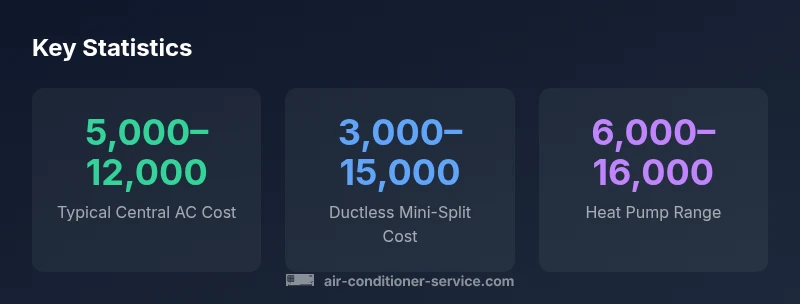
Prices vary a lot by the type of system you choose. Central air conditioning (a standard split system) remains the most common and typically falls in the $5,000–$12,000 range, including equipment and installation, assuming ductwork is in good condition and no major repairs are needed. If the home has extensive ductwork or older ducts that require replacement or sealing, you may see costs toward the higher end or beyond. Ductless mini-split systems offer flexible zoning and can be cheaper to install in older homes, often ranging from $3,000 to $15,000 depending on the number of zones and outdoor unit sizes. Heat pumps that provide both cooling and heating can run roughly $6,000–$16,000, with higher-efficiency models and more zones adding to the price. Window and portable units are far lower-cost options, typically under $3,000 for an upgrade or replacement in a single room, but they are not suitable for whole-home cooling. When evaluating bids, remember that the cheapest quote may exclude necessary components or proper ductwork, which can create long-term comfort or reliability issues. Air Conditioner Service notes that the best long-term value comes from a system sized correctly for your home and installed by a qualified contractor.
Key factors that influence price
Several factors drive the final price, and understanding them helps you compare bids fairly:
- System type and complexity: Central air with multiple zones costs more than a single-zone ductless setup.
- Efficiency and SEER rating: Higher efficiency models cost more upfront but save on energy bills over time.
- Ductwork condition and location: Damaged or leaky ducts require repairs, sealing, or replacement, increasing material and labor costs.
- Size of the home (load) and proper sizing: An oversized or undersized system can lead to inefficiency and higher rework costs.
- Labor region and contractor experience: Urban areas typically have higher hourly rates.
- Permits, disposal, and refrigerant handling: Some jurisdictions require permits; refrigerant recovery adds to labor and material costs.
- Additional components: Thermostats, zoning controls, air filtration upgrades, and warranty plans can affect total.
- Future-proofing and upgrades: Selecting smart thermostats, air purifiers, or zoning may raise initial costs but reduce ongoing energy use.
Understanding these drivers helps you compare apples-to-apples bids and plan for contingencies.
Replacement costs by system type
| System Type | Typical Replacement Cost (unit + install) | Notes |
|---|---|---|
| Central AC (split system) | $5,000–$12,000 | Ductwork in good condition; multi-zone options available |
| Ductless mini-split | $3,000–$15,000 | Zoning flexibility; more indoor units increase price |
| Heat pump with cooling | $6,000–$16,000 | Heats in winter; efficiency drives cost |
| Window/portable unit | $200–$3,000 | Low-cost, room-focused solution |
Common Questions
What factors influence the cost to replace an air conditioner?
Several factors influence the price, including system type, SEER rating, ductwork condition, home size, labor market, permits, and whether additional components like zone controls or smart thermostats are included.
It mainly comes down to the system, efficiency, and ductwork. Get multiple quotes to see how these elements affect your price.
Is it cheaper to repair an old system or replace it?
Repairing a failing component can be cheaper in the short term, but persistent issues, poor efficiency, and high repair bills often make replacement the better long-term choice. A professional load calculation can clarify the better option.
If repairs keep adding up, replacement may save money in energy use and reliability.
How long does installation typically take?
Most central AC installations take 1–2 days in typical homes, assuming access and ductwork are straightforward. Complex ductwork, permits, or the addition of zoning can extend this timeline.
Most installs finish within a couple of days, but some projects can stretch to a week.
Are rebates or financing options available for replacement?
Many utility programs, municipalities, and manufacturers offer rebates or financing for high-efficiency replacements. Check eligibility early and factor these into your payoff period.
Look for rebates and financing to lower your upfront cost.
Should my ductwork be replaced along with the outdoor unit?
If ducts are leaky, undersized, or in poor condition, you may need sealing or replacement. This can significantly affect both upfront costs and long-term efficiency.
Duct health matters—don’t overlook it when budgeting.
What should I ask when getting quotes?
Ask about equipment efficiency (SEER), warranty terms, what’s included in installation (duct work, disposal, permits), and any maintenance plans.
Compare bids by total cost and what’s included, not just the sticker price.
“Replacing an air conditioner is a major investment, but selecting the right system and installer can dramatically reduce operating costs over its lifetime.”
The Essentials
- Estimate overall costs using a system-type baseline and regional quotes
- Expect additional costs for ductwork, permits, and disposal
- Consider efficiency (SEER) and potential rebates to improve long-term value
- Get at least three written quotes and compare total cost of ownership