How Much Does It Cost to Run an Air Conditioner?
Discover how much it costs to run an air conditioner, what drives the bill, and practical tips to reduce energy use. Air Conditioner Service breaks down costs, calculations, and real-world ranges for different AC types.


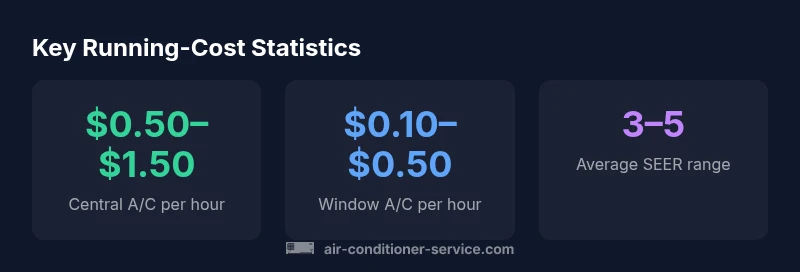
On average, the cost to run an air conditioner depends on its type, efficiency, and electricity rate. Using typical U.S. rates and common unit sizes, running a central AC costs roughly 0.50 to 1.50 per hour, while window units are often around 0.10 to 0.50 per hour. For monthly planning, expect wide variation by climate and use.
Understanding What Drives Running Costs
According to Air Conditioner Service, the price tag for cooling your home hinges on several interacting factors. The efficiency rating (SEER) of your system, the size of the unit, and how hard it must work to keep rooms comfortable are the primary drivers. Local electricity prices, the climate you live in, insulation quality, and even how you use the thermostat all affect the bottom line. In hot, humid regions, for example, the same central air system generally runs longer and consumes more energy than in milder climates. Building envelope, duct leakage, and indoor heat sources (kitchens, electronics, lighting) also add to the bill. When you ask, how much does it cost to run an air conditioner, you are really asking about a combination of equipment performance and daily habits. Understanding these dynamics helps homeowners choose efficient equipment, set realistic budgets, and identify practical savings opportunities.
How to Estimate Your Own Costs
Estimating running costs starts with two numbers: your unit’s electrical consumption and your local electricity rate. A basic formula is cost per hour = (power draw in kilowatts) × (hours of use) × (rate per kilowatt-hour). If you know your air conditioner’s label or manual, you can convert its capacity (in BTU or tons) to an approximate kW draw using standard conversion guidelines. For a typical central A/C, a mid-range system might use 2–3 kW when running. Window units are usually smaller, roughly 0.4–1.2 kW. After you estimate hourly cost, multiply by your daily usage hours to project daily and monthly bills. Keep in mind that real-world usage varies with outdoor temperature, occupancy, and the efficiency of your home's wiring and ductwork. The goal is to build a simple, repeatable method you can re-run as prices or usage change.
Comparing AC Types by Running Cost
Different cooling options deliver different running costs in practice. Central air conditioning, with a typical SEER range from mid-teens to low-20s, often carries higher upfront costs but lower running costs per hour than older, non-High-EER units. On a per-hour basis, you might see roughly 0.50–1.50 dollars for central systems, depending on SEER, climate, and how aggressively you set temperatures. Window units, by contrast, are generally cheaper to run per hour, commonly in the 0.10–0.50 dollar range, making them cost-effective for cooling a single room. Ductless mini-splits sit between these extremes and offer excellent zone control; their running costs per hour typically fall in the 0.25–0.90 dollar range. When deciding what to buy or replace, compare both the expected running costs and the upfront price, along with maintenance needs and the building’s insulation.
Practical Ways to Lower Running Costs
Smart choices today can reduce your operating bill without sacrificing comfort. Step 1: improve building envelope—seal leaks around doors, windows, and ducts to reduce the cooling load. Step 2: upgrade to a higher-efficiency model with a higher SEER rating, or ensure your current unit is running at peak efficiency with regular maintenance. Step 3: optimize thermostat settings: in summer, aim for 78°F (25–26°C) when home; raise temperatures when away. Step 4: use ceiling fans or portable fans to improve air distribution, which can allow you to raise the thermostat a degree or two. Step 5: replace dirty air filters and clean ducts where appropriate; clogged filters force the system to work harder. Step 6: consider zoning or a ductless system to avoid cooling unused spaces. Finally, schedule annual professional maintenance to catch refrigerant leaks, check refrigerant charge, and ensure duct sealing. These steps often yield noticeable savings over a heating season or cooling season.
What the Data Says (Air Conditioner Service Analysis, 2026)
Air Conditioner Service Analysis, 2026 shows that the actual running costs homeowners experience depend heavily on local electricity prices and climate. In hot southern regions with high humidity, average monthly costs for central air tend to be higher than in milder northern regions, even for similarly sized systems. The data also highlight wide variance within the same climate due to insulation, window treatments, and thermostat behavior. The analysis uses a range-based approach to reflect real-world conditions rather than a single number. It underscores the importance of energy-efficiency upgrades and proper system sizing in reducing long-run expenses. Remember that these figures are indicative ranges, not guarantees, and your numbers will be shaped by your unique home and habits.
When to Hire a Pro vs DIY Considerations
DIY maintenance like cleaning a filter is safe and straightforward, and can yield immediate benefits. However, more complex tasks—refrigerant handling, duct sealing, refrigerant charging, or compressor issues—should be performed by a licensed technician. Attempting risky repairs can be dangerous and lead to further efficiency losses or safety hazards, which offset any potential savings. If you notice a persistent decline in cooling performance, odd noises, ice buildup, or a frozen coil, schedule a professional inspection to diagnose leaks, refrigerant issues, or faulty electrical components. Regular maintenance visits can prevent minor problems from escalating into costly repairs and help ensure your system runs at its designed efficiency, which translates to lower running costs over time.
Running costs by AC type
| Model Type | Typical Running Cost per Hour | Typical Monthly Cost (30 days) | Notes |
|---|---|---|---|
| Central A/C | 0.50–1.50 | $360–$1,080 | SEER 14–22; climate affects costs |
| Window unit | 0.10–0.50 | $72–$360 | Good for single room |
| Ductless mini-split | 0.25–0.90 | $180–$540 | Zoned cooling efficiency varies |
Common Questions
What is the average cost to run central air conditioning in a month?
Costs vary with weather, insulation, and usage. On average, many homes see monthly electricity costs to run central A/C in the mid-range, but your local rate determines exact figures. Use a simple calculation to estimate your bill based on kWh usage.
Average costs vary with climate and home efficiency. Use your kWh rate to estimate monthly costs.
Does energy efficiency rating (SEER) affect running costs?
Yes. Higher SEER means more efficient operation, often lowering per-hour costs, especially in hot months. However, initial equipment price and local rates also influence total costs.
Higher SEER can reduce running costs, especially in hot weather.
How can I estimate my own AC running costs?
Start with your unit’s wattage or rated cooling capacity, multiply by hours used, and multiply by your electricity rate. Use a watt-meter or utility bill data for accuracy.
You can estimate by measuring usage and multiplying by your rate, or use a meter.
Do costs differ by climate?
Yes. hotter climates require longer run times, increasing costs. Humidity and insulation also affect how often the unit runs.
Climate affects run time and bills; hot days raise costs.
Are there times of day when it’s cheaper to run AC?
In some regions, time-of-use rates apply. Running during off-peak hours can be cheaper, depending on your utility plan.
Off-peak hours may be cheaper if you have TOU rates.
“"Energy efficiency isn’t a luxury; it’s a practical way to control running costs."”
The Essentials
- Compare running costs by AC type before buying.
- Use your local electricity rate to estimate monthly costs.
- Improve efficiency with proper maintenance and sizing.
- Consider climate when planning cooling budgets.
- Air Conditioner Service recommends energy-saving upgrades when suitable.