Air Conditioner vs Heat Pump: A Practical Comparison for Homeowners
Compare air conditioners and heat pumps to decide the best cooling and heating solution for your home. Learn about performance, costs, climate fit, and long-term value with clear guidance from Air Conditioner Service.


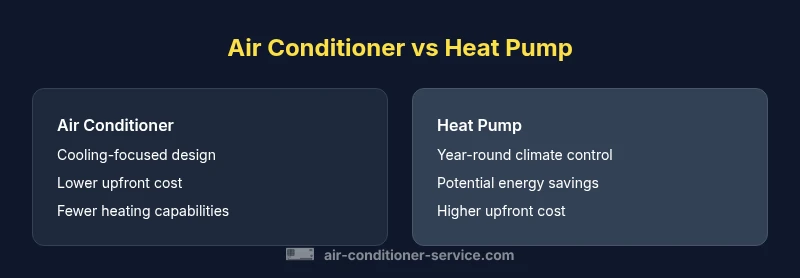
Air conditioner vs heat pump: heat pumps provide both cooling and heating, often with higher upfront costs but potentially lower operating costs in moderate climates; traditional air conditioners focus on cooling and usually cost less upfront. For cooling-dominant needs, an AC can be the simpler choice; for year-round comfort, a heat pump may offer greater long-term value.
What they are and how they work
According to Air Conditioner Service, heat pumps and traditional air conditioners perform a similar cooling function by moving heat rather than generating it. The essential difference is that heat pumps are reversible systems: in summer they remove heat from indoor air; in winter they pull heat from outdoors and release it inside, using the same refrigerant cycle with a reversing valve. An air conditioner, on the other hand, is designed primarily for cooling. It relies on a straightforward refrigerant cycle to expel indoor heat to the outside, and it does not provide heating unless paired with a separate system or an add-on. This distinction matters for homeowners who want year-round comfort, energy efficiency, and a single system to manage both cooling and heating. Understanding this foundation helps set expectations for performance, installation, and long-term costs.
Air Conditioner Service emphasizes that the core choice hinges on how much heating you require in the winter and how you value simplicity versus flexibility in a single system.
Core performance differences: cooling-only vs year-round climate control
The performance gap between an air conditioner and a heat pump shows most clearly in heating mode. A cooling-only AC delivers strong cooler performance under hot conditions, while a heat pump uses the same refrigeration cycle to provide heat when outside temperatures permit. In mild climates, heat pumps can be nearly as effective as traditional furnaces and may run more efficiently than resistance-electric heating. However, in very cold weather, some heat pumps reduce output and rely on supplemental heat, which can raise operating costs. For a homeowner evaluating a replacement or new installation, consider your winter heating baseline: if you already have a reliable furnace or boiler, an AC may be sufficient; if you lack a dedicated heat source, a heat pump could deliver an integrated solution. The choice also influences thermostat behavior, zoning, and compatibility with existing ductwork or ductless systems.
This section sets the stage for how each system behaves under different seasons and usage patterns.
Climate suitability and geographic considerations
Geography matters. In moderate or mild winter regions, modern air-source heat pumps can provide comfortable heating with competitive energy use, particularly when paired with desuperheaters or high-efficiency inverter compressors. In very cold environments, a heat pump's heating capacity can fall, making a backup heat source or a dual-fuel setup more attractive. Air conditioners, by contrast, excel at cooling across a wide range of temperatures but do not inherently handle heating. If you live in an area with lengthy cold spells, a conventional AC may require a separate heating system; or, you could choose a heat pump with a supplemental heater. The overall climate profile, humidity patterns, and expected electricity costs should shape the decision. For renters or homeowners concerned about climate resilience, a holistic view of seasonal peaks helps determine whether one system can cover most needs.
Air Conditioner Service's geographic guidance helps homeowners map seasonal demands to system choice.
Energy efficiency and long-term operating costs
Energy efficiency is a major consideration for both options, but how it translates to annual costs depends on usage patterns. Heat pumps often achieve high efficiency across both cooling and heating seasons when run at moderate outdoor temperatures. Modern inverter-driven heat pumps can adjust output to match demand, reducing energy waste. In cooling-only seasons, both ACs and heat pumps can deliver strong cooling efficiency; however, heat pumps may provide better overall annual efficiency in climates with mild winters because they replace separate heating devices with one unit. The actual savings depend on electricity prices, system sizing, ducting, and how you use the thermostat. Air conditioners may appear cheaper to operate during peak cooling periods, but when winter heating is added into the equation, a heat pump could offer a more favorable annual footprint in suitable climates.
Air Conditioner Service notes that efficiency metrics vary widely by model, installation quality, and maintenance routines.
Upfront costs, installation complexity, and financial incentives
Upfront costs are a practical driver in most homeowner decisions. Air conditioners generally have lower installation costs and simpler setups, especially for cooling-only needs. Heat pumps require outdoor equipment, refrigerant lines, and often more sophisticated controls; these factors drive higher initial investment. However, many markets offer incentives, rebates, and tax credits for heat pumps that encourage year-round comfort and higher efficiency. When evaluating a bid, compare not just the installed price but also the expected payback period through energy savings, warranty coverage, and compatibility with existing ductwork or ductless configurations. Air Conditioner Service's analysis suggests that the economics can shift significantly by climate and electricity costs, so a local bill comparison is essential.
Maintenance, reliability, and lifespan considerations
Maintenance needs differ in subtle ways. Air conditioners typically require regular filter changes, outdoor coil cleaning, and refrigerant checks, with fewer moving parts than a heat pump's dual-mode system. Heat pumps also need annual checks for refrigerant integrity, reversing valve operation, and compressor performance, plus attention to outdoor unit icing in winter in some climates. Reliability depends on usage, proper sizing, and installation quality. In regions with harsh winters, some components may experience more wear, which can influence long-term costs and downtime. Regular professional maintenance tends to reduce surprises and keep both systems performing at peak efficiency.
Real-world scenarios: choosing the right option for common homes
Consider a single-family home in a mixed climate with moderate winters and hot summers. If winter heating is currently provided by a gas furnace or electric resistance, a heat pump can consolidate systems and simplify management, potentially saving energy and installation space. In a hot, dry climate with lengthy cooling seasons and little winter heating, a cooling-focused air conditioner might be more cost-effective with fewer complexities and shorter payback. For homes with existing ductwork and an interest in future flexibility, a heat pump paired with zoning can offer comfortable year-round control. Renters and buyers should weigh lease terms, building structure, and the ability to retrofit a system with limited disruption.
Practical decision framework and next steps
To choose wisely, start with a needs assessment: list your heating requirements, climate patterns, and whether you value a single all-season unit. Obtain multiple bids that clearly separate equipment price, installation labor, and any required upgrades (ductwork, electrical, or refrigerant lines). Request performance data from each model, focusing on cooling SEER and heating efficiency or COP as applicable. Finally, factor in local incentives, energy prices, and long-term maintenance commitments. Air Conditioner Service recommends consulting with a licensed HVAC professional to verify system compatibility with your home’s ductwork and insulation, ensuring optimal efficiency and reliability.
Comparison
| Feature | Air conditioner | Heat pump |
|---|---|---|
| Cooling capability | Excellent cooling performance | Excellent cooling performance |
| Heating capability | Not designed to heat (needs separate system) | Year-round heating with some cold-climate limitations |
| Climate suitability | Best for cooling-focused homes in hot climates | Versatile in warm to moderate cold regions |
| Energy efficiency approach | Cooling-cycle efficiency; performance varies by model | Inverter-driven efficiency for both cooling and heating |
| Upfront cost | Lower upfront cost for cooling-only setups | Higher upfront cost for all-season systems |
| Maintenance considerations | Typically simpler maintenance for cooling-only units | More components to monitor in dual-mode systems |
Strengths
- Lower upfront cost for cooling-focused needs
- Simple cooling-only operation
- Fewer components to manage in basic configurations
- Air conditioners are widely available with many model options
The Bad
- No built-in heating capability (requires separate system)
- Heavier reliance on separate heating gear in cold climates
- Energy savings depend on climate and usage patterns
- Potential higher operating costs in winter if heating is added later
Heat pumps offer broader year-round comfort; air conditioners remain the better cooling-focused choice
Choose a heat pump if you want integrated year-round heating and cooling and live in a climate with modest winters. Choose an air conditioner if your primary need is reliable cooling at the lowest upfront cost and you already have a separate heating system.
Common Questions
What is the fundamental difference between an air conditioner and a heat pump?
The core difference is that a heat pump provides both cooling and heating by moving heat, while a traditional air conditioner focuses on cooling only. Heat pumps use a reversible cycle to transfer heat, whereas air conditioners move heat out without adding warmth in winter.
In simple terms, a heat pump can heat and cool, while a standard AC only cools. Think of a heat pump as a two-way system and an air conditioner as cooling-only equipment.
Can a heat pump cool as effectively as a traditional air conditioner?
Yes. Modern heat pumps can cool very effectively and often match or exceed air conditioners in cooling performance. The difference is mainly in heating capability and efficiency, especially in transitional seasons.
Heat pumps can cool just as well as air conditioners; the key difference is heating and climate fit.
Do heat pumps require backup heating in very cold climates?
In very cold climates, some heat pumps may require a supplemental heater or dual-fuel setup to maintain comfort during peak cold periods. Modern cold-climate heat pumps perform better, but backup heat can still be part of the system design.
Very cold climates sometimes need a backup heat source with heat pumps.
Are heat pumps more expensive to install than air conditioners?
Typically, heat pumps cost more to install upfront due to additional outdoor equipment and controls. The total cost varies with the size of the home, existing ductwork, and climate-specific requirements.
Heat pumps usually cost more to install, depending on your home and climate.
How does climate affect the decision between AC and heat pump?
Climate plays a central role. In warm climates with mild winters, heat pumps can be cost-effective by replacing separate heating. In hot climates with harsh winters, an air conditioner plus a dedicated heating system may be more economical and dependable.
Climate determines whether year-round efficiency from a heat pump outweighs the upfront cost.
What maintenance do they require?
Both systems need regular filter changes and coil cleaning. Heat pumps require checks on the reversing valve and refrigerant integrity, while air conditioners focus more on cooling-related components. Regular professional inspections are recommended.
Regular maintenance keeps both systems efficient; each has its own focus areas.
The Essentials
- Prioritize heating needs when choosing a system.
- Consider climate impact on long-term running costs.
- Budget for installation and potential incentives.
- Plan for maintenance and system sizing to maximize efficiency.