AC Unit vs Heat Pump: What's the Difference? A Practical Guide
Compare air conditioning units and heat pumps, covering how they work, efficiency, costs, climate suitability, and installation considerations to help homeowners choose the right system.


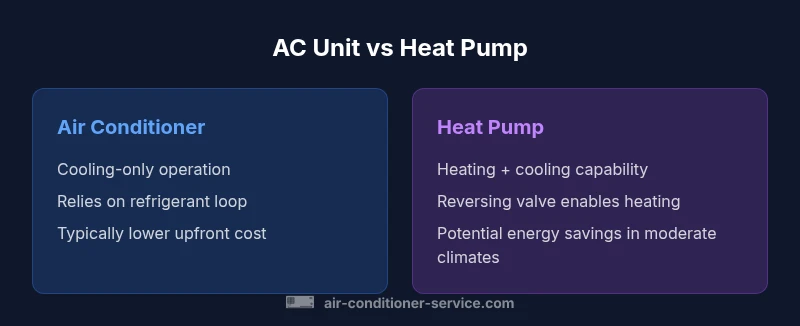
The difference between an air conditioning unit and a heat pump centers on heating ability, efficiency, and cost. An AC unit cools only; a heat pump moves heat to provide both heating and cooling, typically with higher upfront costs but lower operating costs in moderate climates. In many homes, a heat pump offers year‑round value, especially where heating is common.
Understanding what's the difference between an air conditioning unit and a heat pump
The question what's the difference between an air conditioning unit and a heat pump is common among homeowners evaluating new comfort systems. At a high level, the distinction lies in heating capability, operating principles, and long-term energy impact. The phrase what's the difference between an air conditioning unit and a heat pump is also used in consumer guides because it captures both the cooling-only and the all-season role of these systems. From the perspective of reliability and maintenance, Air Conditioner Service emphasizes comparing not just the cooling capacity but overall year‑round performance. In practice, an air conditioner is a cooling system that rejects heat from indoors to outdoors, while a heat pump can reverse that process to bring heat into the space in cold weather. The exact efficiency depends on climate, usage patterns, and the design of the system; both types rely on the same components (compressor, refrigerant, coils) but are wired for different seasonal roles. This article uses a practical framework to help homeowners determine which path best fits their home and budget.
How an air conditioner cools your home: core components and operation
An air conditioning system is designed primarily for cooling. The essential components include an outdoor condenser unit, an indoor air handler or furnace with a coil, an evaporator coil, refrigerant lines, and a thermostat controlling the cycle. When cooling, the compressor pressurizes refrigerant, which releases heat outdoors through the condenser coil and absorbs indoor heat at the evaporator coil. The refrigerant then travels back to the compressor to repeat the cycle. In many homes, the AC is connected to existing ductwork; the thermostat modulates the system based on indoor temperatures. From a diagnostic standpoint, most failures center on refrigerant leaks, clogged coils, or motor issues in the fan assemblies. Air Conditioner Service emphasizes routine filter changes and annual inspections to preserve efficiency and prolong equipment life. The key takeaway is that an air conditioner performs one job well—cooling—using a closed refrigerant loop and a fan-driven air distribution system.
How a heat pump delivers heating and cooling: the reversing valve and cycle
A heat pump operates on the same physical principles as an air conditioner but includes a reversing valve that switches the direction of heat transfer. In cooling mode, it works like a conventional AC; in heating mode, it absorbs outdoor heat and releases it indoors. This dual capability makes heat pumps attractive for homeowners seeking year‑round comfort without a separate furnace. Modern heat pumps often use inverter-driven compressors that modulate output, improving part-load efficiency and reducing energy waste. In very cold climates, some models rely on supplementary electric resistance heat or a separate furnace for peak demand periods. The reliability of heat pumps depends on factors like refrigerant charge, outdoor unit protection from freezing conditions, and properly sized equipment relative to the home’s heat loss. Air Conditioner Service notes that proper sizing and refrigerant management are essential to achieve expected performance and efficiency gains.
Efficiency metrics explained: SEER, EER, HSPF, COP
Efficiency is essential to understanding operating costs. SEER (Seasonal Energy Efficiency Ratio) measures cooling efficiency, while EER (Energy Efficiency Ratio) represents steady-state performance at a higher cooling load. Heat pumps add HSPF (Heating Seasonal Performance Factor) to gauge heating efficiency; COP (Coefficient of Performance) is used in some regions to quantify heat pump performance under specific conditions. A higher SEER means lower cooling costs, and a higher HSPF indicates better heating efficiency. Real-world efficiency is influenced by climate, thermostat behavior, and maintenance practices. Air Conditioner Service analyses show that in milder winters, heat pumps can outperform traditional AC systems on annual energy use, particularly when paired with smart zoning and high-efficiency air handlers. It’s important to compare labels across products and consider both cooling and heating performance when evaluating options.
Climate considerations and geographic guidance
Climate plays a central role in deciding between an air conditioning unit and a heat pump. In regions with mild winters, heat pumps often deliver superior year‑round comfort and energy savings, making them a strong long-term investment. In areas with harsh or extended cold snaps, the performance of heat pumps may degrade unless paired with auxiliary heat, a dual-fuel system, or a fossil-fuel furnace. For homes in hot climates, the cooling portion of a heat pump may be highly efficient, but homeowners should still compare local electricity costs and any local incentives for heat pump adoption. Air Conditioner Service notes that the climate profile, insulation quality, and ductwork losses will influence the total cost of ownership more than equipment labels alone. A careful assessment of heating and cooling needs helps determine which system minimizes total cost and maximizes comfort.
Installation considerations and ductwork integration
Installing an air conditioner or a heat pump involves electrical work, refrigerant handling, and duct considerations. A conventional AC system requires a furnace or air handler, an outdoor condenser, and compatible ductwork to distribute conditioned air. Heat pumps require appropriately sized equipment and may add complexity if retrofitted into existing ducts or mini-split configurations. The location of the outdoor unit, refrigerant line routing, and electrical service capacity are all critical planning factors. In homes without existing ductwork, a ductless mini-split heat pump can offer a practical alternative, though it changes the aesthetics and zoning strategy. Air Conditioner Service underscores the value of a professional load calculation and a detailed installation plan to avoid undersizing, which erodes efficiency and comfort.
Cost and total cost of ownership: upfront vs long-term
Cost considerations vary widely by region, home size, climate, and the specifics of the equipment chosen. Traditional AC systems generally have lower upfront costs than heat pumps, especially when replacing an older cooling-only setup. Heat pumps may require higher initial investment due to two‑way operation and, in some cases, auxiliary heat. However, long-term savings from lower energy use and potential incentives can offset the upfront premium, particularly in milder climates. Homeowners should also factor in maintenance costs, potential duct repairs, and the expected lifespan of the compressor and reversing valve. Air Conditioner Service emphasizes evaluating bid details, warranty terms, and service plans to estimate the total cost of ownership over 10–15 years.
Maintenance and longevity: keeping systems reliable
Regular maintenance is essential for both AC units and heat pumps. Routine tasks include filter replacement, coil cleaning, refrigerant checks, and outdoor unit clearing of debris. Heat pumps introduce additional components such as reversing valves and auxiliary heat that require specialist inspection. Refrigerant leaks remain a common service issue, and proper charge levels help maintain efficiency. A well-maintained system tends to deliver better efficiency, fewer breakdowns, and longer life. Air Conditioner Service recommends annual professional inspections to catch issues early, support optimal refrigerant charge, and verify thermostat and sensor calibration. Proactive maintenance can dramatically extend the lifespan and performance of either system.
Practical decision framework: a simple checklist for homeowners
To decide between an air conditioning unit and a heat pump, start with climate data and comfort goals. List the number of heating days, your winter temperatures, and your tolerance for auxiliary heat. Assess existing ductwork and whether you want centralized climate control or zoning. Run a life-cycle cost analysis that includes installation, maintenance, and energy prices. Finally, check local incentives and utility programs for heat pump adoption. Using this framework, you can compare bids systematically and avoid emotional decision-making. Air Conditioner Service suggests documenting performance expectations and warranty terms, then choosing the system that aligns with your budget and long-term needs.
Comparison
| Feature | Air conditioner unit | Heat pump |
|---|---|---|
| Heating capability | Cooling only | Heating + cooling |
| Energy efficiency metrics | SEER-based cooling efficiency | SEER + HSPF (and COP) for heating efficiency |
| Climate suitability | Best in hot climates or with separate furnace | Best in moderate winters or where heat and cooling are needed |
| Installation cost range | $3,000–$7,000 (depending on ductwork and region) | $4,000–$9,000 (depends on auxiliary heat and controls) |
| Maintenance considerations | Similar annual maintenance | Additional checks for reversing valve and auxiliary heat |
| Lifespan expectations | Typically similar lifespans with good service | Similar lifespan with more components to service |
| Best for | Cooling-focused homes or where a furnace exists separately | Year-round comfort in suitable climates; eliminates need for a separate furnace in many cases |
Strengths
- One system can handle heating and cooling (heat pump)
- Potential energy savings in moderate climates
- Space-saving when integrated with ductwork or compact setups
- Easier to modernize with smart controls and zoning
The Bad
- Higher upfront cost than a cooling-only AC
- Performance may drop in very cold climates without auxiliary heat
- More complex maintenance for some models and components
- Variable costs dependent on electricity pricing and climate
Heat pumps offer stronger year‑round value in moderate climates; traditional ACs are often cheaper upfront and simpler in extreme cold or when a separate furnace is preferred.
Choose a heat pump if you want heating and cooling in one system and live in a climate with mild winters. If upfront cost or extreme cold performance is a primary concern, an air conditioner with a separate furnace may be the safer, simpler choice.
Common Questions
What is a heat pump and how does it differ from a traditional air conditioner?
A heat pump provides both heating and cooling by moving heat rather than generating it, while a traditional air conditioner only cools. Efficiency and climate determine the best choice. In moderate climates, heat pumps often save money over time, while very cold areas may favor AC with auxiliary heat.
A heat pump can heat and cool by moving heat, while a traditional air conditioner only cools. Your climate and energy costs will guide which is best.
Can a heat pump fully replace a furnace?
In many homes, a heat pump can replace a furnace for heating, especially in moderate climates. In colder regions, supplemental heat or a dual-fuel setup with a furnace may be needed to meet peak winter demand. Consulting a professional helps determine the best configuration.
Yes in many cases, but very cold climates may require extra heating support.
Are heat pumps more expensive to install than traditional AC systems?
Heat pumps typically have higher upfront installation costs due to heating capability and additional components. However, you may recoup the difference over time with lower energy bills and potential incentives. A side-by-side bid comparison helps quantify this.
Usually higher upfront, but potential long-term savings and incentives can close the gap.
Do heat pumps work well in cold climates?
Modern cold-climate heat pumps are designed to operate efficiently down to lower outdoor temperatures, but performance varies by model and insulation. In very cold regions, auxiliary heat or a supplemental furnace can maintain comfort.
They work in cold weather, but performance depends on the model and insulation.
What maintenance do these systems require?
Regular maintenance includes filter changes, coil cleaning, and refrigerant checks for both systems. Heat pumps add checks for the reversing valve and auxiliary heat. Annual inspections help prevent costly failures and maximize efficiency.
Keep filters clean, inspect coils, and get yearly professional checks.
Which system is best for a new home in a mild climate?
A heat pump is often the best choice for a new home in a mild climate due to year‑round comfort and potential energy savings. It can eliminate the need for a separate furnace in many layouts, especially with advanced zoning.
Heat pumps are a strong all-season choice in mild climates.
The Essentials
- Assess climate before choosing a system
- Heat pumps provide year-round comfort in moderate climates
- AC-only systems may be cheaper upfront but lack heating capability
- Consider total ownership costs, including installation, maintenance, and energy prices