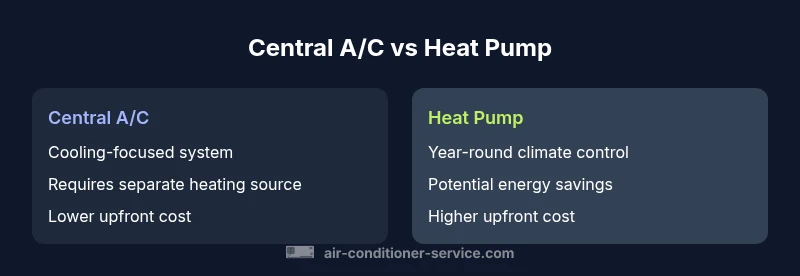
Central A/C vs Heat Pump: A Practical Guide for Homeowners
This guide compares central air conditioners and heat pumps, highlighting efficiency, climate suitability, upfront and long-term costs, and maintenance to help homeowners decide.


When weighing central air conditioner vs heat pump, consider climate, electricity costs, and how you use heating and cooling. Both can deliver reliable comfort, but their strengths vary by season and home design. This quick comparison will help you estimate relative upfront costs, long-term savings, and installation considerations so you can choose the best fit for your home.
What the central air conditioner vs heat pump conversation really means
For many homeowners, the choice between a central air conditioner and a heat pump is not just about cooling. It’s about year-round comfort, total energy costs, and how the system integrates with your insulation, ductwork, and heating equipment. The central air conditioner vs heat pump decision hinges on climate, desired comfort, and long-term budget. According to Air Conditioner Service, the most reliable path starts with a home assessment that measures insulation levels, air leakage, and existing duct efficiency. From there, you can translate that assessment into practical options for cooling performance, heater compatibility, and potential rebates. Understanding the core difference—cooling-only versus year-round climate control—sets the stage for deeper evaluation in the sections that follow.
How each system works: core components and cycles
Both options rely on a compressor, evaporator coil, condenser coil, and refrigerant to move heat. A central air conditioner circulates refrigerant to absorb heat from inside the home and release it outdoors, delivering cooling with no built-in heating function. A heat pump performs the same cooling cycle but reverses the refrigerant flow to extract heat from outdoor air and move it indoors for heating. This bidirectional capability means a heat pump can function as a full year-round climate control system in many homes, especially when paired with a suitable auxiliary heat source for very cold days. Understanding reversing valves, defrost cycles, and outdoor unit performance helps homeowners anticipate seasonal behavior and maintenance needs.
Climate and usage patterns: where each shines
Climate strongly influences the central air conditioner vs heat pump decision. In milder winters, a heat pump often provides comfortable heating at a lower operating cost due to its efficiency in moving heat rather than generating it. In very cold climates, heat pumps may require supplemental or backup heating to maintain warmth during peak demand. A central air conditioner paired with a traditional furnace or boiler remains robust in extreme winter conditions, delivering reliable heat when outdoor temperatures plunge. For homes with high cooling needs in hot seasons, both systems can deliver strong performance; the presence of smart thermostats and zoning can optimize comfort and reduce energy use in either setup.
Efficiency and operating costs: a pragmatic view
Efficiency is central in the central air conditioner vs heat pump debate, but it’s not a single-number story. Heat pumps tend to deliver greater energy efficiency overall because they transfer heat rather than generate it, which can translate to lower energy bills in moderate climates. A cooling-only central air conditioner is typically very efficient for cooling seasons, especially when paired with a modern furnace or heat source for heating. Air Conditioner Service analysis shows that homeowners in temperate regions often see meaningful savings with a heat pump, while regions with cold winters may experience higher operating costs during winter if auxiliary heat is heavily used. In both cases, proper insulation, air sealing, and a correctly sized unit are essential to achieving expected efficiency gains.
Installation considerations: ductwork, compatibility, and space
Choosing between central air conditioner vs heat pump also means evaluating existing infrastructure. If you already have ductwork designed for central cooling, a heat pump can often be installed with minimal changes, especially if it’s a heat pump model designed for ducted homes. Conversely, a cooling-only system may require upgrading or replacing your furnace to provide heating. Some homes benefit most from a dual-fuel arrangement, where a heat pump handles most of the year’s heating and cooling and a furnace provides backup heat. The cost, space requirements, and outdoor unit placement will influence installation timelines and permits, so a professional assessment is essential before committing.
Heating capabilities and winter performance: a closer look
Heat pumps provide space heating through refrigerant compression, which can be highly effective in moderate cold and well-insulated homes. In extreme cold, performance can drop, and backup heat may be necessary. A central air conditioner relies on a separate heating system (furnace or boiler) to achieve warmth, which means the homeowner experiences a split in equipment responsibility. For households seeking seamless climate control with a single system, heat pumps offer a compelling option, especially in milder climates where supplemental heat is rarely needed. If you live in a region with harsh winters, evaluate the total heating strategy, including insulation, air sealing, and the efficiency of any backup heat source.
Controls, zoning, and smart technology: optimizing comfort
Both systems benefit from advanced controls, including programmable thermostats and smart sensors. Zoning can dramatically improve comfort and energy efficiency by directing cooling and heating to occupied rooms. A heat pump with smart zoning can deliver efficient year-round comfort when paired with a compatible air handler or integrated duct system. For cooling-only setups, integrating smart thermostats can still yield considerable energy savings by reducing temperature swings and adjusting settings based on occupancy. Maintenance plans for smart systems should account for software updates and sensor calibration as part of regular service.
Maintenance, reliability, and longevity considerations
Regular maintenance matters for both options. Routine inspections, coil cleanings, refrigerant checks, and fan maintenance keep efficiency high and prevent unexpected breakdowns. Heat pumps, with more components in the refrigeration loop (including reversing valves and defrost controls), may require slightly more ongoing checks. Both systems depend on proper refrigerant charge and duct integrity to perform optimally. A well-maintained system in a well-sealed home tends to deliver better reliability and longer service life, translating to lower lifetime costs and fewer unexpected repairs. Air Conditioner Service recommends annual professional tune-ups to maximize efficiency and prevent seasonal failures.
Decision framework: a practical plan to choose between central A/C and heat pump
Start with climate, insulation, and existing heating equipment. If you live in a region with mild winters and want a single-system solution, a heat pump is often a strong fit. If you experience very cold winters or already have a reliable furnace, a central air conditioner paired with that furnace remains a solid, predictable choice. Budget also matters; heat pumps tend to have higher upfront costs but can offer meaningful savings over time in the right climate. Consider incentives, energy rebates, and long-term maintenance costs as part of the total cost of ownership. Finally, consult a qualified HVAC professional to assess ductwork, refrigerant lines, and installation feasibility for your home.
Comparison
| Feature | central air conditioner | heat pump |
|---|---|---|
| Heating capability | Primarily cooling; heating requires a separate furnace/boiler | Heats and cools using refrigerant cycles; may use backup heat in very cold weather |
| Cooling capability | Cooling-focused; provides reliable cooling | Cooling-capable with year-round climate control |
| Energy efficiency profile | Efficient for cooling; heating efficiency depends on separate system | Typically highly efficient overall; strong performance in moderate climates |
| Upfront cost | Lower upfront cost (cooling-focused) | Higher upfront cost (full year-round system) |
| Maintenance complexity | Similar maintenance; heating handled by separate system | Slightly more components to service (reversing valve, defrost) |
| Climate suitability | Best in climates with reliable heating via separate system | Best in moderate climates; check winter backup needs in cold regions |
| Rebates/incentives | Often eligible for cooling-focused incentives | Often eligible for energy-efficiency incentives for heat pumps |
Strengths
- Year-round comfort with one system in many homes
- Potential long-term energy savings in moderate climates
- Quieter outdoor units with modern designs
- Space-saving option when replacing an aging system
- Eligibility for energy-efficiency rebates and incentives
The Bad
- Higher upfront cost for heat pumps and auxiliary heat in extreme cold
- Heating reliability can depend on backup heat in very cold climates
- Central AC requires a separate heating system if not already installed
- Potentially higher maintenance complexity for heat pump components
- Performance depends on climate and home insulation quality
In most temperate climates, a high-quality heat pump offers the best balance of comfort and energy savings; in very cold regions, central air with a dedicated furnace remains reliable.
Choose a heat pump when you want year-round comfort and potential energy savings in moderate climates. If winters are extreme or you already have a robust furnace, sticking with a central air conditioner paired with that system can be more dependable. A professional assessment will confirm the best fit for your home and budget.
Common Questions
What is the main difference between a central air conditioner and a heat pump?
The central air conditioner cools your home and relies on a separate heating system, while a heat pump provides both heating and cooling using the same refrigerant loop. The choice depends on climate, energy costs, and how you use your home’s space.
The main difference is heating. A heat pump handles both heating and cooling with one system, while a central A/C cools and needs a separate heater.
Can a heat pump replace my furnace or boiler?
Yes, in many homes a heat pump can replace a separate heating system, especially if paired with a compatible backup heat source for very cold days. A professional assessment confirms if your ductwork and electrical supply meet the requirements.
A heat pump can often replace your heater, but check for backup heat needs in extreme cold.
Is a heat pump suitable for very cold climates?
Heat pumps work well in many winters, but severe cold can reduce efficiency. In such climates, homeowners often add a supplemental heat source or rely on an existing furnace for peak winter conditions.
They work for cold climates with backup heat; extreme cold may require supplemental heating.
What maintenance differences should I expect?
Both systems benefit from annual professional tune-ups, coil cleaning, and refrigerant checks. Heat pumps may require additional checks for the reversing valve and defrost cycle, while central A/C systems rely on the conditioning of your heating equipment.
Regular professional check-ups keep either system running well.
Which is cheaper to install, central air conditioning or a heat pump?
Upfront costs vary by system and climate. Heat pumps generally cost more to install, but incentives and long-term energy savings can balance the total cost over time.
Heat pumps usually cost more upfront but can save more over time with energy efficiency.
Do rebates differ for central AC vs heat pumps?
Both can be eligible for rebates or incentives, depending on local programs and energy-efficiency standards. Heat pumps often feature prominently in newer incentive schemes for low-carbon heating.
Check local programs—heat pumps often have good incentives for energy efficiency.
The Essentials
- Assess climate and insulation first
- Heat pumps shine in moderate climates for year-round comfort
- Central A/C plus furnace works well in very cold regions
- Consider upfront cost vs long-term savings and rebates
- Smart controls and zoning maximize either option