Air conditioner or evaporative cooler: A practical comparison for homeowners
Compare air conditioners and evaporative coolers across climate suitability, energy use, maintenance, and costs to decide which cooling solution fits your home and budget.


When choosing between an air conditioner or evaporative cooler, the quick answer is: air conditioners provide reliable, consistent cooling in a wide range of climates, while evaporative coolers are cheaper to buy and run in dry, hot areas. Your decision should hinge on climate, humidity, energy costs, and maintenance tolerance. For humid regions, an air conditioner is usually the safer bet.
Climate Fit: Where each system excels and where it struggles
The decision between an air conditioner or evaporative cooler begins with climate. Air conditioners excel in a broad range of weather conditions, including high humidity, because they remove heat and moisture from indoor air with a closed refrigerant cycle. Evaporative coolers, by contrast, rely on the natural evaporation of water to drop air temperature, which works best in hot, dry environments with low humidity and good air movement. If your home sits in a dry desert area or a region with long, hot summers and low humidity, evaporative cooling can be a very cost-effective option. In humid coastal or humid inland climates, evaporative coolers struggle to achieve comfortable levels of cooling because the added humidity can make spaces feel muggy. According to Air Conditioner Service, the best rule of thumb is to assess humidity levels over a typical cooling season and compare them against your comfort thresholds. This helps you avoid overspending on a solution that won’t perform well in your climate.
The climate fit also depends on home orientation, insulation, and whether you want whole-home cooling or zone-specific control. If you’re seeking consistent temperatures in multiple rooms, a central air conditioning system typically offers more precise zoning than most evaporative cooler configurations. If your goal is to cool a single living area or a garage in a dry region, a portable evaporative cooler or a window-mounted unit might be sufficient and more cost-effective. Air Conditioner Service emphasizes that climate-informed choices are the cornerstone of long-term satisfaction, not just initial cost.
Cooling Mechanisms Explained
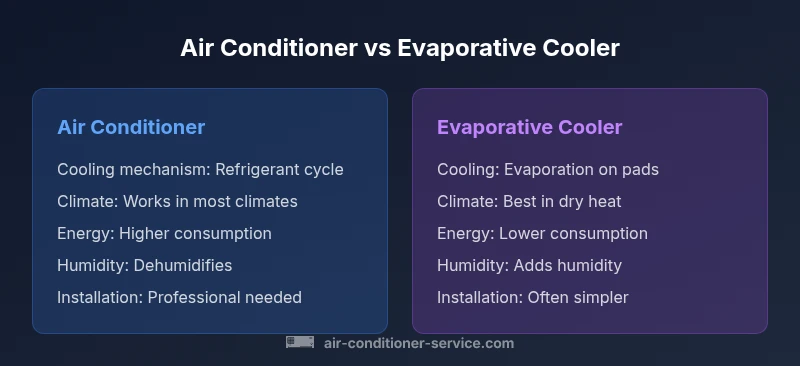
Air conditioners use a closed refrigerant cycle with a compressor, condenser, evaporator coil, and a fan to move cooled air through the ductwork. The refrigerant absorbs heat from indoor air and releases it outside, producing a reliable, dehumidified cooling effect. Evaporative coolers (also known as swamp coolers) rely on the evaporation of water on cooling pads to lower air temperature; they introduce more humidity into the space rather than removing moisture. This fundamental difference leads to higher effectiveness in arid environments and reduced electricity usage, but with limitations in humid climates where added moisture can feel uncomfortable. The key takeaway is that ACs deliver precise temperature and humidity control, while evaporative units primarily lower air temperature with a humidity trade-off. Air Conditioner Service notes that understanding these mechanisms helps homeowners set realistic expectations for comfort and energy use.
Humidity and Comfort Dynamics
Humidity levels strongly influence perceived comfort. An air conditioner can maintain a steady indoor humidity close to optimum comfort ranges by removing moisture alongside heat, which is particularly beneficial in homes with damp basements or high external humidity. Evaporative coolers, by design, add moisture to the air as they cool, which can be pleasant in bone-dry climates but uncomfortable in humid regions or for occupants sensitive to humidity. This humidity difference also affects furniture, electronics, and mold risk. In the short term, evaporative coolers may feel more refreshing during a dry heat wave, but prolonged use in higher humidity can lead to damp walls, window condensation, and a less comfortable living environment. The Air Conditioner Service team highlights that humidity management is a primary reason many households prefer air conditioning in mixed or humid climates.
Energy Use and Operating Costs
Operating costs for cooling depend on climate, equipment efficiency, and usage patterns. Air conditioners typically draw more electricity than evaporative coolers, especially when cooling entire homes in humid environments. However, modern high-efficiency AC systems with SEER ratings can offset some consumption through smarter controls and zoning. Evaporative coolers consume less energy in dry climates because their cooling method is simpler and relies less on compressors. Yet running a pad-based cooler in a dry season requires water, and pump and pad maintenance can add to ongoing costs. Air Conditioner Service analysis shows that the energy advantage of evaporative cooling is strongest when outdoor humidity remains low and air exchange rates are high. In humid climates, the energy savings are often outweighed by the reduced cooling effectiveness, making a traditional air conditioner a more economical choice over the long term.
Installation and Space Considerations
Installation needs differ substantially. Central air conditioners demand proper ductwork, outdoor condenser units, and professional sizing, which can elevate upfront costs but deliver whole-home comfort and quiet operation. Ductless mini-splits provide flexibility with reduced ductwork and targeted cooling but still require professional installation. Evaporative coolers are generally simpler to install, especially portable or window models, and they require less electrical infrastructure. Some evaporative systems can be added to existing homes with minimal modifications, but whole-home evaporative cooling is less common in regions with higher humidity. Air Conditioner Service notes that many homeowners underestimate the space and ventilation needs for evaporative systems, especially in rooms with poor airflow or where outdoor intake is restricted.
Maintenance and Longevity
Maintaining an air conditioner involves regular filter changes, refrigerant checks, and periodic professional service to ensure efficiency and longevity. A well-maintained AC can last 12-15 years or longer with routine care, though costs may rise with age as components wear. Evaporative coolers require more routine maintenance related to water systems, pads, and fans. Pads degrade and require replacement, pumps may fail, and fans can accumulate mineral buildup in hard water areas. While evaporative coolers have lower upfront maintenance costs, neglect can severely reduce their effectiveness and lifespan. Air Conditioner Service emphasizes scheduling seasonal maintenance to prevent efficiency losses and to catch leaks, pad wear, or motor wear early.
Noise, Comfort, and Indoor Air Quality
Noise levels vary by unit and installation type. Central AC can be quieter in operation due to insulated ductwork and a distant outdoor condenser, though indoor air handlers may add some sound. Evaporative coolers tend to be noisier because of fans, pumps, and water movement, especially in older models with outdoor pads. Regarding indoor air quality, AC systems with well-maintained filters can reduce dust and allergens, contributing to a cleaner environment. Evaporative coolers do not filter air as effectively unless equipped with dedicated filters, and humidity adds potential for mold if ventilation is inadequate. A balanced approach—choosing the right unit and ensuring proper air exchange—helps maintain comfort and health.
Environmental Impact and Water Use
Environmental considerations include energy consumption, refrigerant leakage risk, and water use. Air conditioners rely on refrigerants, some with higher global warming potential if leaks occur, though modern units use more eco-friendly refrigerants. Evaporative coolers use substantially less electricity but require a continuous water supply, which can raise water usage in drought-prone areas. If water resources are a concern, this trade-off should be considered carefully. Air Conditioner Service notes that homeowners should weigh local water availability, electricity costs, and refrigerant management when evaluating the environmental footprint of each option. In many cases, selecting a high-efficiency AC system with a smart thermostat can reduce overall environmental impact while maintaining comfort.
Climate-specific Scenarios: Case Profiles
Consider three representative homes to illustrate real-world decisions. Home A sits in a dry desert climate with hot days and low humidity; evaporative cooling can deliver substantial cost savings if humidity remains low and airflow is adequate. Home B experiences humid summers with frequent dew and rain; an air conditioner or a heat pump configuration will deliver reliable comfort with humidity control. Home C is a mixed climate with moderate humidity and variable temperatures; a hybrid approach—seasonally switching between evaporative styles for summer and AC in shoulder months—can optimize comfort and cost. These scenarios show that the best choice is not universal; it depends on climate patterns, occupancy, and energy prices. Air Conditioner Service emphasizes testing the actual cooling needs of your home before committing to a single solution.
Choosing by Room or Whole-Home Approach
For smaller spaces like a single bedroom or a workshop, evaporative coolers or window AC units provide a cost-effective and flexible solution with minimal installation. For full-home cooling, central air conditioning paired with smart zoning presents the most predictable comfort level and energy management. If you expect to expand or modify your home, an air conditioner-based approach is often more scalable and provides better resale value. The decision should also consider energy rebates, maintenance responsibilities, and compatibility with existing home systems. A practical way to decide is to map rooms by cooling needs and energy profiles, then align equipment selection with those profiles, ensuring you can achieve the same or better comfort with the chosen system.
Practical Decision Framework: Quick Checklist
- Assess humidity: is the climate predominantly dry or humid?
- Estimate seasonal comfort: do you prioritize stable humidity control or humidity-friendly cooling?
- Compare upfront costs vs long-term energy use: which aligns with your budget and plans?
- Check home structure: are there ductwork or window mounting constraints?
- Plan maintenance: can you commit to pad maintenance and water management, or is regular professional service preferred?
- Review local incentives: are there rebates for high-efficiency AC or water-conserving evaporative systems?
Using this framework helps homeowners avoid overpaying for features they don’t need and ensures sustained comfort across seasons. Air Conditioner Service suggests documenting climate data and energy bills to quantify the potential savings of each option.
Authoritative Sources and Further Reading
For deeper, sourced guidance on cooling options, consult reputable sources that cover climate considerations, energy efficiency, and home cooling strategies:
- U.S. Department of Energy (DOE) – Energy Saver: Room air conditioners and central air conditioning systems guidelines. https://www.energy.gov/energysaver
- Environmental Protection Agency (EPA) – Climate and comfort considerations for home cooling. https://www.epa.gov
- University extension programs on heat management and evaporative cooling principles. https://extension.university.edu
These sources offer objective information to help homeowners make informed decisions tailored to their climate and home characteristics.
In Summary: A Balanced View
Choosing between an air conditioner or evaporative cooler is not a one-size-fits-all decision. It hinges on climate, humidity, water availability, energy costs, and willingness to perform maintenance. An air conditioner delivers reliable, humidity-controlled cooling in most climates and supports advanced features like smart thermostats and zoning. Evaporative coolers offer an economical, low-tech alternative for dry environments, with the added benefit of reduced electricity usage and simpler installation. The right choice often combines climate data, a realistic maintenance plan, and a clear view of long-term costs. Air Conditioner Service advocates a climate-centered approach, backed by analysis and practical experience, to help homeowners select the most sensible option for their household.
Data-backed Guidance and Next Steps
- Gather regional humidity and temperature data for typical summers.
- Compare the installed cost of a modern, energy-efficient AC system with evaporative cooling options for your climate.
- Estimate annual operating costs using local electricity rates and water costs where applicable.
- Consider a pilot test: run a single window AC or evaporative unit for a season and track comfort and bills.
- Consult a licensed HVAC professional to obtain a reliable load calculation and a maintenance plan tailored to your home.
Final Notes: Roadmap to a Comfort-Centric Choice
A well-informed decision balances climate suitability, energy efficiency, and maintenance tolerance. The evaporative cooler has a place in specific dry climates and budget-conscious scenarios, while the air conditioner offers broader applicability and stronger humidity control. Use the comparison here as a framework to tailor a solution that matches your home, budget, and lifestyle. The Air Conditioner Service team recommends documenting your climate profile and performing a side-by-side feature review before committing to a purchase.
Data snapshot and key takeaways
- Climate defines value: evaporative cooling shines in dry heat; AC dominates in humidity and mixed climates.
- Energy use is climate-driven: evaporative coolers are cheaper to run in arid zones; ACs are more flexible but energy-intensive.
- Maintenance impacts performance: simpler pad maintenance for evaporatives vs refrigerant and filter maintenance for ACs.
- Installation varies in complexity and scale: window/portable models for evaporatives; ducted or mini-split for ACs.
- Long-term costs depend on usage: upfront cost vs. operating expenses determine overall value. Air Conditioner Service underscores the need for a climate-aware plan to maximize comfort and minimize expense.
Comparison
| Feature | Air Conditioner | Evaporative Cooler |
|---|---|---|
| Cooling mechanism | Refrigerant-based cycle with compressor and evaporator | Water evaporation through cooling pads |
| Climate suitability | Versatile in humid and dry climates | Best in hot, dry climates |
| Energy usage | Typically higher energy consumption | Lower energy consumption in dry climates |
| Humidity impact | Dehumidifies indoor air | Adds humidity to indoors |
| Upfront cost | Higher upfront cost (central or multi-zone systems) | Lower upfront cost (window/portable options) |
| Maintenance | Filter changes, refrigerant checks, professional service | Pad replacement, water system upkeep, pump maintenance |
| Space and installation | Core system with ducts or split components | Window/portable units with minimal installation |
| Lifespan and reliability | Longer lifespan with proper service | Lifespan tied to pad/pump wear and maintenance |
Strengths
- Lower upfront cost for evaporative coolers in dry climates
- Lower operating costs when humidity is low
- Air conditioners provide precise humidity control and reliable cooling across climates
- Air conditioners offer better indoor air filtration with filters
The Bad
- Evaporative coolers require dry climates and can underperform in humidity
- Evaporative coolers add humidity to indoor air
- Pads and water systems require regular maintenance
- Central AC has higher upfront cost and installation complexity in some homes
Air conditioning generally offers more versatile, predictable cooling; evaporative cooling excels in dry climates with lower upfront and operating costs.
In humid regions, an AC system is typically the safer long-term choice. In dry climates, evaporative coolers can deliver substantial savings with acceptable comfort when properly maintained. Air Conditioner Service's recommendation is to tailor the solution to climate, usage, and budget, leveraging the detailed comparison above.
Common Questions
Which system cools better in humid climates?
In humid climates, air conditioners generally provide more reliable and comfortable cooling because they dehumidify air while cooling. Evaporative coolers may feel sticky or damp, which can reduce comfort and perceived effectiveness. If humidity regularly exceeds comfortable levels, an AC or heat pump is the preferred choice.
In humid climates, go with an air conditioner for reliable cooling and humidity control. Evaporative coolers tend to add moisture and can feel uncomfortable when the air is already humid.
Is evaporative cooling suitable for humid climates?
Evaporative cooling is not ideal in humid climates because it adds moisture to the air and relies on dry air to achieve cooling. If your home already has high humidity, an evaporative cooler will likely feel less effective and may require dehumidification strategies alongside cooling.
Evaporative cooling is usually not the best choice in humid climates due to added humidity and reduced cooling efficiency.
Is professional installation required for central AC or evaporative systems?
Central air conditioning and many split systems typically require professional installation with proper load calculations and ductwork. Evaporative coolers, especially window or portable models, often demand less invasive installation but may still benefit from professional setup for optimal airflow.
Professional installation is often recommended for central AC, while evaporative coolers can be simpler to install, depending on the model.
What maintenance is needed for air conditioners and evaporative coolers?
Air conditioners require regular filter changes, coil cleaning, and periodic refrigerant checks along with professional service. Evaporative coolers need pad replacement, water system maintenance, and pump checks. Regular maintenance helps sustain efficiency and prolongs system life for both.
ACs need filters and coils maintained; evaporative coolers require pad and pump upkeep.
Can I switch from an evaporative cooler to an air conditioner later?
Yes, you can switch later, but it often involves replacing or modifying the existing installation, especially if ductwork or electrical circuits are involved. A staged approach—starting with a portable unit or window AC and planning a full system later—can spread costs and simplify decision-making.
You can switch later, but plan for potential installation changes and costs.
The Essentials
- Assess local humidity before choosing cooling technology
- Weigh upfront costs against operating costs in your climate
- Prioritize humidity control and filtration for indoor air quality
- Consider installation feasibility and future scalability
- Use a climate-informed decision framework to guide installation