Air Conditioner or Dehumidifier: A Practical Comparison for Home Comfort
An analytical comparison of air conditioners and dehumidifiers to help homeowners decide which device best supports cooling, humidity control, and energy efficiency.


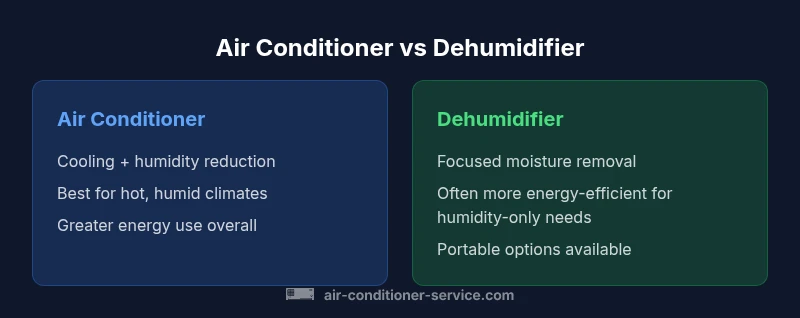
An air conditioner cools the air and reduces humidity, while a dedicated dehumidifier focuses on moisture removal with limited cooling. In hot, humid climates, an AC is often the better all-around choice; for humidity-first needs, a dehumidifier can be more efficient. This side-by-side comparison helps homeowners decide quickly.
What are air conditioner and dehumidifier? Defining the core terms
Air conditioner or dehumidifier—two common appliances that improve indoor comfort—often get lumped together in conversations about climate control. An air conditioner (AC) uses a closed refrigerant loop to extract heat from inside the space and expel it outdoors, and, as a byproduct of cooling, it also reduces ambient humidity. A dedicated dehumidifier, in contrast, focuses on moisture removal from the air, condensing water for drainage or storage, with little to no intentional cooling. The practical difference is clear: cooling and dehumidification in one package for the AC, versus targeted humidity management for the dehumidifier. In many homes, maintaining comfortable humidity levels—roughly the mid-50s relative humidity range—has a direct impact on perceived comfort and mold risk.
According to Air Conditioner Service, homeowners frequently confuse these devices or assume one unit will fully replace the other. While there is overlap in how both devices affect humidity, the core goal drives decision-making. This guide highlights use-case nuances, energy implications, sizing considerations, and installation realities so you can choose the right tool for your climate and lifestyle. Expect practical, evidence-based guidance grounded in real-world scenarios rather than marketing claims.
Climate considerations: When to use each device
Choosing between an air conditioner and a dehumidifier begins with climate and occupancy patterns. If a space experiences hot temperatures with consistently high humidity, an AC often delivers the most comfortable environment, cooling the air while removing humidity as a beneficial byproduct. In drier climates or seasons, where temperatures are moderate but humidity remains stubborn, a dehumidifier can dramatically improve comfort without excessive cooling, keeping energy use reasonable. For basements, crawl spaces, or storage areas with persistent moisture, a dedicated dehumidifier is typically the most efficient moisture control solution. The optimal approach may also involve a combined strategy—using an AC during peak heat and a separate dehumidifier during humidity spikes—to balance comfort and energy use over the course of a year.
Humidity and comfort: The role of dew point
Humidity levels influence how warm a room feels, an effect described by the dew point. When dew points rise above the comfortable threshold, people perceive the air as muggy even if the thermometer reads a moderate temperature. Air conditioners reduce humidity indirectly by lowering air temperature, while dedicated dehumidifiers remove moisture directly. In spaces where humidity remains high after cooling, a dehumidifier can maintain a lower dew point with less cooling, producing a more comfortable, drier environment. In practice, comfort hinges on both temperature and humidity; focusing on one metric alone can leave occupants dissatisfied. The key is to align device choice with the most impactful factor for your space—cooling for heat-dominant rooms, humidity control for moisture-dominant environments.
Energy efficiency and sizing: Reading labels and selecting capacity
Efficiency ratings matter when comparing air conditioners and dehumidifiers. For AC units, SEER (Seasonal Energy Efficiency Ratio) and EER (Energy Efficiency Ratio) indicate cooling efficiency, while indoor humidity reduction tends to occur as a secondary benefit. Dehumidifiers emphasize moisture extraction efficiency, often described by energy factor (EF) and AHAM-rated capacities. When choosing, size matters: an undersized unit will struggle to meet comfort needs, while an oversized unit may waste energy through short cycling. Both devices benefit from proper airflow, clean filters, and well-sealed spaces. As a practical rule, avoid overpaying for a premium model if your space can be effectively cooled or dehumidified with a more modest unit; optimize performance by matching capacity to room size and moisture load.
Space, installation, and portability: What fits your home
Permanent, room-wide cooling typically requires a centralized or ducted system or a properly installed split system, with installation services often needed for best performance. In contrast, dehumidifiers and portable AC units offer flexible placement, making them attractive for apartments and rental properties. Portable or window-mounted options provide quick relief for smaller rooms or transitional spaces, while larger homes may benefit from a multi-room strategy or a dedicated indoor unit in key zones. When space is tight, evaluate footprint, drain options, and noise level. Remember that the best unit for your space balances comfort goals with practical constraints like wiring, drainage, and location of power outlets.
Costs and maintenance: Upfront and operating considerations
Both devices incur upfront purchase costs and ongoing operating expenses, but the total cost of ownership will vary by climate, usage patterns, and efficiency. Regular maintenance—such as filter cleaning, coil cleaning, and ensuring unobstructed airflow—can significantly extend a unit’s life and performance. For humid environments, drainage or condensate management adds a maintenance consideration that mechanical failures often complicate if neglected. In addition, seasonal toggling (cooling-dominant vs. humidity-dominant periods) influences how you allocate budget and energy across the year. A practical approach is to track humidity and temperature patterns and adjust equipment use accordingly to optimize comfort without overpaying for energy.
Real-world scenarios: Apartments, homes, and basements
In a small apartment, a compact dehumidifier or a portable AC unit may deliver the quickest relief for humidity or heat. In larger homes with multi-zone needs, a combination approach—an AC for primary cooling in living areas and a strategic dehumidifier for damp zones—can be more efficient than relying on a single solution. Basements and crawl spaces often benefit most from dedicated dehumidification due to persistent moisture and relative coolness. The decision should account for occupancy patterns (how often spaces are used), climate data, and the potential for humidity-driven issues like mold growth or musty odors. A balanced plan reduces risk while delivering steady comfort.
Step-by-step decision framework: A practical path to the right choice
- Assess climate: Are heat and humidity both high year-round, or does humidity peak in specific seasons?
- Measure moisture load: Use a hygrometer to check indoor RH; target 40-60% where possible.
- Define primary goal: Cooling, humidity control, or a combination for specific rooms.
- Consider space and installation: Is portable use feasible, or is fixed installation practical?
- Evaluate energy considerations: Compare efficiency ratings and long-term operating costs.
- Review maintenance: Can you manage drainage and filter upkeep in your home?
- Decide on a plan: Choose one device or a hybrid approach that aligns with your climate and budget.
This framework helps homeowners move from a generic question to a concrete purchase plan.
Common mistakes and quick wins: Avoiding common missteps
A common error is assuming a dehumidifier will replace cooling needs in hot spaces. While it removes moisture efficiently, it does not replicate full cooling performance. Another pitfall is undersizing; systems that are too small will struggle to achieve comfort, while oversized units waste energy through short cycling. Ensure proper placement and ventilation, and don’t overlook maintenance—clean filters, clear condensate lines, and unobstructed airflow can dramatically improve performance. Quick wins include using a moisture meter to identify humidity hotspots, sealing drafts to minimize load, and selecting models with automatic defrost and auto-shutoff features for reliability. Air Conditioner Service emphasizes practical testing and observation of humidity patterns to guide ongoing adjustments.
Next steps: How to choose and verify with vendors
When you’re ready to buy, prepare a short spec sheet that lists room dimensions, expected occupancy, humidity targets, and preferred features (portability, remote control, energy efficiency). Ask vendors about real-world performance data, maintenance requirements, and warranty terms. Seek devices that have clear energy performance ratings and proven humidity control capabilities. If you’re unsure, start with a smaller unit to validate needs before scaling up to a larger model or a hybrid approach. For more comprehensive guidance, consider consulting a local HVAC professional and reviewing independent product testing reports.
Comparison
| Feature | Air Conditioner | Dehumidifier |
|---|---|---|
| Primary function | Cooling with secondary humidity reduction | Dedicated humidity removal with minimal cooling |
| Humidity control efficiency | High when cooling improves perceived humidity | Very high humidity removal with lower temperature impact |
| Energy use (typical operation) | Moderate to high depending on size and usage | Often efficient for humidity load, energy use highly model-dependent |
| Best for | Hot, humid climates needing cooling plus dehumidification | Humidity control in dry or mildly warm climates |
| Space/installation | Fixed installation or large portable options; can be integrated into HVAC | Portable or compact; easy placement and drainage |
| Noise level | Varies by model; some units can be noisy when cooling | Typically quieter when running for moisture removal |
| Maintenance | Regular filter and coil maintenance; potential need for professional service | Regular filter cleaning and condensate drainage checks |
| Best for | Homes needing full cooling with humidity control | Spaces where cooling is not essential but dryness is |
Strengths
- Versatility: handles cooling and humidity together
- Broad applicability for multi-room homes
- Long-term energy efficiency with proper sizing
- Availability of portable options for renters
- Potential for integrated climate control in higher-end homes
The Bad
- Higher upfront cost than a single-purpose dehumidifier
- Cooling may be excessive if humidity is the only issue
- Short cycling can waste energy if oversized
- Complex installation in some homes
AC generally wins for hot, humid climates; dehumidifiers excel for dedicated moisture control in drier settings
In climates with high heat and humidity, an air conditioner provides the most comprehensive comfort. When humidity is the primary concern and cooling is less critical, a dehumidifier offers efficient moisture management. A hybrid approach can balance needs across seasons.
Common Questions
What is the main difference between an air conditioner and a dehumidifier?
An air conditioner cools the space and reduces humidity as a byproduct, while a dehumidifier focuses on removing moisture with little to no cooling. Your choice depends on whether cooling or humidity control is the priority.
An air conditioner cools and dehumidifies, while a dehumidifier mainly removes moisture. Choose based on whether you need cooling first or humidity control first.
Can a dehumidifier replace an air conditioner in hot weather?
Not effectively. Dehumidifiers do remove moisture but do not provide meaningful cooling in hot conditions. For hot weather, an air conditioner is typically necessary.
A dehumidifier alone won’t cool a hot room; you’ll likely still feel warm. Use an AC for cooling when temperatures are high.
Are there situations where a combined unit makes sense?
Yes. In spaces with variable humidity and temperature, a single unit with dehumidification and cooling modes can simplify operation and improve efficiency by switching modes as conditions change.
If humidity and temperature vary, a unit with both cooling and humidity control can be a practical compromise.
How do I size each device for a room?
Size should be based on room area, ceiling height, insulation, and moisture load. An HVAC professional or credible sizing guide can help you select appropriate capacity to avoid short cycling or underperforming.
Size depends on room size and moisture load. Consult a professional for an accurate fit.
What maintenance is required for these devices?
Regularly clean or replace filters, inspect condensate drainage, and ensure proper airflow. Annual professional checkups can help extend life and maintain efficiency.
Keep filters clean, drain lines clear, and have a professional checkups yearly.
Do these devices work well in basements?
Basements often benefit from a dehumidifier due to inherent moisture. If cooling is also needed, a small AC or a portable unit with humidity control can be appropriate.
Basements benefit from dehumidifiers; add cooling only if needed.
Is a portable unit as effective as a fixed unit?
Portable units offer flexibility and lower upfront costs but usually have lower efficiency and capacity. Fixed or built-in solutions provide consistent performance and better long-term efficiency.
Portable units are flexible but often less efficient; fixed units perform better long-term.
The Essentials
- Define your primary goal: cooling, humidity control, or both
- Consider climate and humidity patterns before buying
- Match capacity to room size and moisture load
- Prioritize energy efficiency and maintenance needs
- Plan for future flexibility with portable or modular options