Evaporative Cooler and Air Conditioner: A Practical Comparison
A thorough side-by-side comparison of evaporative cooler and air conditioner, covering climate suitability, operating costs, maintenance, installation, and practical scenarios to help homeowners decide the best cooling option.


Both evaporative cooler and air conditioner provide indoor cooling, but they work very differently and suit different climates. This comparison helps homeowners decide which option fits their climate, budget, and maintenance tolerance. The evaporative cooler excels in dry, hot environments with lower operating costs, while air conditioners offer reliable cooling in humid areas and provide precise temperature control.
Evaporative Cooler Basics
According to Air Conditioner Service, evaporative coolers use water evaporation to lower air temperature, delivering a margin of comfort with minimal refrigerants and relatively simple components. In dry, arid regions, this technology can feel dramatically effective because air with less moisture can absorb more water vapor, creating a noticeable cooling sensation. These devices typically consist of a fan, a water reservoir, and moisture-laden pads that become cool as water evaporates. In practical terms, you’ll often see a noticeable drop in room temperature when the device runs, and you’ll feel a refreshing breeze rather than a chiller. The key advantage highlighted by the Air Conditioner Service Team is the low upfront cost and straightforward maintenance, which appeals to homeowners and renters seeking practical, affordable cooling solutions. If you’re evaluating an evaporative cooler for a home, consider ceiling height, airflow patterns, and the number of windows or openings available for cross-ventilation to maximize effectiveness.
Air Conditioner Basics
Air conditioners work by extracting heat from indoor air through a refrigerant cycle and releasing it outside. This process involves an outdoor condenser unit, indoor evaporator coil, compressor, and refrigerant lines. The result is precise temperature control and reliable performance in a variety of climates, including humid environments where evaporative cooling would add excess humidity. Modern AC units often include features such as programmable thermostats, air filtration, and variable-speed fans, which improve comfort and energy efficiency. For homeowners considering a switch or retrofit, the initial cost is higher than most evaporative cooling options, but the long-term reliability and comfort, especially in humid regions, can justify the investment. The Air Conditioner Service team notes that professional sizing and proper refrigerant handling are essential for optimal performance.
Climate Suitability and Sizing
Choosing between an evaporative cooler and air conditioner hinges on climate and space. Evaporative cooling is most effective in hot, dry climates where humidity stays low and outdoor air can be cooled efficiently by evaporation. In humid regions, the added moisture can make spaces feel muggy and less comfortable. An air conditioner, by contrast, provides consistent cooling regardless of humidity and can maintain a precise indoor temperature. Proper sizing is critical for both options; an undersized unit won’t meet comfort needs, while an oversized unit wastes energy. When sizing evaporative solutions, consider room volume and the number of open windows to support airflow; for AC, use standard load calculations and professional assessments. Air Conditioner Service’s 2026 analysis emphasizes climate-specific performance as a deciding factor, especially for households with sensitive occupants or thermal comfort requirements.
Operating Costs and Efficiency
Operating costs differ markedly between the two technologies. Evaporative coolers typically consume less electricity than refrigerant-based air conditioners because they rely mainly on a fan and a water pump to move air and induce evaporation. This lower energy draw can translate into significantly reduced monthly bills in the right climate. However, the cost savings may be offset by higher water usage and mineral buildup in the pads over time. Air conditioners use electricity to power the compressor and fans, leading to higher energy usage but more consistent cooling regardless of outdoor humidity. When evaluating long-term costs, consider local electricity and water rates, expected maintenance, and potential pad or filter replacements. Air Conditioner Service notes that climate and usage patterns largely determine the total cost of ownership.
Installation and Maintenance Considerations
Installation complexity varies widely between evaporative coolers and air conditioners. Portable evaporative units can sometimes be moved between spaces and installed without major retrofit work, while whole-house systems may require ductwork and structural considerations. In contrast, most modern air conditioners require professional installation for refrigerant handling, electrical connections, and ductwork (or space planning for ductless mini-splits). Maintenance for evaporative systems focuses on pad replacement, water quality, and periodic cleaning of tanks and fans. AC systems require filter changes, coil cleaning, refrigerant checks, and annual service to maintain efficiency. In both cases, regular maintenance preserves performance, reduces costs, and extends equipment life.
Humidity, Indoor Air Quality, and Comfort
Humidity management is a central differentiator. Evaporative cooling raises indoor humidity as water evaporates, which can improve perceived comfort in dry climates but may worsen indoor moisture conditions in already humid spaces. Air conditioners typically dry the air as they remove heat, reducing humidity and increasing perceived comfort in humid environments. For households with allergies or sensitivities, consider filtration options in air conditioning systems, while evaporative units may benefit from moisture control measures and dehumidification when needed. The broader takeaway is to align humidity expectations with climate and personal comfort preferences.
Noise, Aesthetics, and User Experience
Noise levels from evaporative coolers are typically related to the fan and pump and can be quieter than large refrigerant-based systems in some setups. However, the fan noise may be noticeable in quiet rooms or at high speeds. Air conditioners produce noise from the compressor and fan, which can be more noticeable, especially with older units. Aesthetics and space requirements also differ: evaporative units often integrate with windows or portable units, while air conditioners may require outdoor condensers or built-in ducted solutions. From a user experience standpoint, many households value the low maintenance of evaporative systems for small spaces, while others prioritize the controlled comfort and quieter operation of a modern AC system.
Real-World Scenarios and Recommendations
For homes in arid regions with good cross-ventilation, an evaporative cooler can deliver substantial comfort at a lower operating cost. In coastal or humid areas, or households with high cooling demands, an air conditioner offers more reliable temperature control and humidity management. Renters may favor portable evaporative units or ductless mini-splits that don’t require permanent ductwork, whereas homeowners planning long stays might lean toward a central air system with energy-efficient features. A practical approach is to map climate data, occupancy patterns, and electricity/water costs. Air Conditioner Service’s team emphasizes testing in real conditions and documenting energy use to determine the practical value of each option for a given home.
Environmental Impact and Sustainability Considerations
Environmental impact includes energy consumption, refrigerant use, and water use. Evaporative coolers have relatively small refrigeration-related environmental footprints, given their lack of refrigerants, but water usage and mineral buildup can present concerns. Modern air conditioners reduce indoor temperatures efficiently but involve refrigerants and more energy consumption. Choosing high-efficiency models, using thermostats, and performing regular maintenance can mitigate environmental impact for both options. Homeowners should weigh not only annual energy consumption but also the broader sustainability profile of each solution when making a decision.
The Decision Framework: Step-by-Step Guide
- Assess climate data for humidity and heat patterns in your area. 2) Determine whether you can accommodate humidity control or filtration needs. 3) Compare upfront costs and long-term operating costs, including maintenance. 4) Consider installation constraints such as ductwork, window access, or space for outdoor components. 5) Ask for professional load calculations and energy-efficiency ratings. This structured approach helps ensure you select the most cost-effective, climate-appropriate cooling solution for your home. Air Conditioner Service recommends documenting your findings and revisiting the decision if your situation changes.
Conclusion: Making the Right Choice for Your Home
The evaporative cooler and air conditioner represent two distinct approaches to indoor cooling, each with its own strengths and trade-offs. By evaluating climate, humidity, costs, maintenance, and installation constraints, homeowners can identify the option that best aligns with comfort goals and budget. For many households, a hybrid approach—using evaporative cooling when conditions allow and switching to air conditioning during peak humidity or extreme heat—can offer the best balance of comfort and efficiency. The Air Conditioner Service team would advise testing early and adjusting based on real-world performance.
Comparison
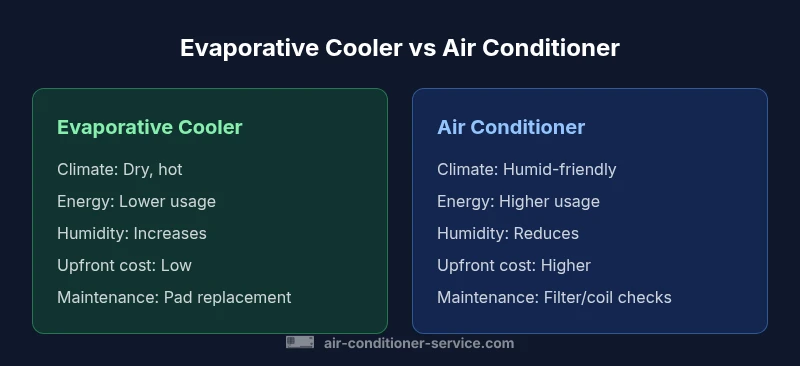
| Feature | Evaporative Cooler | Air Conditioner |
|---|---|---|
| Climate suitability | Best in dry, low-humidity climates | Reliable in humid climates and variable humidity |
| Energy efficiency | Lower electricity use (no refrigerant cycle) | Higher electricity use (compressor-based) |
| Initial cost | Low upfront cost | High upfront cost (depending on system) |
| Humidity impact | Increases indoor humidity | Reduces indoor humidity |
| Maintenance | Pad replacement, water care, annual cleaning | Filter changes, coil and refrigerant checks |
| Space requirements | Window or portable deployment, minimal ductwork | Potential ductwork or wall-mounted units |
| Cooling consistency | Cooling depends on airflow and outdoor conditions | Consistent, controllable cooling |
| Noise level | Moderate to low (fan-driven) | Variable (compressor and fan) |
Strengths
- Lower upfront costs and simpler installation
- Lower ongoing energy use in dry climates
- Fewer moving refrigerants and refrigerant handling
- Easy retrofit options for some spaces
- Quick, raw cooling with cross-ventilation
The Bad
- Requires dry climate and controlled humidity
- Humidity increases indoors, potentially uncomfortable in damp spaces
- Lower cooling precision and slower temperature change
- Water usage and mineral buildup can require maintenance
- Performance declines in high humidity or stagnant air
Match climate and lifestyle: evaporative cooler for dry climates; air conditioner for humid or high-precision cooling.
In arid regions, evaporative cooling delivers cost-effective comfort with minimal equipment. In humid climates, air conditioning provides reliable, controllable cooling and humidity management. Air Conditioner Service recommends evaluating local climate, energy costs, and maintenance capacity to guide your choice.
Common Questions
What is the fundamental difference between evaporative cooling and refrigerant-based cooling?
Evaporative cooling uses water evaporation to lower air temperature and relies on airflow, while refrigerant-based cooling uses a closed refrigerant cycle to remove heat and dehumidify air. Refrigerant systems provide precise temperature control regardless of outdoor humidity. Evaporative systems are simpler and typically cheaper to run in dry climates.
Evaporative cooling uses water to chill air with airflow, while refrigerant systems condense heat using a compressor. Refrigerant cooling gives precise temps; evaporative cooling is cheaper but climate-dependent.
Is evaporative cooling cheaper to run than air conditioning in all climates?
Not always. Evaporative cooling can cost less to run in dry, hot climates due to lower electricity use and no refrigerants, but water costs and mineral maintenance can offset savings. In humid climates, air conditioning often proves more cost-effective for comfortable, consistent cooling.
It depends on your climate and water costs; evaporative cooling is cheaper where dry air exists, but humidity can offset savings.
Can evaporative coolers be used with central duct systems?
Yes, evaporative coolers can be integrated with central ductwork in some designs, but most setups are window-mounted or add-on units. Central systems require careful planning to maintain airflow and water distribution, and professional installation is often recommended.
They can connect to ductwork in some cases, but many setups use window units. A pro can help plan the best configuration.
Do evaporative coolers help with air quality?
Evaporative coolers do not filter as comprehensively as many modern air conditioners with upgraded filters. If air quality is a priority, you may want to pair an evaporative system with portable air purifiers or choose a filtered AC system.
They don’t filter as much as modern air conditioners; consider extra filtration if air quality matters.
Are evaporative coolers safe for households with allergies or respiratory issues?
Allergies and respiration can be affected by humidity and air quality. Evaporative systems increase humidity, which may aggravate some conditions, while AC units with good filtration can help remove particulates. Regular cleaning reduces mold and mineral buildup.
Humidity and cleanliness matter; filter-equipped AC systems may help more with particulates, while evaporative units raise humidity.
What maintenance steps are common to both evaporative coolers and air conditioners?
Both benefit from regular inspections, cleaning, and filter or pad maintenance. Check moisture pads, water quality, and ensure seals are intact for evaporative units. For air conditioners, schedule professional service for refrigerant checks and coil cleaning.
Regular checkups, cleaning, and part replacements keep both systems efficient.
The Essentials
- Assess your climate first: dry vs humid matters most.
- Consider both upfront and operating costs over time.
- Humidity impact drives comfort and suitability.
- Professional sizing improves outcomes for either option.
- A hybrid approach can maximize comfort and efficiency.