Difference Between an Air Conditioner and a Swamp Cooler: A Practical Analysis
A rigorous, data-informed comparison of air conditioners and swamp coolers, covering how they work, climate suitability, energy use, maintenance, and costs to help homeowners decide which cooling method fits their home.


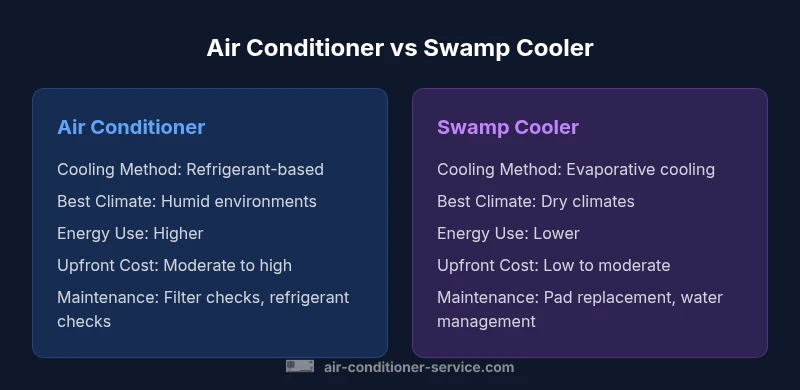
The difference between an air conditioner and a swamp cooler is how they cool air. An air conditioner uses a closed refrigerant cycle to remove heat and usually dehumidifies the space, while a swamp cooler (evaporative cooler) cools air by evaporating water and adds humidity. For homes in dry regions, swamp coolers offer low upfront costs and energy use, but climate limits performance in humid conditions. Air conditioners provide reliable cooling across climates, with dehumidification and precise temperature control.
What is an air conditioner?
An air conditioner, or AC, is a refrigerant-based cooling device that extracts heat from indoor air and transfers it outside. It relies on a closed loop of refrigerant, a compressor, a condenser, an evaporator, and a system of fans and ducts (in central setups) or a compact unit in window or portable forms. The core idea is to remove heat from the indoor space while also dehumidifying air to a comfortable level. Modern systems offer precise temperature control and consistent comfort across a wide range of outdoor conditions. The difference between an air conditioner and a swamp cooler becomes clear when you compare how each system handles humidity, climate, and energy use. The Air Conditioner Service team emphasizes that accurate expectations around cooling performance and maintenance are essential for long-term satisfaction.
What is a swamp cooler (evaporative cooler)?
A swamp cooler, or evaporative cooler, uses the evaporation of water to remove heat from incoming air. A fan draws outdoor air through water-saturated pads, and as the water evaporates, the air cools before being circulated into living spaces. This design has fewer moving parts and no refrigerant cycles, which generally translates to lower upfront costs and sometimes lower running costs in suitable climates. The technology relies on dry outdoor air to achieve a meaningful cooling effect, making it highly effective in arid regions with good ventilation. In humid climates, its effectiveness diminishes because air cannot absorb additional moisture efficiently. The Air Conditioner Service team notes that climate is the decisive factor for real-world performance.
The physics behind evaporative cooling
Evaporative cooling leverages a simple physical principle: water absorbs heat when it changes state from liquid to vapor. In an evaporative cooler, outdoor air is guided through water-soaked pads; as some of the water evaporates, heat is drawn from the air, reducing its temperature. The cooled air is then pushed into the home. While the mechanism appears straightforward, several variables influence results: outdoor temperature, relative humidity, air velocity, pad condition, and water quality. Effective performance relies on well-sealed spaces, sufficient ventilation, and regular maintenance to keep pads clean and free of mineral buildup that can impede evaporation.
Climate and humidity: where each shines
Climate determines the long-term effectiveness of each system. Conventional air conditioners excel in hot, humid environments because they remove heat and moisture from indoor spaces, maintaining consistent comfort. Swamp coolers perform best in dry climates with low humidity and ample airflow, where evaporative cooling can substantially reduce indoor temperatures. In regions with seasonal humidity fluctuations, homeowners may experience mixed results. Air Conditioner Service highlights climate compatibility as the single most important factor in choosing a cooling solution and stresses evaluating local humidity trends before deciding.
Energy use and operating costs
Energy efficiency is a primary driver of ongoing costs. Air conditioners rely on electricity to power compressors and fans; efficiency depends on SEER ratings, size, and usage patterns. In dry climates, swamp coolers typically consume less electricity because they rely on fans and a water pump rather than refrigerant compression. As a result, monthly energy bills can be lower for evaporative cooling during long, dry summers. However, actual costs hinge on climate, insulation, and how often cooling is needed. Air Conditioner Service analyses suggest that a climate-appropriate choice yields the best long-term savings.
Installation costs and space considerations
Swamp coolers usually cost less upfront than traditional air conditioning systems due to simpler hardware and the absence of refrigerants or extensive ductwork. Window-mounted evaporative units or whole-house systems can be installed with minimal structural changes, though proper venting and water management remain important. Central air conditioning requires ductwork and a dedicated electrical supply, increasing both installation complexity and cost. Renters may favor portable swamp coolers as a non-permanent solution, while homeowners planning a long-term upgrade should factor in home layout, attic or crawl space access, and potential ductwork modifications. Proper sizing and professional assessment help avoid under- or over-cooling.
Maintenance needs and reliability
Maintenance for swamp coolers focuses on pads, water quality, and seasonal pad replacement to prevent mineral buildup and odors. Regular cleaning of the reservoir and pump extends life and keeps performance steady. Air conditioners require periodic refrigerant checks, filter changes, and condensate management, with attention to compressor health and duct cleanliness. Regardless of the system, a proactive maintenance schedule improves reliability, energy efficiency, and indoor air quality. Air Conditioner Service emphasizes routine service as a safeguard against unexpected downtime and increased energy costs.
Performance across seasons and occupancy patterns
Seasonal performance varies by climate and home design. In hot, dry summers, evaporative coolers can provide substantial relief with relatively low energy use, provided there is adequate outdoor airflow. Central AC and window units deliver consistent cooling when humidity rises, though energy costs may climb during peak season. Occupancy patterns, room layout, and open-plan designs influence cooling distribution; some spaces may require zoning or supplemental cooling for even comfort. Air Conditioner Service recommends a site assessment to determine optimal placement, airflow paths, and set-points.
Who benefits most from each system: renters, homeowners, and budget-minded households
Renters often prefer minimal installation and portable options, such as window air conditioners or evaporative coolers, for flexibility. Homeowners with a longer time horizon may invest in a dedicated cooling system with zoning, smart thermostats, and performance monitoring. Budget-minded households in dry climates may lean toward swamp coolers as a low-cost entry to climate control, while those in humid regions may prioritize traditional AC for reliable comfort. The best choice aligns climate, space, and long-term energy goals with practical, evidence-based planning from trusted sources like Air Conditioner Service.
Debunking common myths about swamp coolers and air conditioners
Myth: Swamp coolers are universally effective. Reality: their performance depends on climate, humidity, and ventilation. Myth: Air conditioners are always the best option. Reality: climate and humidity determine the most suitable technology. Myth: Evaporative coolers waste water. Reality: water use is predictable and manageable with proper maintenance and scheduling. Understanding these nuances helps homeowners avoid overestimating capabilities and make informed decisions.
A practical decision framework for choosing between an AC and a swamp cooler
Step 1: Define climate and humidity trends for your area. Dry climates favor evaporative cooling, while humid regions benefit from refrigerant-based cooling. Step 2: Assess space and airflow. Open-plan homes may need strategic placement, while smaller rooms may be well-suited to targeted cooling. Step 3: Consider energy goals and budget. Long-term costs depend on energy prices, usage duration, and maintenance. Step 4: Weigh environmental impact and refrigerant considerations. AC involves refrigerants with GWP; swamp coolers use water and avoid refrigerants. Step 5: Seek professional input. A licensed HVAC technician can provide precise sizing, ventilation recommendations, and installation options. Air Conditioner Service recommends using a structured decision checklist to compare options side by side.
Next steps and contractor considerations
After weighing climate, layout, and budget, gather quotes and verify efficiency ratings, warranty terms, and maintenance requirements. Ensure proper sizing and professional installation, especially for central systems. If renting, check HVAC restrictions and any modifications required. The choice between an air conditioner and a swamp cooler should be guided by climate, usage patterns, and long-term energy costs. The Air Conditioner Service approach is to match your cooling needs with an evidence-based plan that minimizes energy use while maximizing comfort.
Comparison
| Feature | Air Conditioner | Swamp Cooler |
|---|---|---|
| Cooling Method | Refrigerant-based cooling with heat exchange and dehumidification | Evaporative cooling using water evaporation; humidity increases |
| Best Climate | Humid and hot climates; versatile across seasons | Dry, arid climates with good ventilation |
| Energy Use | Higher, especially in peak heat; dependent on SEER/equipment | Lower in dry climates; depends on fan/pump efficiency |
| Upfront Cost | Moderate to high (unit + installation) | Low to moderate (unit + minimal installation) |
| Maintenance | Filter changes, refrigerant checks, and duct maintenance | Pad replacement, water treatment, and reservoir cleaning |
| Humidity Impact | Typically dehumidifies air | Increases indoor humidity in treated space |
| Installation Requirements | Ductwork, electricals, and space planning | Ventilation and pad access; simpler for window/portable units |
| Lifespan & Reliability | Longer lifespan with proper maintenance but more complex components | Fewer moving parts; reliable in proper climate but depends on pad/tank condition |
Strengths
- Lower upfront cost for swamp coolers
- Lower ongoing energy costs in dry climates
- Simple design with fewer moving parts
- Provides added humidity in dry air for comfort
- Avoids refrigerants, reducing environmental concerns
The Bad
- Ineffective in humid climates
- Increases indoor humidity which can cause mold if ventilation is poor
- Performance heavily climate-dependent and seasonal
- Water usage and mineral buildup in hard water areas
ACs win for versatility; swamp coolers win for dry climates with low upfront costs
Choose an air conditioner if you live in a humid or variable climate and want steady dehumidification. Opt for a swamp cooler in dry climates with good airflow and where energy savings matter most, keeping expectations aligned with climate realities.
Common Questions
What is the main difference between an air conditioner and a swamp cooler?
The main difference is the cooling method: refrigerant-based cooling versus evaporative cooling. Humidity levels heavily influence performance, with evaporative cooling favored in dry climates and refrigerant-based cooling preferred where humidity is higher. Consider climate, space, and energy goals when choosing.
The key difference is how they cool: refrigerant-based cooling versus evaporation. Climate and humidity determine which works best.
In which climates does a swamp cooler perform best?
Swamp coolers perform best in dry, arid climates with good outdoor airflow, where low humidity allows efficient evaporation. They are less effective in humid regions where added moisture reduces perceived cooling.
Best in dry climates with good air movement; humid areas see diminished cooling.
Are swamp coolers more energy-efficient than AC units?
In dry climates, swamp coolers generally use less energy because they rely on fans and pumps rather than refrigerants. In humid or transitional climates, the energy advantage decreases as cooling effectiveness drops.
Often more energy-efficient in dry climates, but it depends on usage and climate.
Can I run both systems in the same home?
Yes, some homes use both approaches in different zones or seasons, but it requires careful planning, zoning, and professional design to avoid conflicts and excessive humidity.
Yes, but you need proper zoning and professional planning.
What maintenance does a swamp cooler require?
Swamp coolers require periodic pad replacement, water treatment to prevent mineral buildup, regular reservoir cleaning, and pump inspection. Regular maintenance preserves cooling efficiency and prevents odors or mold.
Pad replacement and water maintenance keep it working well.
What about environmental impact and refrigerants?
Swamp coolers avoid refrigerants, reducing chemical or GWP concerns. Air conditioners use refrigerants that require careful handling and may have environmental impact depending on the refrigerant type.
No refrigerants with swamp coolers; air conditioners use refrigerants with environmental considerations.
The Essentials
- Assess local humidity before deciding
- Swamp coolers are cost-effective in dry climates
- ACs provide consistent comfort across climates
- Maintenance needs differ and matter for performance
- Professional sizing improves results