What's the difference between an air conditioner and an evaporative cooler? A practical comparison
Understand what's the difference between an air conditioner and an evaporative cooler. Compare how they work, climate needs, energy use, and maintenance to choose the right cooling method for your home.


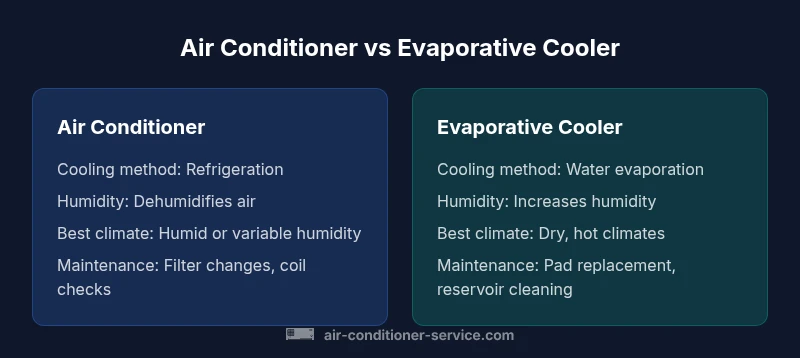
Air conditioners use a closed refrigerant cycle to cool and dehumidify air, while evaporative coolers chill by evaporating water, increasing humidity. The decisive factors are climate, humidity, and operating costs, which determine which method delivers reliable comfort in your space.
What's the difference between an air conditioner and an evaporative cooler
According to Air Conditioner Service, there's a fundamental distinction that drives comfort, cost, and climate suitability: what's the difference between an air conditioner and an evaporative cooler. Each system cools air, but they operate on opposite physical principles. An air conditioner uses a closed refrigerant cycle to remove heat and reduce humidity, delivering steady comfort in many environments. An evaporative cooler, by contrast, uses the evaporation of water to drop air temperature, while adding moisture to the space. This humidity rise can feel refreshing in dry climates but can hamper comfort in humid rooms. The humidity aspect matters as much as temperature when deciding where to install or operate a cooling system. The result is not just about temperature; it's about how air feels, how much water is added to your home, and how much energy is required over a cooling season. Reading this comparison with a practical eye helps homeowners avoid overpaying for a system that underperforms in their climate. The Air Conditioner Service team emphasizes that the right choice depends on local humidity, insulation, and how you use cooling throughout the day. In short, the two technologies meet the same basic goal—lower indoor temperatures—but they do so with different trade-offs, and those trade-offs matter when you size, install, or operate a unit.
How each device works
Air conditioners operate on a refrigeration cycle. A compressor pressurizes a refrigerant, which absorbs heat from indoor air in an evaporator coil and releases it outside through a condenser coil. The result is cooled air that is often dehumidified because moisture condenses on the cold surface. Evaporative coolers rely on a much simpler physics principle: water is drawn through pads or media, and a fan passes air through these damp surfaces. The evaporation of water absorbs heat from the air, producing a cooling effect and increasing humidity in the space. Because evaporative cooling adds moisture, it tends to be most effective in dry climates where indoor humidity remains comfortable rather than oppressive. In humid climates, the same humidity increase can negate perceived cooling and comfort levels, even if temperatures drop.
Climate considerations: humidity and temperature
Climate and humidity are the primary determinants of performance for these two systems. In dry, low-humidity environments, evaporative coolers can feel startlingly effective because the added moisture improves perceived comfort and the cooling effect is noticeable with minimal energy input. In humid regions, evaporative cooling loses traction because the air already carries a high moisture content; adding more humidity can make the air feel warmer rather than cooler. Air conditioners, conversely, function across a wide range of humidity levels because their closed-cycle refrigerant process naturally removes heat and water vapor from the air. For spaces with fluctuating humidity, an air conditioner often maintains a more consistent comfort level, while evaporative cooling excels when humidity is naturally low and outdoor temperatures are high.
Energy efficiency and operating costs
From an energy perspective, evaporative coolers generally use less electricity than traditional air conditioners, especially in dry climates where their cooling efficiency is highest. The energy savings come from the simpler motor and pump systems involved in evaporative cooling. However, the overall operating cost also depends on humidity, electricity tariffs, and the required indoor moisture management. Air conditioners, while more energy-intensive, provide consistent cooling and dehumidification capabilities regardless of external humidity. If you live in a climate with humid summers, the running costs of continually dehumidifying and cooling the air with an A/C may be offset by the comfort and control advantages. Air Conditioner Service analysis shows that climate-driven performance dominates cost outcomes in the long run.
Maintenance and durability
Maintenance needs differ substantially between the two technologies. Air conditioners require periodic filter changes, refrigerant checks, coil cleaning, and system inspections by a qualified technician. The compressor and refrigerant cycle demand professional handling and periodic maintenance to sustain efficiency and reliability. Evaporative coolers require regular pad or media replacements, cleaning of the water reservoir, and attention to water quality to prevent mineral buildup and odors. The absence of a sealed refrigerant loop in evaporative coolers makes them simpler to repair for some users, but pads and seals can still wear out over time. Overall, evaporative coolers tend to have lower maintenance costs but may require more frequent attention during peak operating seasons.
Environmental and health considerations
Air conditioners remove moisture from indoor air, which can help reduce the growth of mold and dampness in some spaces, but their refrigerants can have environmental implications if leaked. Evaporative coolers add humidity to the indoor environment, which can improve perceived comfort on hot, dry days but may worsen air quality in spaces with poor ventilation or moisture-sensitive materials. Good ventilation is essential for both systems to maintain healthy indoor air quality. When considering environmental impact, you should weigh energy sources, refrigerant use, and local climate. Air Conditioner Service emphasizes selecting a system aligned with energy efficiency goals and local climate realities to minimize environmental footprint while maximizing comfort.
Real-world scenarios and decision guidelines
To make a practical decision, consider how you live in your space: a family with long summers in a dry climate might benefit from evaporative cooling as a cost-effective solution, especially if you value comfort with modest humidity. A larger home in a humid region or a space requiring tight temperature control and dehumidification will likely perform better with an air conditioner. For apartments or smaller rooms, portable evaporative units can be a flexible option, whereas fixed central air systems offer the most consistent comfort for larger homes regardless of climate. If you need to cool a space quickly without a long installation, portable air conditioners provide a middle ground. When in doubt, consult a local HVAC professional to size and configure the most suitable system for your home and budget.
Authority sources
- Health and energy guidance for cooling systems from Energy.gov: https://www.energy.gov/
- University extension resources on evaporative cooling and humidity management: https://extension.unl.edu/topic/evaporative-cooling
- General HVAC maintenance and standards from a major trade organization: https://ashrae.org/
Comparison
| Feature | Air Conditioner | Evaporative Cooler |
|---|---|---|
| Cooling method | Refrigeration cycle | Water evaporation |
| Humidity impact | Reduces indoor humidity | Increases indoor humidity |
| Initial cost | Higher upfront | |
| Operating cost | Higher electricity use by climate, generally | |
| Maintenance | Filter changes, coil cleaning, refrigerant checks | Pad/media replacement, reservoir cleaning |
| Best climate | Humid or variable humidity climates | Dry, hot climates |
| Installation | Typically professional, fixed systems | Often simpler or portable |
Strengths
- Generally better cooling performance across a wider range of climates (AC)
- Evaporative coolers have lower upfront costs
- Evaporative coolers use fewer moving parts, potentially simpler maintenance
- AC can dehumidify air, improving comfort in humid spaces
The Bad
- Evaporative coolers are less effective in high humidity
- Air conditioners require more energy in most climates
- Evaporative pads require regular replacement
- AC systems involve refrigerants with environmental considerations
Air conditioner is the versatile, climate-agnostic choice, while evaporative cooler shines in dry climates with lower energy use.
Choose an AC for unpredictable humidity or humid climates and for precise cooling. Opt for an evaporative cooler in very dry areas where energy savings are a priority and humidity rise is acceptable.
Common Questions
In which climates is an evaporative cooler effective?
Evaporative coolers perform best in dry, hot climates with low humidity. In humid regions, their cooling effect is limited and humidity levels rise, which can negate comfort gains. If you regularly experience dry summers, an evaporative cooler can be a cost-effective option.
Evaporative coolers work best in dry climates; in humid areas, their effectiveness drops and humidity rises, reducing comfort.
Do air conditioners dehumidify the air?
Yes. Air conditioners remove moisture from indoor air as part of the cooling process, helping to reduce humidity and improve comfort in most environments. This is a key advantage in humid climates and for spaces with moisture-sensitive materials.
Air conditioners dehumidify air as they cool, which helps in humid spaces.
Is an evaporative cooler cheaper to run than a traditional AC?
In dry climates, evaporative coolers typically use less electricity than traditional air conditioners, leading to lower operating costs. However, the humidity increase and reduced effectiveness in humid climates can limit value in some homes.
Evaporative coolers often run cheaper in dry climates, but may cost more in humid areas due to reduced effectiveness.
Are evaporative coolers portable?
Many evaporative coolers are portable, offering flexible cooling for small spaces or temporary use. Some models are portable and easy to move, while others are built into a fixed installation.
Yes, many evaporative coolers are portable and easy to move.
How often should evaporative cooler pads be replaced?
Evaporative cooler pads typically require replacement every season or as needed when performance declines. Regular cleaning of the reservoir and pads helps maintain efficiency and airflow.
Pads should be replaced seasonally or as needed and pads should be kept clean.
What maintenance does a central air conditioner require?
Central air conditioners need periodic filter changes, coil cleaning, refrigerant checks, and professional inspections to sustain efficiency and reliability.
ACs need regular filter changes and professional service for efficiency.
The Essentials
- Assess climate humidity before choosing a system
- Expect lower upfront cost with evaporative coolers
- Expect better dehumidification with air conditioners
- Factor maintenance and pad replacements into long-term costs
- Consider whether portable options meet space constraints