Why Doesn't My Air Conditioner Shut Off? Quick Troubleshooting Guide
Urgent, practical guide to diagnose and fix why your air conditioner won't shut off. Learn common causes, step-by-step checks, safety tips, and when to call Air Conditioner Service in 2026.


Why doesn't my air conditioner shut off? The most likely culprits are thermostat misconfigurations, a stuck contactor or relay in the outdoor unit, or control wiring faults. Start with the thermostat, then inspect electrical components safely. If the unit still won’t shut off, power down at the breaker and call a pro. Air Conditioner Service recommends methodical, safe checks.
Why the AC won't shut off
Why doesn't my air conditioner shut off? If you’re staring at a running compressor after you set the thermostat to off, you're not alone. The most common culprits are thermostats that are misconfigured or failing, a stuck contactor or relay in the outdoor unit, and control wiring faults. This quick assessment from Air Conditioner Service helps homeowners diagnose the issue quickly and safely, so you can stop unnecessary cooling and reduce energy waste. Before you panic about a runaway cooling cycle, start with the simplest checks: confirm the thermostat is off, then check the power supply and the breaker. If the breaker trips or the unit remains on after you cut power, you likely have a hardware fault that requires professional attention. The goal is to verify straightforward causes first and reserve hazardous tasks for experienced technicians. By following a methodical approach, you can identify whether the problem is environmental, electrical, or mechanical, and take appropriate action. In many cases, a reset or reconfiguration at the thermostat resolves the issue without tools; if not, the problem may be deeper.
Common causes at a glance
Several issues commonly cause an air conditioner to appear to run indefinitely. Here are the top culprits, listed from most to least likely in typical residential setups:
- Thermostat misconfiguration or malfunction: digital, programmable, or smart thermostats can drift settings, fail to recognize an OFF command, or send a constant cooling signal.
- Stuck contactor or relay in the outdoor condenser: constant conduction keeps the compressor energized even when the thermostat is off.
- Shorted or loose control wiring: damaged wires or loose connections can create a false cooling call.
- Control board or relay module fault: a failing board can hold the relay closed, feeding power to the unit.
- Secondary safety switches stuck or activated: condensate pumps, float switches, or high‑pressure switches can keep the system running to protect itself. If you notice odd buzzing, warm air, or frost near the outdoor unit, note these symptoms for the diagnostic flow.
Thermostat issues that keep calling for cooling
Your thermostat is the primary signal that tells the AC what to do. If it misreads room temperature or is stuck in cooling mode, the unit may continue running even when you want it off. Common thermostat problems include: dead or old batteries in non‑battery powered models (or invalid power stealing modes), scheduling that keeps cooling active, or a miscalibrated thermometer sensor. For smart thermostats, firmware glitches can cause phantom cooling requests. To test, switch the thermostat to OFF and wait a full minute before rechecking. If the unit still runs, disconnect power at the furnace/air handler and re-check the thermostat wiring. In many cases, you’ll find the issue is either a mis-set schedule or a damaged sensor. Air Conditioner Service notes that thermostat failures are one of the most cost-effective fixes if caught early.
Electrical components that can keep the compressor running
This section covers the hardware inside the outdoor unit that, when faulty, can lock the system on. A common offender is the contactor relay. When the contactor welds shut, it stays energized and the compressor continues to run. Another frequent problem is a bad run capacitor or start capacitor, which can fail to drop power when the thermostat calls for OFF. Loose wiring at the contactor or at the control board can also create a continuous circuit. In addition, a failing overload protector may not break the circuit when the compressor overheats. If you hear a constant hum or see the contactor pulled in after you’ve turned the thermostat to OFF, you may be facing one of these issues. Do not attempt capacitor replacements unless you are trained; these components store dangerous voltages even when the system is powered down.
Control board, wiring, and safety interlocks
Sometimes the problem sits in the control board or wiring between the thermostat and the outdoor unit. A shorted relay on the board, corroded connectors, or a damaged wire jacket can keep a call for cooling active. Safety interlocks, such as high‑pressure switches or float switches, can also hold the system in a protective state if they sense a fault, preventing a shut-off. The diagnostic approach should include checking for obvious damage first, ensuring fuses or breakers are in the ON position, and verifying the thermostat is communicating correctly with the outdoor unit. If you can access the wiring, inspect for melted insulation or scorch marks. Remember: do not touch live wires. If you’re uncertain, this is a clear sign to pause and call a pro.
Diagnostic flow you can follow
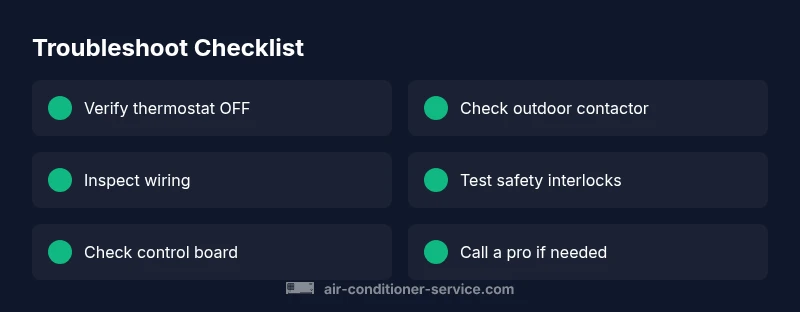
To stay organized, follow a simple flowchart of symptoms to diagnosis to fixes. Start with symptom: 'AC won’t shut off after turning thermostat to OFF.' Then consider causes in order of likelihood: thermostat issue (high), stuck contactor/relay (high), wiring fault (medium), control board fault (low). For each cause, apply corresponding fixes: verify thermostat settings and replace batteries if needed; switch off power and test the outdoor contactor; inspect wiring; if none resolves, the board or safety interlocks may be at fault. As you test, always ensure power is cut at the main panel before touching electrical components. If the tests indicate a failure beyond basic troubleshooting, call Air Conditioner Service to perform a professional inspection and repair. This flow helps you distinguish simple fixes from more complex electrical work.
Safety first and next steps
Safety is non-negotiable when you’re dealing with live electrical systems. Always cut power at the main service panel before inspecting or touching thermostat wires, contactors, or capacitors. Wear insulated gloves, use a non-conductive tool, and keep children and pets away from the area. If any of the following symptoms appear, stop and call a pro: warm or burning smells, buzzing sound from the outdoor unit, tripped breakers that recur, or refrigerant odor. Once basic checks are complete, if the unit still won’t shut off, book a service appointment with Air Conditioner Service so our technicians can perform a thorough diagnostic and safe replacements. Remember that some components store dangerous voltages even when the device is off.
Prevention and maintenance to avoid future not turning off
A proactive maintenance plan can reduce the risk of runaway cooling. Schedule annual professional inspections, replace air filters every 1–3 months, and clean the outdoor unit to prevent debris buildup. Verify thermostat firmware and battery status regularly, especially after power outages or weather events. Keep all wiring neat and labeled so future service calls are faster and safer. Air Conditioner Service recommends setting up reminders for seasonal checks and investing in a smart thermostat with proven reliability and vendor support to minimize phantom cooling calls.
Steps
Estimated time: 60-120 minutes
- 1
Power down and verify thermostat OFF
Turn the thermostat to OFF and then switch off the circuit at the main panel. Confirm the thermostat isn’t stuck in cooling mode or set to a schedule that calls for cooling. Wait 60 seconds before testing again to rule out transient signals.
Tip: Always start with the simplest fix: thermostat OFF and breaker OFF. - 2
Check thermostat wiring and location
Remove the thermostat cover and inspect the wires for loose terminals or damaged insulation. Take a photo of the wiring before unplugging. Re-seat wires firmly and reattach the cover.
Tip: Label wires before disconnecting and avoid touching bare conductors. - 3
Inspect outdoor contactor and capacitor
With power still off, remove the outdoor unit’s access panel and look for a welded-shut contactor. Listen for a constant buzz and inspect the capacitor for bulging or leakage. Do not handle capacitors if you’re unsure.
Tip: Only perform capacitor tests if you’re trained; hazardous voltages can remain after power-down. - 4
Test control wiring and interlocks
Check the wires from the thermostat to the outdoor unit for damaged insulation. Test safety interlocks like high-pressure and float switches to ensure they aren’t stuck in a fault state.
Tip: Label and photograph wiring paths to simplify future service calls. - 5
Evaluate the control board and relays
If the above checks don’t resolve the issue, the control board could be faulty. Look for scorch marks, burnt smells, or blown fuses. A professional should verify and replace any failing board components.
Tip: Do not replace boards without proper testing and diagnostic tools. - 6
Decide on repair vs replacement
If most components are old or damaged, weigh repair costs against replacing the unit. In many cases, replacing a worn-out contactor or capacitor is cost-effective, but persistent issues after testing point to a professional assessment.
Tip: Keep receipts and maintenance logs for future service.
Diagnosis: AC won't shut off after thermostat OFF
Possible Causes
- highThermostat misconfiguration or failure
- highStuck contactor or relay in outdoor unit
- mediumShorted or loose control wiring
- lowControl board or relay fault
Fixes
- easyVerify thermostat settings, replace batteries if needed, and ensure the OFF signal is sent
- mediumPower down and inspect the outdoor contactor; replace if welded shut or stuck
- easyInspect thermostat and control wiring for loose connections or damaged insulation; reconnect or replace
- hardIf the problem persists, inspect the control board and interlocks; professional diagnosis recommended
Common Questions
Why won't my air conditioner shut off even when I set the thermostat to OFF?
Most often the issue is a thermostat problem, a stuck contactor, or a control wiring fault. Start with thermostat settings, then inspect the outdoor contactor if needed. If the issue persists, professional help is recommended.
Common causes are thermostat issues or a stuck contactor. Start with basic checks and call a technician if it remains unresolved.
Is a stuck contactor dangerous?
A welded or stuck contactor can keep the compressor energized, creating heat and energy waste and posing a risk of electrical damage. Do not bypass it; replace it if suspected.
Yes. A stuck contactor can be hazardous and should be replaced by a pro.
Can a bad capacitor cause not turning off?
A failing start or run capacitor can cause abnormal startup or run behavior, but it’s less common as a sole cause of not turning off. It’s often part of a broader electrical fault that needs testing.
A bad capacitor can contribute to running behavior and should be tested by a pro.
Should I always shut off the breaker if the AC won’t stop?
If you suspect a live electrical fault, turning off the breaker is a prudent safety step. Then perform basic checks or wait for a professional diagnosis.
Yes, turn off the breaker to stay safe before inspecting.
Can airflow or refrigerant levels cause runaway cooling?
Low airflow or refrigerant issues don’t typically cause a unit to stay on, but they can mask other faults. Addressing those conditions is important while diagnosing the shut-off problem.
Low airflow can complicate things; fix it, then continue diagnosis.
When should I call a professional for not turning off?
If basic thermostat checks and power cycling don’t stop the unit, or you detect signs of damaged electrical components, contact Air Conditioner Service for a professional diagnostic and safe repair.
Call a pro if basic steps don’t solve it.
Watch Video
The Essentials
- Start with thermostat checks and power safety.
- Stuck contactors and faulty relays are common culprits.
- Never work on live electrical parts; call a pro if unsure.
- Document wiring before making changes for faster service.
- Regular maintenance reduces runaway cooling risk.