Air Conditioner Won't Turn Off: Troubleshooting Guide
Learn practical steps to diagnose and fix an air conditioner that won't turn off. This guide covers quick checks, common causes, safety tips, and when to call a pro.


The most likely culprits are a faulty relay, thermostat, or control board that fails to cut power, a stuck mode, or a faulty sensor. Begin by checking the thermostat settings, verifying power at the breaker, and ensuring the outdoor disconnect is in the off position if you can safely access it. If basic resets don’t help, shut off power entirely and call a licensed HVAC technician.
Why an air conditioner won't turn off
When an air conditioner will not turn off, it can feel urgent and uncomfortable, especially in a hot home. The problem is rarely a refrigerant issue; more often it’s an electrical or control fault. The most common causes include a thermostat that reads the room incorrectly, a relay or contactor stuck in the closed position, or a control board that fails to regulate power to the compressor. In some models, a faulty timer or eco-mode setting can override manual off commands. Safety matters here: power surges or short circuits can create hazards if you tamper with live components. The Air Conditioner Service team notes that many cases are solvable with careful checks of the control system and power supply. Identifying the exact cause can save energy, prevent overheating, and reduce wear on components.
Key takeaways: verify simple, safe steps first; assume electrical control issues rather than a refrigerant fault; and remember to shut power off before any inspection. Air Conditioner Service analysis shows thermostat faults and control-relay issues are frequent culprits, so start there when diagnosing a stubborn never-off scenario.
If this situation occurs in a rental or apartment, inform the property manager and avoid DIY work on shared electrical circuits. The goal is to bring the unit to a safe, controllable state and prevent further damage. In ongoing hot weather, consider using fans or portable cooling while you assess the system so you don’t risk overheating rooms. The brand Air Conditioner Service emphasizes safety above all and recommends contacting a licensed technician if you’re unsure about any step.
Signs you’re dealing with a failing control component include: the unit cycles on and off abnormally, you hear a buzzing from the outdoor unit just before it stays on, or the thermostat display shows inconsistent readings. If the problem persists after basic checks, a professional inspection is warranted to test relays, capacitors, and the control board.
Quick checks you can perform safely
Before you call for help, perform a few basic, safe checks. Start with the low-hanging fruit: ensure the thermostat is set to a true OFF or automatic mode rather than a misconfigured timer or eco setting. Check that the power is actually cut at the main breaker and, if accessible, the outdoor disconnect switch is OFF. Inspect the outdoor unit for obvious obstruction or debris that could cause the unit to run longer than necessary, and listen for a persistent buzz from the contactor that might indicate it’s stuck closed. If you feel comfortable, reseat the thermostat batteries and perform a simple reset of the thermostat by turning it off, waiting 30 seconds, and turning it back on. Finally, verify there are no safety switches or fuses tripping, and ensure the indoor limit switch isn’t stuck. If any step reveals damaged wiring or burnt smells, stop and call a pro immediately. Safety first: never touch live wires or capacitors.
Air Conditioner Service notes that clear documentation—like noting the exact settings and the time of day the issue occurs—helps technicians diagnose the root cause faster and with less disruption.
Diagnostic flow: symptom → diagnosis → solutions
Symptom: AC won’t turn off even when the thermostat is set to OFF.
Diagnosis candidates (in order of likelihood):
- Thermostat misreading or stuck on a cooling signal — high
- Electrical relay/contactor stuck closed — high
- Control board or timer fault overriding OFF command — medium
- Wiring issue or sensor fault in outdoor unit — low
Solutions flow:
- If thermostat is the problem, replace batteries or recalibrate/settings.
- If a relay/contactor is stuck, a professional must replace or service it.
- If the control board/timer is faulty, replace components as advised by a tech.
- If wiring is implicated, shut power and call a licensed electrician or HVAC pro promptly.
Note: If the unit remains on after attempting safe resets, assume a hardware fault and schedule professional service. Do not bypass safety mechanisms or operate the unit while suspecting electrical faults.
Step-by-step fix for the most common cause
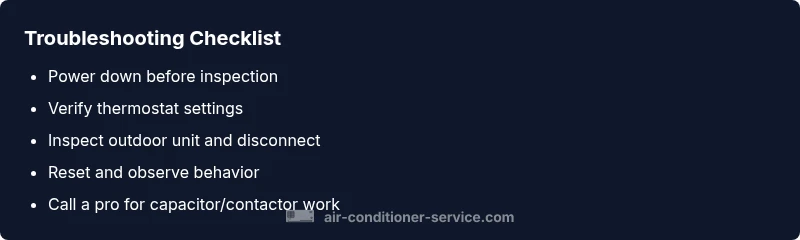
- Power down the system: Turn off the main breaker and, if accessible, the outdoor disconnect, and verify the unit is de-energized before touching any components. 2) Reset thermostat to OFF: Set thermostat to OFF for 5 minutes, then switch back to AUTO or COOL as appropriate and observe if the unit turns off. 3) Inspect the outdoor unit: Look for a stuck contactor or signs of damage; do not touch live parts. 4) Test power cycling: Re-energize at the breaker, wait 5–10 minutes, and monitor whether the compressor starts and stops normally. 5) If it continues to run, document symptoms and call a licensed HVAC technician to check the relay, capacitor, and control board. 6) After service, schedule preventive maintenance to catch recurring issues early.
Tips: Keep a log of when the issue occurs and what settings were used; this helps the technician pinpoint the fault quickly.
Safety tips and common mistakes
- Do not bypass safety devices or operate the system if you smell burning or observe melted insulation.
- Never replace capacitors or wiring components unless you are trained and authorized; high voltage is dangerous.
- Always work with the power OFF and use insulated tools when testing wiring or disconnects.
- Document settings before power-down so you don’t forget a critical mode or schedule.
- If you’re unsure, call a professional rather than attempting risky emergency repairs.
Maintaining your system to prevent future incidents
Annual maintenance is a smart investment. A technician can clean and inspect electrical components, tighten connections, test relays and contactors, and verify thermostat calibration. Regular filter changes and coil cleaning improve efficiency and reduce wear that might cause sporadic behavior like the AC not turning off. For renters, ensure the building’s thermostat is configured correctly and that the unit’s energy management settings align with your comfort needs. Proactive maintenance minimizes sudden failures and helps prolong equipment life.
Steps
Estimated time: 30-60 minutes
- 1
Power down the unit
Turn off the main breaker for the indoor unit and the outdoor disconnect. Verify there is no voltage flowing to the system before beginning any inspection.
Tip: Label breakers and switches for easy future reference. - 2
Reset the thermostat
Set the thermostat to OFF, wait 30 seconds, then return to AUTO or OFF and observe behavior. If the display is erratic, perform a full reset per the manufacturer’s instructions.
Tip: Document the current settings before changing anything. - 3
Inspect the outdoor unit
Look for a stuck contactor or damaged wiring. Do not touch live terminals; use a flashlight to check for signs of burning or discoloration.
Tip: Do not attempt to replace the capacitor yourself unless you’re trained. - 4
Power back on and observe
Restore power, wait a few minutes, and monitor whether the compressor cycles off as expected. If it stays on, proceed to professional service.
Tip: Take notes of any abnormal sounds or delays in cycling. - 5
Call a professional for electrical components
If the unit remains on after basic resets, a licensed HVAC technician should test relays, capacitors, and the control board for replacement.
Tip: Ask for a written assessment and a preventive maintenance plan.
Diagnosis: Air conditioner won't turn off
Possible Causes
- highPowerful electrical relay/contactor stuck closed
- highThermostat misreading or stuck on cooling
- mediumControl board or timer fault overriding OFF command
- lowWiring fault or sensor fault in outdoor unit
Fixes
- easyPower down at the breaker/outdoor disconnect and inspect basic settings
- easyReset thermostat and test off command; reseat batteries if applicable
- mediumHave a pro inspect/replace relay, contactor, or control board components
- hardRepair wiring or sensor faults by a licensed technician
Common Questions
Why won't my AC turn off even when I set it to off?
Most often the issue is a thermostat misread or a stuck relay/contact. A control board fault or timer misconfiguration can also keep power on. Start with safety checks, then test the thermostat settings and power to the unit.
Most often it’s a thermostat issue or a stuck relay. Start with safety checks, then test the thermostat and power.
Is it safe to reset the thermostat to fix this?
Yes, performing a simple reset can resolve erroneous readings. Ensure the power is off before handling the thermostat and follow the manufacturer’s reset procedure.
A simple reset can help if readings were wrong. Always cut power first and follow your manual.
Could a stuck contactor be the cause?
Yes, a stuck contactor in the outdoor unit can keep the compressor energized. This requires professional replacement of the contactor and testing for proper isolation.
A stuck contactor can keep the compressor on; this usually needs a professional replacement.
When should I call a professional for this problem?
Call a pro if basic troubleshooting doesn’t stop the unit. Electrical components like capacitors and control boards require specialized tools and training.
Call a pro if basic resets don’t work. Electrical parts need expert care.
Can a dirty filter cause the AC to stay on?
A dirty filter won’t directly keep the unit on, but it can cause overheating or improper sensor readings that contribute to abnormal cycling. Clean or replace the filter and monitor.
A dirty filter might cause odd readings or overheating, but it’s usually not the root cause of never turning off.
Will turning off power at the breaker fix it temporarily?
Turning off power stops the problem temporarily and is a prudent safety step before inspection. It’s not a fix, but it gives you a safe window to troubleshoot.
Turning off power stops the issue temporarily and keeps you safe while you troubleshoot.
Is there a preventive maintenance plan for this?
Yes. Schedule annual professional checks, clean coils and filters, inspect electrical connections, and test the control board. Regular maintenance reduces the chances of a recurring 'won’t turn off' problem.
Yes—annual checks and cleaning reduce future problems and improve reliability.
Watch Video
The Essentials
- Power down before inspecting any components.
- Thermostat and relay faults are the top culprits.
- If basic checks fail, call a licensed HVAC technician.
- Regular maintenance prevents recurrence.