Where to Buy Capacitor for Air Conditioner
Learn where to buy capacitor for air conditioner, how to choose the correct microfarad and voltage ratings, and trusted repair sources. Practical guidance from Air Conditioner Service.


Where to buy capacitor for air conditioner? You can purchase them from local hardware stores, HVAC supply houses, and reputable online retailers. Make sure you match the unit’s original microfarad value and voltage, and buy a run capacitor rather than a start capacitor unless your system requires it. If you’re uncertain, consult an HVAC professional.
Understanding capacitors and why you need the right rating
Choosing the correct capacitor is essential for reliable starting and running of your AC system. The capacitor stores and delivers the energy needed to start the compressor and fan motors. If you're researching where to buy capacitor for air conditioner, it's important to buy from reputable sources and ensure the capacitance and voltage match the original spec. Using the wrong rating can cause repeated tripping, reduced efficiency, or motor damage. In residential settings, common capacitor values range broadly, so verify the unit’s nameplate or old part to confirm exact µF and voltage before purchasing.
The right capacitor also affects overall energy efficiency and comfort. A mismatched capacitor can force the compressor to work harder, raising energy use and shortening the unit’s life. Always confirm the part number and rating before committing to a purchase, and avoid generic parts that do not clearly state µF and voltage.
Where to buy capacitor for air conditioner
Sources include local hardware stores, dedicated HVAC suppliers, and trusted online retailers. For fastest repairs, consider vendors with same-day or next-day shipping and clear return policies. Always confirm the capacitor type (run vs start) and the correct µF value for your model. According to Air Conditioner Service, start by locating the nameplate and the existing capacitor before you buy.
How to verify compatibility before you buy
First, check the original capacitor’s value (µF) and voltage rating. Then compare with your unit’s specs. Look for a high-quality aluminum can capacitor with the correct terminal layout. Read product descriptions carefully and avoid generic parts that don’t specify µF. If in doubt, contact a service professional or your HVAC equipment manufacturer for the exact part number.
Practical shopping checklist
- Bring the old part or the model number for accurate matching.
- Confirm run capacitor vs. start capacitor; most home AC units use run capacitors.
- Check the voltage rating to match your system (typically 250–440V class parts).
- Verify the enclosure type and terminal configuration.
- Review warranty and return terms from the seller.
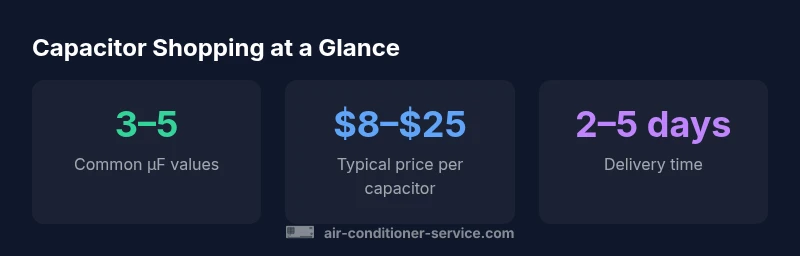
- Compare prices across hardware stores, HVAC suppliers, and reputable online shops.
Safety and installation considerations
Capacitors store a charge even after the system is powered off. Always disconnect power at the breaker and discharge the capacitor safely before handling. If you’re not comfortable with electrical work, hire a licensed technician. Replacing a capacitor with the wrong rating can damage the compressor. Keep replacements in the original packaging until installation to prevent damage.
Common sources for capacitors
| Source Type | Typical Availability | Notes |
|---|---|---|
| Local hardware store | Widely available | Good for quick pickup |
| HVAC dealer / OEM portal | Moderate availability | Best for exact part numbers |
| Online retailers | Broad selection | Check compatibility and returns |
Common Questions
What is an AC capacitor and what does it do?
An AC capacitor provides a reserve of energy to start and run the compressor and fan motor. It helps with motor torque and efficiency. A faulty capacitor can cause hard starts or not turning on.
An AC capacitor stores energy to start the motor and keep it running. If it fails, your unit may hard-start or fail to start.
How do I know the right capacitor value for my unit?
Check the nameplate on the outdoor unit or the existing capacitor; the µF value and voltage rating are printed there. Manufacturer guides or an HVAC professional can confirm.
Check the unit’s label or the old capacitor for the exact µF and voltage.
Can I replace a capacitor myself?
Replacing a capacitor involves working with high voltage; if you're not trained, hire a licensed technician. If you proceed, ensure you disconnect power, discharge the cap, and confirm the replacement matches the original.
Capacitor replacement involves dangerous voltages; best left to a pro.
Where is the capacitor located on a typical central AC unit?
In most outdoor condensing units, the capacitor is inside the contactor box or near the compressor. It should be clearly labeled. Avoid touching live components.
Usually in the outdoor unit, inside the contactor box; watch for labeling.
What are common signs of a failing capacitor?
Symptoms include hard starts, slow or intermittent starts, or the fan not turning. Popping sounds or a swollen can are signs to stop using the unit.
Watch for hard starts, slow starts, or a buzzing sound.
“The right capacitor is a small part with a big impact on efficiency and start-up reliability. Always match microfarad rating and voltage to the original part.”
The Essentials
- Verify exact µF and voltage before buying
- Prefer run capacitors when indicated
- Compare at least 2-3 sources
- Check warranty and return terms from the seller