How to Check an Air Conditioner Capacitor
Learn to safely test your AC capacitor, spot failure signs, and replace with the correct rating. Practical steps, safety tips, and when to call a professional from Air Conditioner Service.


Learn how to safely check an air conditioner capacitor and determine if it needs replacement. This step-by-step guide covers visual inspection, basic electrical testing with a multimeter or capacitance tester, and clear criteria for replacement. Before you start, ensure power is off, identify the correct capacitor type and rating, and have a replacement ready if needed.
Understanding the role of the capacitor in an air conditioner
An air conditioner’s motor relies on a start or run capacitor to provide the extra surge of energy needed to start and run the compressor and fan. The run capacitor stays in the circuit to help maintain motor speed, while the start capacitor gives a short burst to kick the motor into motion. If either capacitor begins to fail, the system may struggle to start, run inefficiently, or hum loudly. If you're wondering how to check air conditioner capacitor, understanding its role helps identify signs of wear and makes it easier to decide whether testing or replacement is needed. According to Air Conditioner Service, a failing capacitor is a common cause of no-cool situations and hard starts. A clear understanding of capacitor function helps homeowners distinguish between wiring issues, thermostat problems, or a locked rotor. Recognizing these signs early can prevent further damage and save on costly repairs.
Safety first: electrical hazards and disconnection procedures
Electrical work around an air conditioner carries real risks, including shock and a capacitor dump. Always power down the system at the thermostat and at the outdoor disconnect, then switch off the circuit feeding the unit. Wait several minutes for any stored charge to dissipate, and verify the absence of voltage with a non-contact tester before touching any wires. Wear PPE such as insulated gloves and eye protection, and keep metal tools away from exposed terminals. If you’re not sure you can safely meet these safety steps, stop and contact a licensed technician. The goal is to minimize the chance of shock, burns, or equipment damage while you inspect or service the capacitor.
Visual cues and measurement concepts you should know
Beyond visual signs, capacitor health is about capacitance—the stored energy that helps start and run the motor. A healthy capacitor should show stable readings across attempts and no visible swelling or electrolyte leakage. Replace with an identical rating to avoid overworking the motor or reducing efficiency. Air Conditioner Service analysis notes that the majority of capacitor-related failures are detected through readings that fall outside the labeled tolerance or through physical deformities. Look for bulged or cracked cans, heat-discolored terminals, or electrolytic leakage as red flags.
Visual inspection techniques
Inspect the capacitor can for bulges, cracks, or leakage; physical damage often signals failure even before testing. Check terminal connections for corrosion, loose leads, or signs of overheating. If the unit is housed in a protective cover, remove it carefully and avoid disturbing refrigerant lines. Document any damage to accessory parts for later replacement. The location of the capacitor (outdoor condenser vs. indoor air handler) may affect how you access it and what kind of replacement part you purchase. A thorough visual check helps you decide if you can safely test or if service is required.
Electrical testing methods: using a multimeter or capacitance tester
To test capacitance, you’ll need a multimeter with capacitance mode or a dedicated capacitance tester. First, discharge the capacitor safely, then detach the leads from the circuit. Set your meter to capacitance mode, connect the probes to the capacitor terminals, and read the value. Compare the reading to the capacitor’s labeled µF; readings far from the stated value suggest a failing part. If your meter cannot read capacitance, you can perform a basic resistance test: after discharging, a good capacitor will show an initial low resistance that quickly rises toward infinity as the capacitor charges. For a quick sanity check, measure across the terminals with an ohmmeter after discharging; a steady, infinite reading indicates a healthy capacitor, while a short or very low reading indicates a problem. These measurements are more reliable when performed with the proper equipment and a reference from the unit’s manual.
What to do if the capacitor reads out of spec
If the capacitance reading falls outside the manufacturer’s tolerance, the capacitor is likely failing and should be replaced. Some meters display a range rather than an exact value; in that case, follow the label and your unit’s service manual for acceptable limits. When replacing, select a capacitor with the same µF rating and the same or higher voltage rating as the original. After installation, re-check connections and retest the system to confirm proper operation. If you cannot obtain an exact match, consult the HVAC manufacturer’s documentation or a professional for guidance on compatibility and warranty implications.
Replacement options: cap types and safety considerations
Capacitors come in several form factors and ratings. The two most common types for residential HVAC are start and run capacitors, each labeled with a µF value and voltage rating. Ensure you install the correct type for your unit; using the wrong device can damage the compressor or reduce efficiency. When selecting a replacement, prioritize an exact or very close µF rating and matching voltage. Apply any manufacturer-recommended terminal grease to prevent corrosion and ensure a clean connection. If you are unsure about the correct part, a quick hostname check of your unit’s model number and the existing capacitor label usually provides the needed specifications. Remember, wrong parts can void warranties and create safety hazards.
When to call a professional
If you lack the required tools, are uncomfortable discharging a capacitor, or the unit is under warranty, it’s wise to contact a licensed HVAC technician. A professional can perform precise capacitance tests, verify motor windings, inspect relays, and ensure refrigerant safety. In many cases, professionals can complete the replacement and test the system with proper service equipment, reducing the risk of injury or component damage. Even for experienced DIYers, a second pair of skilled hands can improve safety and accuracy when handling high-energy electrical components.
Common mistakes and myths
Common mistakes include testing without discharging, using the wrong µF rating, or confusing start and run capacitors. Another frequent error is attempting replacement without isolating power, which can lead to electric shock or a momentary capacitor dump. Some homeowners believe a capacitor must visibly swell before failing; many capacitors fail under load without obvious external signs. Relying on intuition instead of measurements is risky; always use proper testing tools and compare results to the label and service manual.
Tools & Materials
- Multimeter with capacitance mode(Select a meter that can measure capacitance (µF) and voltage; ensure it is rated for electrical work on HVAC components.)
- Capacitance tester (optional)(More precise readings can be obtained with a dedicated capacitor tester.)
- Insulated screwdriver set(To safely disconnect and reconnect leads from the capacitor terminals.)
- Gloves and eye protection(Basic PPE for electrical work and potential capacitor discharge risks.)
- Non-contact voltage tester(Helpful for quick power checks before touching components.)
- Replacement capacitor with the same µF and voltage rating(Keep on hand if testing indicates the capacitor is out of spec.)
Steps
Estimated time: 30-60 minutes
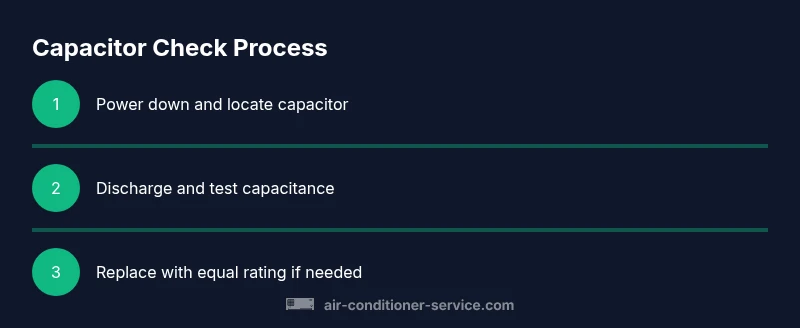
- 1
Power down and locate the capacitor
Turn off power at the thermostat and the outdoor disconnect. Locate the capacitor housing in the condenser or air handler and review the label to confirm the rated µF and voltage.
Tip: Label the access panel to prevent accidental re-energization. - 2
Disconnect the capacitor leads
Carefully remove the wires from the capacitor terminals using insulated tools. Avoid tugging on wires; document which wire goes to which terminal.
Tip: Take a photo before disconnecting for reference. - 3
Discharge the capacitor safely
With power off, bridge the terminals briefly using a resistor or discharge tool to bleed residual charge. Do not touch terminals during discharge.
Tip: Always discharge after disconnecting from the circuit. - 4
Test capacitance with a meter
Set your meter to capacitance mode and connect the probes to the capacitor terminals. Read the value and compare to the label. If the reading is far from the rated value, the capacitor is likely failing.
Tip: Ensure the leads do not short or touch nearby components. - 5
Check physical condition and connections
Inspect the capacitor can for bulges or leaks and verify terminal connections are clean and tight. Reinstall a new capacitor if needed.
Tip: If you see swelling or leakage, replace immediately. - 6
Replace and reassemble
Install a new capacitor with the same µF and voltage rating, reconnect wires in their original order, secure the cover, and restore power. Run the unit briefly to verify operation.
Tip: Double-check that the unit runs smoothly without unusual noises.
Common Questions
Can a bad capacitor prevent the AC from starting?
Yes. A faulty capacitor can prevent the compressor or fan from starting, or cause repeated restarts. Visual signs along with capacitance readings help confirm failure.
Yes. A bad capacitor can stop the unit from starting, and testing with a meter confirms the failure.
Do I need specialized tools to test a capacitor?
A multimeter with capacitance mode or a dedicated capacitance tester is typically sufficient. An oscilloscope is not required for basic testing.
A capacitance-capable multimeter or a dedicated tester is usually all you need.
How do I identify the correct capacitor rating?
Check the unit’s label near the capacitor for µF and voltage. Replace with the same rated µF and equal or higher voltage rating as recommended by the manufacturer.
Look at the label on the capacitor and match both the microfarad rating and voltage.
Is it safe to replace the capacitor myself?
It can be safe if you have proper training and follow lockout procedures. If you’re unsure, hire a licensed HVAC technician to avoid shocks or equipment damage.
You can replace it yourself if you’re trained and follow safety steps, otherwise call a pro.
What if the fan runs but the compressor doesn’t?
That can indicate a capacitor issue affecting the compressor. Still, other problems like wiring or a faulty relay could be involved; test accordingly.
If the fan runs but the compressor doesn’t, consider a capacitor as a likely cause and test further.
How long do AC capacitors typically last?
Capacitors are designed for long life but can fail with heat and age. Regular maintenance helps catch issues early, but replacement time varies by unit and usage.
Capacitors last several years but vary with heat and use; maintenance helps detect issues earlier.
The Essentials
- Power down before touching any components.
- Match the capacitor’s µF and voltage rating when replacing.
- Use proper testing tools to confirm capacitance.
- Discharge safely and avoid touch to prevent shocks.
- Call a professional if uncertain or if warranties apply.