What Happens If Your Air Conditioner Freezes Up
Learn what happens when your AC freezes, common causes, and practical steps to thaw safely, restore cooling, and prevent future freezes with expert troubleshooting tips.


Most freezes are caused by restricted airflow or a refrigerant issue. The immediate fix is to power down the unit, check the air filter, and clear obstructions so the coil can thaw. Do not run the system while ice is present, as compressor damage is possible. If it stays frozen, contact a professional for in-depth diagnosis.
What happens when your air conditioner freezes up
Ice on the evaporator coil means heat transfer grinds to a halt. When the coil freezes, the airflow is restricted, the system can't remove heat effectively, and cooling drops to a crawl. Water may drip as the ice melts, which can lead to water damage if the condensate drain is blocked. In worst cases, the compressor may overheat trying to compress refrigerant that’s sitting behind a wall of ice. The question many homeowners ask is "what happens if your air conditioner freezes up" — the short answer is: you lose cooling, humidity control suffers, and parts can be damaged if you ignore it. According to Air Conditioner Service, most freeze events start with restricted airflow from a dirty filter or closed registers, then can be compounded by refrigerant issues or outdoor humidity. Treat any visible ice as a warning sign and act promptly to thaw and diagnose.
Why freezing occurs: common causes
Freezing usually starts with airflow problems and poor system breathing room. A dirty or clogged air filter reduces the volume of air moving across the evaporator, which can cause the refrigerant to cooling to drop below freezing point. Closed or blocked supply vents in rooms reduce return air, creating a pressure imbalance that encourages ice formation. Refrigerant leaks or low refrigerant levels can also cause the coil to drop below freezing, especially when humidity is high. Outdoor conditions matter too: high humidity and cooler indoor temperatures can promote frost on the outdoor coils when the system is running in defrost or standby modes. Regular maintenance, including filter changes and coil cleaning, dramatically lowers freeze risk. According to Air Conditioner Service, these are the most common triggers, and addressing them early prevents expensive damage.
How a frozen coil affects airflow and performance
A frozen evaporator coil blocks heat transfer, so the system can’t effectively cool the air. Reduced airflow means the compressor runs longer or harder, increasing energy use and wear. You’ll notice weak cooling, higher humidity indoors, and possibly frost forming on return ducts or along the refrigerant lines. If the ice persists, the coil can completely stop exchanging heat, turning a cooling problem into a mechanical one. In some cases, the expanding ice can crack coils or electrolyte components, leading to refrigerant leaks. Prevention hinges on maintaining airflow, avoiding overworked systems, and diagnosing refrigerant issues early. Air Conditioner Service emphasizes that even temporary freezes can escalate into costly repairs if ignored.
Safety first: what to do and not do
Before you touch anything, power down the system at the thermostat and at the main breaker. Do not bang on the ice or poke at coils with metal tools—this can puncture tubing or injure components. Don’t run the fan or compressor while the coil is iced; running dry can overheat the compressor once thawing begins. If you notice any burning smell, exposed wires, or pooling water, call a professional immediately. Keep children and pets away from the equipment, and wear gloves if you must handle nearby ice or surfaces. Once thawed, schedule a professional check to confirm there’s no leak or mechanical wear. Air Conditioner Service advises treating safety as your first step to prevent further damage.
Quick checks you can do safely (the easy fixes)
- Check the air filter: a dirty filter is the leading cause of restricted airflow. Replace if discolored or clogged.
- Inspect supply vents and returns: ensure nothing blocks airflow in rooms served by the system.
- Check the outdoor unit: remove leaves, debris, and ensure the fan can rotate freely.
- Verify thermostat settings: confirm it’s set to Cool and not to a higher temperature or fan-only mode.
- Look for obvious ice: if frost is visible on the indoor coil or refrigerant lines, power down and let it thaw before testing again.
- Check condensate drain: ensure it’s not clogged, which can lead to water backup and further issues.
Note: if you’re unsure or if the ice returns after thawing, don’t push the system; call a pro. These quick checks help you assess the situation safely and prepare for a more thorough diagnosis.
When to call a professional: red flags
If ice forms repeatedly after thawing, or if you notice signs of a refrigerant leak (oil slicks, hissing sounds, or a chemical odor), contact a technician right away. If you feel heat from the outdoor unit, hear unusual grinding, or if the system won’t start after power restoration, a professional should inspect wiring, capacitors, and the refrigerant circuit. Persistent icing often means an underlying problem that requires specialized tools and knowledge. Early professional evaluation can prevent compressor damage and expensive replacements.
Diagnostic flow you can follow (overview)
This section aligns with a formal diagnostic flow: observe the symptom, list probable causes, apply safe fixes, and escalate when the problem persists. Start with the simplest explanations (blockage or dirty filter) and move to more complex issues (refrigerant leaks or compressor faults). Document what you observe—frost location, time of day, outdoor temperature, and thermostat behavior—to share with a technician if needed. A structured flow saves time and reduces the risk of overlooking a root cause.
Step-by-step fixes for the most common freeze cause
Below is a practical, safety-first sequence to address the most common freeze cause: restricted airflow due to a dirty filter and blocked vents. This section complements the later STEP-BY-STEP block but sets the scene for the exact procedures.
- Restore airflow by replacing the filter and clearing obstructions from returns and registers.
- Ensure the outdoor unit is free of debris and that the fan spins freely when power is restored.
- Allow the coil to thaw completely before re-energizing the system to avoid compressor shutdowns.
- After thawing, run the system on cool for a short period and monitor for abnormal noises or continued frost.
- If frost returns, suspect a refrigerant issue or a more serious indoor coil problem and call a pro promptly.
Maintenance tips to prevent future freezes
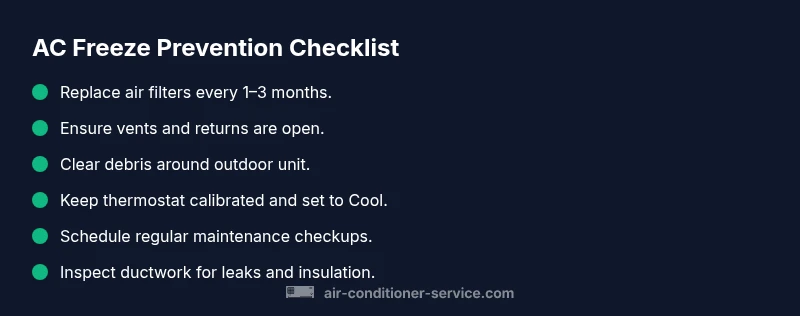
- Schedule seasonal maintenance with a licensed technician to inspect the ductwork, refrigerant charge, and coil cleanliness.
- Replace filters every 1–3 months during peak cooling season or as indicated by the manufacturer.
- Keep outdoor vegetation and debris away from the condenser to ensure adequate airflow.
- Check for proper thermostat calibration and avoid setting the unit to very low temperatures for extended periods.
- Insulate and seal ductwork to minimize unnecessary heat loss and reduce coil icing risk.
Steps
Estimated time: 60-90 minutes
- 1
Power off and safety lockout
Shut off power at the thermostat and main breaker. This prevents shock and compressor damage while you inspect the system.
Tip: Use the breaker if the thermostat isn’t responding. - 2
Inspect and replace the air filter
Remove the filter and inspect for heavy dirt or discoloration. If blocked, replace with the correct size and type.
Tip: Check manufacturer recommendations for filter rating (MERV). - 3
Clear airflow obstructions
Make sure all supply registers and returns are open and free of obstruction by furniture or drapes.
Tip: Move objects at least 6 inches away from vents. - 4
Inspect outdoor condenser
Remove leaves/debris around the condenser and verify the fan spins freely when power is on.
Tip: Do not touch the fan blades while powered. - 5
Thaw the coil safely
If ice is present, allow the system to thaw for 2–4 hours with power off. Do not attempt to chip away the ice.
Tip: Patience is essential; rushing can damage components. - 6
Check evaporator coil accessibility
If reachable and safe, gently brush light dust from the coil with a soft brush; avoid sharp tools.
Tip: Never use sharp metal tools on coils. - 7
Reconnect power and test
Turn the system back on and set to cool. Observe for frost formation and verify airflow is restored.
Tip: If frost reappears, stop testing and call a pro. - 8
Schedule professional assessment
If the issue recurs, a refrigerant problem or a failing component is likely; a technician should inspect and repair.
Tip: Document symptoms and timing for the technician.
Diagnosis: AC not cooling with visible ice on evaporator coil or refrigerant lines
Possible Causes
- highRestricted airflow due to dirty filter or blocked vents
- mediumRefrigerant leak or low refrigerant charge
- lowOutdoor humidity and temperature conditions
Fixes
- easyReplace dirty air filter and clear all vents
- easyCheck outdoor unit for debris and ensure fan operates
- hardIf refrigerant issues suspected, call a licensed tech for leak repair and recharge
Common Questions
What causes an air conditioner to freeze up the most?
The most common cause is restricted airflow from a dirty filter or blocked vents, which allows the coil to drop below freezing. Refrigerant-related issues and outdoor humidity can also contribute. Regular maintenance helps prevent these freezes.
Blocked airflow is the usual culprit; maintain filters and vents to prevent freezing, and check refrigerant if it recurs.
Is a frozen AC dangerous for my unit?
A frozen coil can lead to compressor overheating, reduced cooling, and potential refrigerant leaks if ignored. It’s important to thaw safely and diagnose underlying causes to avoid expensive damage.
Yes, a freeze can harm the compressor and refrigerant system if not handled properly.
Can I fix a freeze by just changing the filter?
Changing the filter often resolves freezes caused by blocked airflow. If the ice persists after thawing and filter replacement, there may be a refrigerant or duct issue requiring professional service.
Replacing the filter is often the first fix, but persistent freezes need a pro.
Should I keep the fan running while thawing?
No. Running the fan while the coil is frozen can mask issues and cause damage when thawing occurs. Let the ice thaw with power off, then test after it’s fully thawed.
Turn off the system; let it thaw first, then test.
How long does it take for a coil to thaw?
A typical thaw takes 2–4 hours, depending on ambient temperature and humidity. Do not rush the process or restart the system during thaw.
Usually a couple of hours, but it depends on conditions.
When should I call a professional?
Call a professional if ice keeps forming after thawing, you suspect a refrigerant leak, or you notice burning smells, strange sounds, or electrical issues.
If icing repeats, or you smell something unusual, get a pro involved.
Watch Video
The Essentials
- Shut off power and thaw before inspection
- Restore airflow by replacing filters
- Keep outdoor unit clear of debris
- Call a professional if ice returns or you suspect a refrigerant leak