Is Air Conditioning the Same as Ventilation? A Clear Look at the Difference
Explore whether air conditioning and ventilation are the same, how they differ, and when to use each. A practical, evidence-based guide for homeowners and renters seeking clarity on cooling, IAQ, and airflow.


Is air conditioning the same as ventilation? Not exactly. Air conditioning cools, dehumidifies, and often filters indoor air, while ventilation exchanges stale indoor air with fresh outdoor air to improve quality. In many homes, both systems work together, but the choice depends on climate, home design, and occupant needs. This article breaks down why they differ and when to use each.
Is Air Conditioning the Same as Ventilation? Clarifying Definitions
According to Air Conditioner Service, many homeowners assume cooling and air exchange are interchangeable terms. In reality, air conditioning (AC) and ventilation serve distinct purposes. Air conditioning is a conditioned, sealed process that controls temperature, humidity, and in many cases air quality via filtration. Ventilation, by contrast, is about moving outdoor air in and indoor air out to dilute indoor pollutants and manage odors. Understanding these definitions is foundational for choosing the right approach in your home. The keyword is central here: is air conditioning the same as ventilation? The short answer is no, they complement rather than replace one another. When you know which function you need, you can tailor a solution that matches climate, occupancy, and energy goals. This distinction helps homeowners avoid undersizing cooling systems or overlooking ventilation needs that affect IAQ. Throughout this guide, you’ll see practical considerations, pricing ranges, and maintenance tips to help you decide which path makes the most sense for your space.
How They Work: Mechanisms, Airflow, and Control
Air conditioning relies on a closed-loop refrigerant cycle, a compressor, and evaporator coils to remove heat from indoor air. In most systems, air is cooled, dehumidified, filtered, and distributed through ducts. Ventilation, meanwhile, introduces fresh outdoor air and exhausts stale indoor air. It can be passive (natural ventilation via windows and vents) or mechanical (assisted by fans or dedicated ventilation systems like HRV/ERV or exhaust fans). The control strategies differ: AC focuses on maintaining a comfortable temperature band, while ventilation emphasizes air exchange rates (measured in ACH) and pollutant dilution. For homeowners, the key decision is not “which one is better,” but “which function is essential now and how can we blend both when appropriate.” The result is that your home’s design, envelope tightness, and occupancy patterns will steer your choice and integration strategy.
Defining Roles: Comfort, IAQ, and Humidity Management
Comfort goes beyond temperature. Humidity levels influence perceived coolness and health. ACs can actively dehumidify, improving comfort during humid seasons, yet they do not guarantee adequate ventilation if the air inside becomes stale. Ventilation improves indoor air quality by reducing concentrations of CO2, volatile organic compounds (VOCs), and odors, but it does not guarantee the level of cooling or humidity control you might require on hot days. Homeowners should map out the goals: what is the priority—temperature, humidity, or IAQ? In real-world homes, the best approach often combines both: a cooling system supported by a ventilation strategy to ensure fresh air and pollutant control without sacrificing comfort. This balance is the core of practical decision-making for most households.
Energy Use and Sizing: What to Expect
Energy consumption differs between cooling and ventilation, and your energy bill will reflect that mix. AC systems, especially in hot climates, can drive up electricity use due to compressor activity and refrigerant cycling. Ventilation systems typically use less energy on a per-gram basis for exchanging air, though fans and ducting introduce ongoing load. When sizing is done correctly, you minimize waste: an oversized AC unit costs more upfront and during operation, and inadequate ventilation may lead to comfort complaints or stale indoor air. The energy impact is not only about instantaneous power draw but also about how well the system keeps humidity in check and how much fresh air can enter without creating excessive conditioning load.
Real-World Scenarios: When to Prioritize Ventilation or AC
In hot, humid regions, air conditioning is essential for comfort, but you still need ventilation to maintain IAQ and prevent a buildup of indoor pollutants. In milder climates, good ventilation might suffice for air quality, with a smaller or absent AC system for cooling. Older homes with leaky envelopes might rely on natural ventilation, while newer, tighter homes benefit from controlled ventilation that provides consistent air changes per hour. Contractors often recommend an integrated strategy: a modest AC capacity paired with a dedicated ventilation solution to ensure air exchange without over-conditioning. This approach helps manage humidity and energy use while supporting occupant health.
Myths About HVAC and Ventilation Debunked
A common misconception is that “more ventilation always means better air.” While improved air exchange reduces pollutant concentration, excessive ventilation can raise energy costs and create temperature swings. Another myth is that a single system can perfectly handle both cooling and air quality; in reality, dedicated components tailored to each function—and their proper integration—deliver better outcomes. By separating the functions, you can optimize maintenance, filtration, and control strategies for each system. The goal is to achieve comfort, IAQ, and energy efficiency through a thoughtful, evidence-based plan.
Maintenance Considerations: Keeping Both Systems Healthy
Maintenance for air conditioning centers on filters, refrigerant levels, and coil cleanliness, along with periodic tune-ups. Ventilation systems require filter replacement, duct cleaning when necessary, and ensuring fans or HRV/ERV units operate correctly. The overlap in maintenance comes from shared air paths and filters: clean filters help both cooling and ventilation work more efficiently. A practical maintenance schedule includes seasonal checks for AC and quarterly or semi-annual checks for ventilation components, with attention to duct sealing and sealant integrity to prevent energy loss.
Decision Framework: A Step-by-Step Path to Choice
If you’re starting from scratch, begin with an energy audit and envelope assessment to determine your home’s air leakage and insulation levels. Determine whether you want mechanical ventilation (to guarantee a minimum air exchange rate) or rely on natural ventilation, supplemented by fans. Then assess climate: hot and humid environments typically require robust cooling plus ventilation, while drier climates may rely more on ventilation to manage IAQ. Finally, consider a blended approach: a modest AC system paired with an efficient ventilation strategy, such as HRV/ERV or strategically placed exhausts and intakes. A qualified contractor can guide you through these steps and help quantify potential energy savings and comfort improvements.
Comparison
| Feature | Air Conditioning | Ventilation |
|---|---|---|
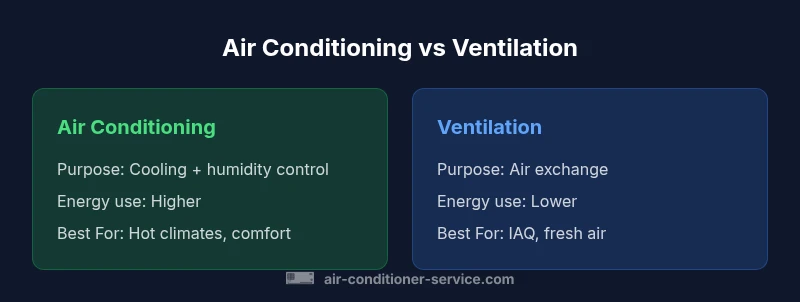
| Purpose | Cooling + humidity control | Air exchange + IAQ improvement |
| Mechanism | Refrigerant-based cooling with ducts | Fans and ducts or natural pathways for air flow |
| Energy Impact | Higher energy use | Lower energy use per exchange; overall depends on system design |
| Air Quality Outcomes | Improved comfort; filtration reduces particulates | Dilutes pollutants; IAQ focus |
| Space & Installation | Needs equipment space and ducting; can be retrofitted | Requires ventilation routes; may be simple in apartments |
| Cost Range | $600-$4500 (basic to mid-range) | $200-$2000 (non-mechanical approaches) |
| Best For | Hot climates seeking consistent cooling | Homes needing reliable humidity control |
Strengths
- Helps homeowners clearly separate cooling and ventilation goals
- Supports energy planning with distinct maintenance needs
- Enables targeted upgrades for IAQ and comfort
- Reduces risk of over-conditioning by matching function to need
The Bad
- May require more upfront planning and coordination
- Can involve higher upfront costs if both systems are installed
- Maintenance complexity increases with two distinct systems
Neither system is universally better; the best choice depends on climate, occupancy, and IAQ goals.
Opt for a blended approach when appropriate: use cooling to handle heat and humidity while deploying ventilation to maintain air quality. A balanced plan often yields the best comfort and energy efficiency.
Common Questions
Is air conditioning the same as ventilation?
No. Air conditioning cools and dehumidifies spaces, often with filtration, while ventilation focuses on exchanging indoor air with outdoor air to improve IAQ. They serve different purposes but can be combined for optimal comfort.
No—AC cools and filters, while ventilation exchanges air to improve air quality. They work best when used together as needed.
Can a single system provide both cooling and ventilation?
Yes. Some HVAC setups integrate cooling with mechanical ventilation or use systems like HRV/ERV to provide continuous air exchange while cooling. In many homes, separate, well-coordinated systems are still used for efficiency.
Yes. Integrated systems or dedicated ventilation with cooling can handle both functions.
What are the signs my home needs more ventilation?
Stuffy air, persistent odors, high humidity, condensation on windows, or headaches can indicate inadequate ventilation. If these signs persist, assess airflow paths and consider mechanical ventilation.
Stuffy air and humidity suggest ventilation needs; a quick airflow check helps decide next steps.
How do energy costs compare between ventilation and cooling?
Ventilation generally uses less energy per hour than cooling, but total costs depend on how much outdoor air is conditioned and the efficiency of both systems. An energy audit helps quantify savings.
Ventilation usually costs less to run than full cooling, but it depends on system design and usage.
Are there health or air quality benefits to ventilation?
Ventilation improves indoor air quality by diluting pollutants and CO2. Proper filtration in conjunction with ventilation can further enhance IAQ. Both systems can support a healthier home when correctly applied.
Ventilation boosts air quality by diluting pollutants; filtration in HVAC helps too.
Do I need permits to install a ventilation system?
Permit requirements vary by location and system type. A licensed contractor can assess local codes and ensure compliance during installation.
Check local codes; a licensed pro can help with permits and installation.
The Essentials
- Define the function: cooling vs air exchange.
- Assess climate and occupancy before selecting a path.
- Consider energy use and IAQ impact in your decision.
- Explore integrated HVAC options with ventilation support.
- Consult a professional for proper sizing and permits.