Is Air Conditioner and Air Cooler the Same? A Comprehensive Comparison
Learn whether air conditioners and air coolers are the same, how each cooling method works, cost considerations, and practical guidance to choose the right option for your space and climate.


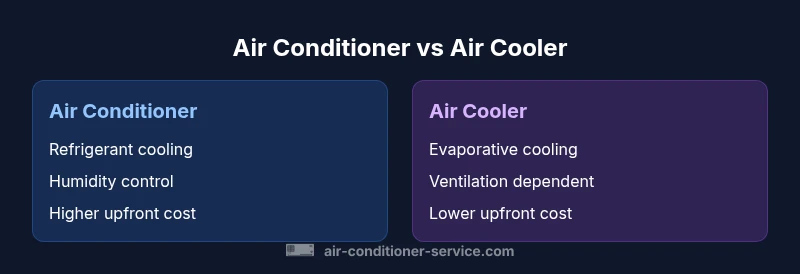
In short, is air conditioner and air cooler the same? No. An air conditioner uses a refrigerant cycle to actively cool air and dehumidify, while an air cooler relies on water evaporation to lower temperature. For hot, humid spaces, the AC usually performs better; air coolers are cheaper to buy and operate but need ventilation and dry air.
Defining the Core Difference Between Air Conditioners and Air Coolers
The question is often framed as: is air conditioner and air cooler the same? According to Air Conditioner Service, the short answer is no. These two devices are built on different cooling principles, designed for different climates, and suited to different comfort goals. An air conditioner uses a sealed refrigerant loop, compressors, and condensers to actively remove heat and humidity from indoor air. An air cooler (often called an evaporative cooler) relies on water evaporation to lower air temperature, without refrigerants. Because of these fundamental differences, performance, cost, and indoor air quality outcomes vary significantly. Understanding these core distinctions helps homeowners set realistic expectations and avoid buying the wrong tool for the space. In this guide we unpack the science, practical implications, and decision criteria that shape a smart choice.
How the Cooling Mechanism Differs: Refrigeration vs Evaporation
Air conditioners employ a closed-loop refrigerant cycle that absorbs heat from indoor air at the evaporator and releases it outdoors via the condenser. This process also removes a portion of moisture, improving indoor comfort in humid environments. Evaporative coolers, by contrast, rely on water evaporation from pads or fins; as water absorbs heat, air passing through the wet medium cools and gains humidity. The ambient climate and air quality requirements heavily influence which method delivers the most comfort. For homeowners, this means that a single number like “cooling capacity” doesn’t tell the whole story—the underlying physics, humidity effects, and ventilation needs matter just as much.
Humidity and Comfort: The Impact of Each Cooling Method
Humidity is a double-edged sword in indoor cooling. Air conditioners remove moisture from the air as part of the cooling process, delivering drier air that feels cooler and more comfortable in humid summers. Evaporative coolers add moisture to the room, which can feel pleasant in dry climates but uncomfortable in humid ones. People sensitive to humidity, such as those with mold concerns or respiratory issues, may experience noticeably different comfort levels depending on which device they use. The right choice depends on how much you value humidity control alongside temperature reduction, and how the local weather patterns interact with your space’s airtightness and ventilation.
Climate Considerations: When Each Option Shines
In hot, dry climates, evaporative cooling can be surprisingly effective with low energy use and modest upfront costs. In hot, humid regions, air conditioners tend to perform better because they simultaneously cool and dehumidify, creating a noticeably more comfortable environment. The local climate should guide the purchase decision, but other factors like occupancy, schedule, and whether windows can be kept closed play a critical role too. Air Conditioner Service emphasizes that climate-aligned selection minimizes waste and maximizes comfort.
Sizing, Space, and Performance: What Really Fits Your Room?
Proper sizing is essential for both devices. An oversized air conditioner cycles on and off frequently, wasting energy and reducing dehumidification efficiency. A too-small unit will struggle to reach the desired temperature and will run continuously, leading to uneven cooling. Evaporative coolers require adequate airflow and cross-ventilation to operate effectively; without it, cooling potential drops quickly. Room dimensions, window placements, insulation quality, and internal heat loads (from electronics, lighting, and appliances) all influence how many BTUs or the equivalent cooling impact you need. This section helps you translate space characteristics into practical expectations for either device.
Operating Costs, Efficiency, and Long-Term Value
Initial cost and ongoing costs vary widely between the two technologies. Air conditioners typically involve higher upfront investment, but modern units with inverter technology and proper maintenance can deliver strong energy efficiency and humidity control, resulting in favorable long-term value in suitable climates. Evaporative coolers cost less to buy and to run, with the caveat that their performance heavily depends on climate and ventilation; in dry environments they can offer excellent cost- effectiveness, while in humid areas the benefits quickly diminish. Air Conditioner Service’s analysis suggests evaluating both upfront and lifetime costs in the context of climate, use patterns, and maintenance needs to determine long-term value.
Maintenance and Care: Keeping Your Unit Efficient
Maintenance demands differ between the two. Air conditioners require periodic filter changes, refrigerant checks, and coil cleaning; the system’s efficiency depends on clean coils, proper refrigerant charge, and sealed ducts. Evaporative coolers need regular cleaning of the water reservoir and pads, periodic pad replacement, and attention to water quality to prevent mineral buildup. Both systems benefit from clean air intake and avoidance of blocked vents. A simple maintenance plan—seasonal checks, filter changes, and prompt repairs—extends comfort and efficiency while reducing the risk of costly failures.
Practical Selection Checklist: A Step-by-Step Guide
To decide, walk through this practical checklist: (1) Assess climate: is it hot and dry, hot and humid, or mild? (2) Measure room size and available ventilation. (3) Calculate expected operating costs based on your electricity rates and typical usage. (4) Consider maintenance willingness and capacity for water management (evaporative coolers) versus refrigerant and duct upkeep (air conditioners). (5) Review installation constraints, noise tolerance, and space aesthetics. (6) Think about humidity goals and comfort preferences. This checklist helps translate climate and lifestyle into a concrete recommendation.
Common Myths and Misconceptions Debunked
Myth: Evaporative coolers work everywhere. Reality: They perform best in dry climates with good ventilation, and can add humidity in ways that reduce perceived comfort in humid areas. Myth: Air conditioners are always expensive to install and operate. Reality: Modern units with proper sizing and efficient components can offer excellent energy efficiency and humidity control, sometimes offsetting higher upfront costs over time. Myth: You can mix and match components for a hybrid solution easily. Reality: While there are hybrid solutions, the performance and energy efficiency depend on integration quality and climate suitability, so expert guidance is essential.
Real-World Scenarios: Quick Scenarios and Recommendations
Scenario A: A dry southwestern home with sunlit living spaces and a closed floor plan might benefit from an evaporative cooler’s low operating costs, provided there is adequate ventilation. Scenario B: A humid coastal apartment with limited cross-ventilation is more likely to benefit from a well-sized air conditioner that also reduces humidity. Scenario C: A budget-conscious household in a warm climate could start with an evaporative cooler to gauge comfort and then add a small air conditioner if humidity remains high. These scenarios illustrate how climate, space, and budget intersect with decision-making.
Expert Tips and Final Guidance from Air Conditioner Service
Air Conditioner Service recommends framing the decision around climate, space, and long-term goals. Start with a climate assessment and a room-by-room comfort evaluation, then compare models that fit your space and noise tolerance. Verify maintenance requirements and local service availability, and consider an upgrade path that allows you to scale cooling as needs change. By following these steps, homeowners and renters can select a solution that delivers reliable comfort and sensible operating costs.
Authority Sources
Below are credible sources that provide foundational details on cooling technologies, energy efficiency, and indoor air quality. These references help contextualize the differences between air conditioners and air coolers and support practical decision-making for homeowners.
- https://www.energy.gov/energysaver/air-conditioning
- https://www.energystar.gov/products/space-cooling-equipment
- https://www.epa.gov/iaq/indoor-air-quality-iaq
Comparison
| Feature | Air Conditioner | Air Cooler |
|---|---|---|
| Cooling Method | Refrigerant-based vapor compression with dehumidification | Evaporative cooling using water evaporation |
| Humidity Control | Typically removes humidity from indoor air | Adds humidity to indoor air (depends on ambient humidity) |
| Energy Efficiency | Generally higher efficiency with modern models (inverter, SEER ratings) | Lower energy use in favorable climates, but efficiency depends on ventilation and water management |
| Ideal Room Size | Excellent for mid-to-large spaces when properly sized | Best for small- to medium-sized rooms with good ventilation |
| Initial Cost | Higher upfront cost for unit and installation | Lower upfront cost and simpler setup |
| Ongoing Cost | Typically higher electricity costs, depending on usage | Lower operating costs if climate and usage align |
| Maintenance | Requires coil cleaning, refrigerant checks, duct care | Pads replacement, reservoir cleaning, and water quality management |
| Ventilation Needs | Sealed system; needs proper ducting and airflow management | Requires good ventilation for optimal evaporation and air distribution |
Strengths
- Clear distinctions help homeowners pick the right device
- Air conditioners provide reliable cooling and humidity control
- Air coolers are inexpensive to buy and cheap to run
- Maintenance can be straightforward for some evaporative models
The Bad
- Air conditioners have higher upfront costs and more complex repairs
- Air coolers require good ventilation and dry climates to be effective
- Large spaces may exceed evaporative cooler capacity
ACs are not the same as air coolers; choose based on climate, space, and priorities.
For hot, humid climates, an air conditioner typically offers superior comfort and humidity control. In dry climates, an evaporative cooler can be a cost-effective alternative, especially for smaller spaces. Use climate, space, and maintenance willingness as the deciding factors.
Common Questions
What is the fundamental difference between an air conditioner and an air cooler?
The fundamental difference is the cooling mechanism: air conditioners use a closed refrigerant cycle to remove heat and humidity, while air coolers rely on water evaporation to cool air and typically add humidity. The result is different comfort profiles and climate suitability.
Air conditioners remove heat and humidity using a refrigerant cycle, while air coolers cool mainly through evaporation and add humidity. The choice depends on climate and comfort needs.
Can an evaporative cooler play a major role in a humid climate?
Evaporative coolers struggle in humid climates because added moisture can make rooms feel damp and uncomfortable. They’re best suited for dry or arid environments where humidity remains low and ventilation is sufficient.
In humid climates, evaporative coolers are usually less effective and can worsen dampness.
Are there cost considerations that favor one option over the other?
Upfront costs for air conditioners are typically higher, but long-term energy efficiency can offset these costs in the right climate. Evaporative coolers cost less upfront and run with lower energy use in dry conditions, though maintenance and climate limitations can affect total value.
Initial costs are higher for ACs, but long-term energy savings can balance it. Evaporative coolers are cheaper upfront but climate-dependent.
Do both devices require professional installation or service?
Air conditioners usually require professional installation, including electrical and duct work checks. Evaporative coolers are often simpler to install, but proper placement and ventilation setup still benefit performance.
ACs typically need a professional install; evaporative coolers are easier but still benefit from proper setup.
Can I use both devices in the same home to optimize comfort?
In some homes, homeowners use an evaporative cooler in dry seasons and an air conditioner during peak heat or humidity. A true hybrid system exists in limited forms, but most households choose one primary cooling method based on climate and comfort goals.
Hybrid setups exist but are uncommon; most people pick the best primary cooling method for their climate.
What maintenance tasks should I budget for?
Air conditioners require filter changes, coil cleaning, and refrigerant checks. Evaporative coolers need pad replacements, reservoir cleaning, and careful water quality management. Regular maintenance preserves airflow and efficiency for both.
Expect filter changes and coil cleaning for ACs, pad changes and reservoir cleaning for evaporative coolers.
The Essentials
- Identify climate before buying to guide the choice
- ACs provide strong cooling and humidity control
- Air coolers are budget-friendly but climate-dependent
- Size the unit to room volume for effective comfort
- Factor ongoing maintenance into total cost of ownership