Is an Air Conditioner the Same as a Fan? A Practical Comparison
A data-driven, practical comparison clarifies when to use an air conditioner vs. a fan, covering cooling mechanisms, humidity, energy use, noise, and cost of ownership for homeowners and renters.


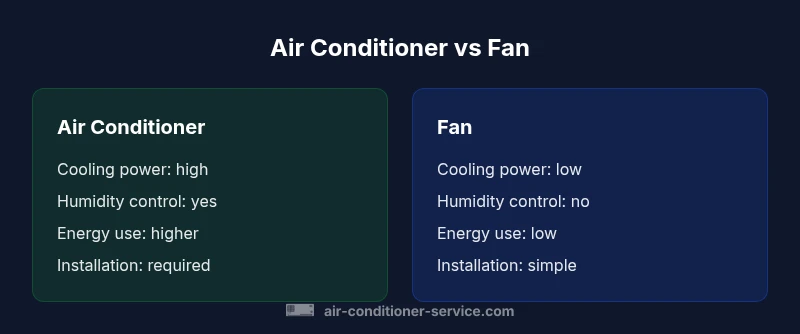
Not exactly. An air conditioner cools by removing heat and humidity, while a fan only circulates air. For reliable cooling and humidity control, choose an air conditioner; use a fan for airflow and budget-friendly comfort in milder conditions. This quick distinction sets the stage for a deeper, evidence-based comparison.
Is an air conditioner the same as a fan? Practical clarification for homeowners and renters. In everyday language, people ask is an air conditioner the same as a fan, and the answer hinges on the core function each device serves. An air conditioner removes heat from indoor air and dehumidifies it, delivering measurable temperature drops and improved comfort in hot conditions. By contrast, a fan merely moves air around, creating a breeze that can make you feel cooler through evaporation and air movement. According to Air Conditioner Service, understanding this distinction is the first step toward making an informed purchase or replacement decision. The practical takeaway is simple: if your goal is consistent indoor cooling and humidity control, an air conditioner is the more capable tool; if you mainly want air movement without cooling, a fan can be sufficient. This section frames the core differences and helps you map them to real-world needs.
How cooling technologies differ: vapor-compression refrigeration versus simple air movement. An air conditioner relies on a closed-loop refrigeration cycle to extract heat from indoor air. This heat is expelled to the outside environment through a condensing unit, and in many models moisture is removed from the air as part of the cooling process. A fan, whether ceiling, tower, or box, does not remove heat or moisture; it speeds up the evaporation of perspiration and improves perceived cooling by circulating air over the skin. The physics is straightforward: cooling requires phase changes and heat transfer, while a fan enhances convective flow. Practically, this means an AC unit can rapidly lower a room’s temperature, whereas a fan can only make you feel cooler in a given moment.
Temperature impact: how much heat is removed. The primary metric property you should care about is the degree to which a device reduces the actual air temperature. An air conditioner can maintain setpoints well below room temperature, even in peak heat, by physically removing thermal energy from the space. A fan cannot achieve this; it can only redistribute existing air. In rooms with poor insulation or high external heat gain, the difference is substantial. Fans may still provide comfort by increasing airflow, but the temperature will remain higher than with cooling equipment. The bottom line: temperature control efficacy is significantly greater with an air conditioner, especially in hot climates.
Humidity management: dehumidification vs. none. Humidity control is a critical advantage of air conditioning. During the cooling process, many ACs also remove moisture from the air, reducing relative humidity and improving comfort in humid environments. A fan does not change humidity; it only moves air. In humid spaces, humidity can linger and contribute to a feeling of stuffiness, even if the air is somewhat cooler due to the fan. For households dealing with dampness, or risk of mold in hot seasons, an air conditioner’s dehumidification feature provides a meaningful benefit that a fan cannot replicate.
Energy use and cost of operation: efficiency and energy context. Energy costs are a central consideration for most households. Air conditioners consume more electricity than fans on a per-hour basis, especially when cooling large spaces or maintaining low setpoints. However, in many climates, the value of rapid and stable cooling can offset higher energy use by improving comfort and productivity, potentially reducing hours of fan operation. Air Conditioner Service analysis shows that total annual energy costs depend on climate, insulation, and usage patterns; in severe heat, the cooling benefits often justify the expense. For light cooling or use during mild weather, a fan can minimize energy costs while delivering acceptable comfort. The choice, therefore, hinges on climate, space size, and tolerance for thermal variability.
Noise levels and comfort implications. Noise is a frequent consideration with both devices. Air conditioners generate compressor noise and fan noise from the indoor unit, which can be noticeable, especially on older models or when running at high cooling levels. Modern units often include sound-dampening features, variable-speed compressors, and better insulation to mitigate noise. Fans tend to be quieter at lower speeds, though ceiling or tower models may become disruptive if run at high speeds, near sleeping areas, or in small rooms with poor ventilation. The practical takeaway is: if you value whisper-quiet operation, research decibel ratings and look for models with low-noise features, regardless of device type.
Installation, space, and placement considerations. Installation and placement requirements create a practical gap between fans and air conditioners. Fans are portable and require minimal installation, making them convenient for renters or spaces with limited electrical capacity. Windows and ductwork are common obstacles for air conditioners, and professional installation might be necessary for central or split systems. For homeowners seeking a fast, non-permanent cooling solution, a high-quality portable or ceiling fan can be deployed quickly, but if you need reliable climate control in a larger room or a whole home, an air conditioner—properly installed—delivers superior performance. The decision should reflect your space layout, energy preference, and long-term planning.
Climate suitability: hot, humid, and variable environments. In severe heat and humidity, air conditioners outperform fans by maintaining cooler temperatures and controlling humidity, which enhances comfort and reduces heat-related stress. In more temperate climates, or in spaces where humidity risk is low, a fan can satisfy daily comfort needs with lower energy use and cost. Budget and environmental considerations matter here: if you must choose one primary device for a region with wide temperature swings, the air conditioner is generally the more robust option, while fans remain excellent supplementary devices for motion and cooling during milder days.
Maintenance and longevity: practical care for both devices. Regular maintenance differs between the two. Air conditioners require periodic filter changes, refrigerant checks, and coil cleaning to maintain performance. In contrast, fans require basic dusting, lubrication for moving parts (in some models), and occasional motor checks. In terms of longevity, a well-maintained AC unit can last 12-15 years or longer, while high-quality fans often last many years with minimal maintenance. For a homeowner balancing upkeep and upfront costs, the maintenance profile matters: fans may be more forgiving for short-term use, while AC units reward long-term, consistent cooling investments.
Choosing guidance: buying criteria in practice. When choosing between an air conditioner and a fan, begin by evaluating space size, insulation, and climate. For a room larger than 200 square feet in a hot climate, an air conditioner is usually the more effective choice. In smaller rooms or where you only need movement, fans may suffice. Consider energy efficiency ratings, space constraints, and noise tolerance. A practical approach is to use fans as a primary cooling option in shoulder seasons or smaller spaces and reserve air conditioning for peak heat or for spaces requiring humidity control. In every case, prudent sizing, proper installation, and a realistic budget are essential to maximizing comfort and minimizing energy waste.
Real-world scenarios and examples. In a sunlit apartment with limited insulation, an air conditioner delivers consistent cooling and humidity reduction that a fan cannot match. In a shared studio or dorm room, a robust ceiling fan paired with a small portable AC can balance comfort and energy costs. In a partially shaded den, where outside temperatures drop in the evening, a fan alone may be adequate for comfort, while supplemental air conditioning during heat waves ensures safety and health. Real-world practice shows that hybrid approaches—combining high-performance fans with selective cooling—often provide the best balance of comfort and energy usage. This section emphasizes tailoring device choice to your climate, space, and budget.
Comparison
| Feature | Air Conditioner | Fan |
|---|---|---|
| Cooling mechanism | Vapor-compression refrigeration that removes heat and moisture | Air movement only; no cooling or dehumidification |
| Temperature impact | Lowers room temperature to a setpoint | Does not lower temperature; improves comfort via airflow |
| Humidity control | Removes moisture from the air in many models | No humidity control; humidity typically unchanged |
| Energy use | Higher energy consumption, but effective cooling | Lower energy use; best for mild cooling or ventilation |
| Noise levels | Can be louder, especially on high cooling settings | Typically quieter at low speeds; some models noisier at high speeds |
| Installation/placement | Requires installation; fixed or semi-fixed configurations | Portable or ceiling-mounted options; simple placement |
| Cost of ownership | Higher upfront and ongoing maintenance costs | Low upfront cost; minimal maintenance |
| Best for | Hot, humid climates needing reliable cooling and humidity control | Small spaces, milder climates, or budget-conscious cooling |
Strengths
- Reliable, consistent cooling and humidity control with an air conditioner
- Lower upfront cost and energy use for fans in mild conditions
- Fans provide flexible placement and quick, portable comfort while reducing energy use
The Bad
- Higher upfront costs and maintenance for air conditioners
- Fans offer limited cooling and no meaningful humidity control
- Air conditioners require installation, venting, and periodic service
Air conditioners win for reliable cooling and humidity control; fans are best for supplementary airflow and budget-friendly comfort.
Choose an air conditioner when you need consistent cooling and humidity management, especially in hot or humid spaces. A fan is ideal for supplementary cooling, portability, and lower upfront costs in mild environments.
Common Questions
What is the main difference between an air conditioner and a fan?
The main difference is function: an air conditioner cools and dehumidifies the air, while a fan circulates air without removing heat or humidity. This affects temperature control, humidity, and comfort.
The air conditioner cools and dries the air, while a fan only moves air for comfort.
Can a fan replace an air conditioner in hot climates?
In very hot climates, a fan cannot reliably replace an air conditioner because it won’t lower the room temperature or reduce humidity. It can help with air movement but won’t provide full cooling during peak heat.
Fans alone don’t cool like ACs, especially in heat.
Do fans really cool a room or just circulate air?
Fans primarily circulate air to create a wind chill effect. They can make you feel cooler, but they don’t remove heat or reduce humidity like an AC. Proper placement and ceiling height can maximize effectiveness.
Fans don’t cool; they move air for comfort.
How does humidity affect comfort with AC versus a fan?
Humidity reduction is a key advantage of many air conditioners, improving comfort and reducing stuffiness. A fan does not affect humidity; in very humid spaces, you may still feel uncomfortable even with a fan running.
Humidity control matters for comfort; ACs handle it better.
What are the long-term costs of running each device?
Air conditioners generally cost more to operate and maintain over time due to refrigerant, filters, and higher electricity use. Fans cost less to run and maintain but offer less cooling and humidity control overall.
ACs cost more to run, but offer full cooling; fans cost less but provide limited cooling.
The Essentials
- Choose cooling that matches climate and space needs
- Air conditioners remove heat and humidity; fans do not
- Fans are portable and cheaper to run in mild conditions
- Air conditioners require installation and maintenance
- Consider hybrid approaches for balanced comfort and cost