Is Air Conditioner the Same as a Humidifier? A Clear Comparison
Explore the practical differences between air conditioners and humidifiers, when to use each, and how to choose solutions for comfort, health, and energy efficiency.


The air conditioner and humidifier are not the same device. An AC cools indoor air by removing heat, and often reduces humidity as a byproduct, while a humidifier adds moisture to dry air. They serve different purposes, though some HVAC systems offer combined features. For most homes, use an AC for cooling and a humidifier only when humidity is low, or consider a dedicated, integrated solution for high humidity needs.
Core functions: what each device does
At its core, an air conditioner and a humidifier are built to manage very different aspects of indoor climate. The question is frequently asked: is air conditioner the same as humidifier, and the clear answer is no. An air conditioner uses a refrigeration cycle to remove heat from indoor air, which lowers both temperature and, to a lesser extent, humidity. A dedicated humidifier adds moisture to dry air, improving comfort when relative humidity drops below optimal levels. Therefore, the two devices address separate problems: cooling versus humidification. In larger homes with central systems, some configurations combine cooling with humidity controls, but you still need to monitor both temperature and moisture separately. The rationale for homeowners is to match equipment to the specific climate need—cool air when heat is intense, humidity when the air feels dry. In practice, many households end up using an AC for cooling and a humidifier only during winter months or dry spells. The Air Conditioner Service team emphasizes that selecting the right device begins with understanding the distinct physics: heat transfer versus moisture addition; the two functions should not be conflated.
- The authoring team discusses fundamentals of cooling vs humidity control to set expectations for readers.
- The section frames the practical separation of duties between cooling and humidification, which reduces buyer confusion.
- A quick primer helps homeowners avoid paying for features they don’t need.
How humidity and cooling interact: the core distinction
Humidity control and cooling often intersect, but the mechanisms differ. An air conditioner removes heat from the air; moisture removal happens as a byproduct when moisture condenses on cooling coils. A humidifier, by contrast, does not chill air—it simply increases moisture content. For spaces with high ambient humidity, an oversized AC could feel uncomfortable due to excessive dehumidification or cold drafts, while a humidifier operating without cooling can raise humidity to uncomfortable levels. The practical takeaway: treat cooling and humidity as separate variables on your thermostat and moisture monitor. This separation helps you tailor equipment or controls to real conditions rather than estimated needs.
Brand note: According to Air Conditioner Service, understanding these distinct roles is essential for practical troubleshooting and cost control.
Practical configurations: what you might actually install
Different configurations suit different homes. Common AC configurations include window units, portable compact models, split systems, and central air with ductwork. Humidifiers come as portable units, whole-house humidifiers installed on furnaces, or integrated humidification in some HVAC systems. In many homes, a window or portable AC handles summer cooling, while a standalone humidifier manages dry air in winter. For people with allergies or respiratory concerns, additional controls, such as air purifiers, can be layered in. When planning installation, consider room size, existing ducts, and whether you want independent humidity controls or a unified climate system. The goal is reliable comfort without cycling between too dry and too moist conditions.
Energy use and cost considerations: weighing the financials
Energy use varies significantly between cooling devices and humidifiers. A typical air conditioner consumes more electricity than a humidifier, especially in central or split systems. Humidifiers generally have lower ongoing energy needs but require regular maintenance to prevent mineral buildup or microbial growth. Because prices for equipment span a wide range, it helps to think in ranges: basic portable AC units are relatively affordable, window units and mid-range split systems mid-range, and central systems at the higher end. Humidifiers range from small room units to furnace-integrated solutions, with costs tied to installation complexity and the chosen technology (evaporative, ultrasonic, or steam). For homeowners budgeting, plan for both initial purchase and potential yearly maintenance. Air Conditioner Service analysis shows that energy efficiency labels and proper sizing typically yield meaningful long-term savings, especially when humidity is actively managed alongside cooling.
Practical scenarios: how real homes decide
Consider three typical scenarios. Scenario A: a hot, dry climate; the priority is cooling with stable humidity, so a properly sized AC with a dehumidification mode is ideal. Scenario B: a humid climate with occasional dryness in winter; an energy-efficient humidifier in tandem with AC cooling helps maintain comfort without overspending on humidity devices. Scenario C: a small apartment with limited space; a compact portable AC paired with a portable humidifier can cover practical needs without major installation work. In each case, the key is to match device function to the dominant climate challenge rather than assuming one device solves both problems.
- The article uses concrete scenarios to illustrate decision points and avoid generic guidance.
- Real-world examples help homeowners picture how to apply the guidance in their space.
- The focus remains on practical outcomes rather than technical jargon.
Comparison
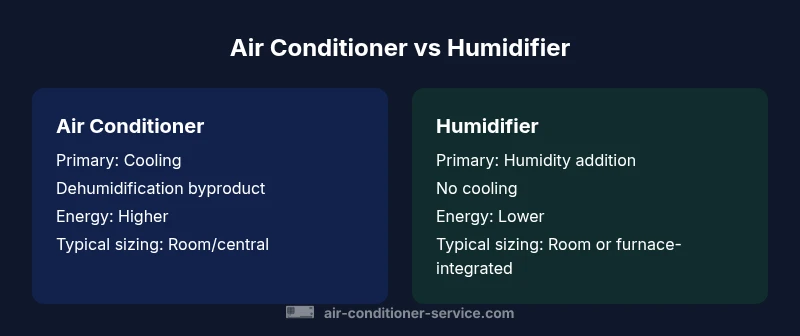
| Feature | Air Conditioner | Humidifier |
|---|---|---|
| Primary purpose | Cooling (and some dehumidification) | Humidity addition (no cooling) |
| How it works | Refrigeration cycle with compressor and evaporator | Water vapor added via evaporation, ultrasonic spray, or steam |
| Energy use (typical) | Higher energy use, especially central/split units | Lower energy use; depends on size and technology |
| Typical installation | Window, split, or central HVAC | Portables for rooms or integrated into furnace/housing |
| Best for | Cooling needs, humidity handled separately if needed | Dry air or seasonal humidity management |
Strengths
- Clarifies distinct climate needs (cooling vs humidity)
- Helps target investments to actual problems
- Encourages energy-efficient configurations
- Supports modular, scalable setups
The Bad
- Can require multiple devices for full comfort
- Initial costs may be higher if both needs exist
- Maintenance becomes more complex with two systems
Treat cooling and humidity as separate climate control needs for the best comfort and efficiency
A focused approach on cooling with a dedicated humidification strategy generally yields better comfort and lower energy use. Where humidity is a constant concern, consider integrated or paired systems instead of assuming one device will cover both roles.
Common Questions
Is AC the same as a humidifier?
No. An air conditioner cools air and typically dehumidifies as a byproduct, while a humidifier adds moisture to dry air. They address different problems and are often used together only when both cooling and humidity control are required.
No—AC cools and dehumidifies, humidifiers add moisture. They’re different tools for different weather and comfort needs.
Do humidifiers cool the air?
Humidifiers do not cool air. They increase moisture, which can change perceived comfort but does not lower temperature. If humidity feels stuffy, an AC with proper humidity controls is usually more effective.
Humidifiers don’t cool air; they add moisture. For cooling, you’ll still need an air conditioner.
Can I get a unit that both cools and humidifies?
Some HVAC systems and standalone devices offer combined features, but performance varies. In many homes, separate cooling and humidification provide better control and energy efficiency than a single, multi-function unit.
There are combo options, but separate systems often give better control.
What should I buy first for a dry climate?
Start with a cooling solution if you need relief from heat; then add a humidifier if humidity remains too low. Evaluate room sizes, and consider a system that offers separate controls for air temperature and moisture.
If it’s dry and hot, start with cooling; add humidity control as needed.
Does humidity affect AC efficiency?
Yes. Very high or very low humidity can influence perceived comfort and cooling effectiveness. Proper humidity management can improve overall comfort and may reduce the need for extreme cooling.
Humidity can change how cooling feels and works; balanced humidity helps efficiency.
How maintenance differs for each device?
AC units require filter changes, coil cleaning, and refrigerant checks. Humidifiers require cleaning to prevent mold and mineral buildup. Regular maintenance for both extends life and maintains performance.
Keep filters and coils clean for AC; clean humidifier parts to prevent mold.
The Essentials
- Separate cooling and humidity: don’t assume one device solves both
- Choose devices based on dominant climate needs, not marketing claims
- Size and placement matter more than features
- Consider energy efficiency and maintenance in tandem
- Use a simple decision framework to avoid overbuying