Difference Between Air Conditioner and Dehumidifier
Discover the difference between air conditioners and dehumidifiers, how each works, when to use them, and practical tips for choosing, sizing, and operating them efficiently.


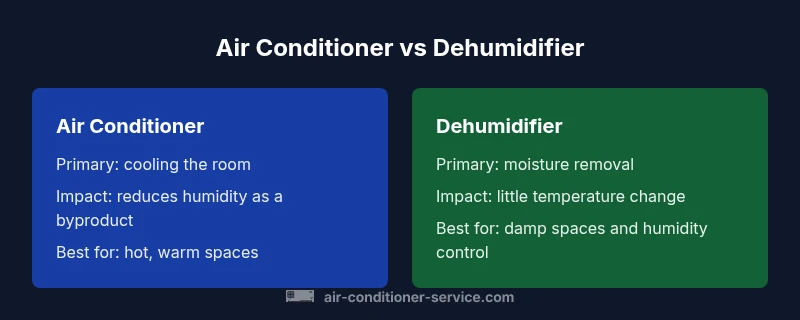
Air conditioners actively cool air, while dehumidifiers primarily remove moisture. The difference between air conditioner and dehumidifier is that cooling is not the main function of a dehumidifier. For hot rooms, use AC for comfort; for damp spaces, use a dehumidifier to reduce humidity without heavy cooling. This quick guide clarifies when to pick which device.
Key Concept: What Sets AC and Dehumidifier Apart
According to Air Conditioner Service, the difference between air conditioner and dehumidifier rests in purpose, operation, and expected outcomes. An air conditioner is designed to cool the indoor air by removing heat, which also causes some moisture to condense on the coil and drip away. A dehumidifier, in contrast, targets water vapor and lowers humidity without significantly changing room temperature. By focusing on different end goals—temperature reduction versus moisture control—these devices serve distinct roles in home comfort. Understanding this foundational split helps homeowners select the right tool for each scenario and avoid misapplied equipment. Consider the climate, room occupancy, and existing insulation when deciding which device to deploy for comfort and health.
How an Air Conditioner Cools the Air
Air conditioners achieve cooling through a closed refrigerant loop that absorbs heat from indoor air and rejects it outside via the outdoor unit. The indoor coil becomes cold, pulling heat from the room as air passes over it. Condensation occurs when the air’s moisture meets the cold surface, which helps reduce humidity indirectly, but this is a secondary effect. The thermostat regulates when cooling kicks in, and the fan speed influences how quickly the space reaches the target temperature. Modern units add features such as variable-speed compressors, smart thermostats, and energy-saving modes that can improve efficiency, especially when paired with proper insulation. While an AC does remove some moisture, its core value is lowering temperature, not achieving precise humidity control in every scenario.
How a Dehumidifier Removes Moisture from the Room
A dehumidifier uses a refrigeration coil (or desiccant in some models) to condense water vapor from the air. Warm, humid air is drawn into the unit, passes over a cold surface, and releases moisture into a collection tank or drainage line. The remaining air is drier and often slightly cooler, though dehumidification alone is not designed to produce cold air. Dehumidifiers are particularly effective in basements, bathrooms, laundry rooms, or spaces with recurring dampness or musty odors. For home comfort, run times depend on humidity targets and room size; combining with an AC can offer both lower humidity and comfortable temperatures when needed.
Humidity Control vs Temperature Control: When to Prioritize Each
If humidity is the primary problem—condensation on walls, mold growth, musty smells—a dehumidifier is typically the best choice because it directly lowers moisture without forcing a temperature drop. In hot climates where comfort hinges on lower air temperature, an air conditioner provides rapid cooling. In many homes, a mixed strategy works best: use the AC to create a comfortable baseline, and deploy a dehumidifier in high-humidity zones or during seasons when cooling is unnecessary but humidity remains high. This approach aligns with practical guidance from the Air Conditioner Service team.
Energy Use and Operating Costs: What to Expect
Energy considerations depend on how you use the devices. An air conditioner generally consumes more electricity when actively cooling large spaces, particularly during peak heat, while a dehumidifier’s energy use scales with moisture removal needs. In practice, lower humidity can make a room feel cooler, potentially allowing a higher thermostat setting on the AC and reducing overall energy use. However, relying solely on dehumidification for a large living area can lead to longer run times and higher energy consumption. The best plan weighs comfort targets against electricity costs and expected usage patterns.
Sizing, Siting, and Airflow Considerations
Sizing matters for both devices. An undersized air conditioner will struggle to reach the desired temperature and may fail to lower humidity as expected, while an undersized dehumidifier may not achieve target moisture reductions in a large or poorly ventilated space. Proper placement is essential: keep vents and the return air path clear, avoid blocking airflow with furniture, and ensure proper drainage. For whole-home solutions, consider a professional assessment to determine appropriate capacity, ducting needs, and humidity targets that minimize hot spots or damp zones across rooms.
Maintenance and Common Issues to Watch For
Regular maintenance keeps both devices running efficiently. Clean or replace filters according to the manufacturer’s schedule, inspect condensate drains for clogs, and check coils for frost or corrosion. A dirty filter can increase energy use and reduce cooling or dehumidification effectiveness. In damp spaces, a dehumidifier may accumulate more condensate and require more frequent drainage or tank emptying. By addressing leaks, mold-prone surfaces, and airflow blockages, you protect indoor air quality and extend device life.
Health, Comfort, and Indoor Air Quality Impacts
Humidity affects comfort and health as much as temperature does. Too much humidity promotes mold, mildew, and allergens, while overly dry air can irritate skin and mucous membranes. An air conditioner helps control both temperature and humidity to some extent but may overshoot dryness if set aggressively. A dehumidifier offers focused humidity management with minimal temperature change, supporting stable IAQ, reduced condensation, and fewer moisture-related issues. To optimize results, monitor indoor humidity with a hygrometer and adjust target levels within a comfortable range.
Real-World Scenarios: Humidity, Climate, and Building Type
Coastal regions with hot summers often rely on the air conditioner as the primary comfort tool, with dehumidification helping to reduce persistent dampness. Dry interior climates still require cooling, but humidity control can be added during damp seasons or in spaces prone to condensation. Basements and crawlspaces benefit from dehumidification to prevent structural moisture damage. The decision framework should account for space usage, occupancy, and ventilation patterns, recognizing that the best solution may involve deploying both devices in tandem across different zones.
Practical Buying Guide and Operational Tips
When deciding between an air conditioner and a dehumidifier, begin with the primary objective: cooling versus humidity control. Evaluate energy efficiency features, such as SEER ratings for ACs and humidity-sensing controls for dehumidifiers. Size units to the room or zone, and consider noise levels, drainage options, and filter accessibility. Plan for maintenance routine, including monthly filter checks and annual coil cleaning where applicable. If you opt for a whole-home dehumidifier, ensure proper integration with your HVAC system to balance humidity and temperature effectively.
Integrating Climate Control: Using Both for Peak Comfort
In mixed climates, coordinating cooling and humidity management delivers the most comfort. Run the air conditioner during peak heat to establish a comfortable baseline, and deploy a dehumidifier to reduce moisture in humid rooms or during rainy periods. Some models offer integrated modes that coordinate dehumidification with cooling, which can simplify control and improve energy efficiency. For households with allergies or moisture-sensitive materials, a joint approach often yields better IAQ while avoiding excessive dryness or cooling. Always verify drainage and humidity targets to avoid over-drying and wasted energy.
Quick Reference Checklist for Choosing Between the Two
- Define your climate and humidity profile: decide whether cooling, humidity control, or both are top priorities.
- Size the unit to the room, considering insulation and airflow. Larger rooms may need multiple zones or whole-home solutions.
- Look for humidity controls on dehumidifiers and programmable thermostats on AC units; smart controls help optimize energy use.
- Plan for drainage: built-in condensate drain, pump, or reservoir management; ensure easy maintenance access.
- Consider a combined approach for year-round comfort, especially in spaces with variable humidity and temperature.
Comparison
| Feature | Air conditioner | Dehumidifier |
|---|---|---|
| Primary purpose | Cooling the air to reduce temperature | Moisture removal to reduce humidity |
| Humidity impact | Drives humidity reduction as a byproduct of cooling | Targets humidity with condensation control |
| Temperature effect | Significant drop in room temperature | Minimal temperature change (usually) |
| Typical usage | Cooling hot rooms and warm spaces | Humid spaces like basements or damp rooms |
| Energy use (qualitative) | Generally higher energy use when cooling | Moderate to high depending on humidity targets |
| Installation/portability | Can be fixed or portable; central systems require ducting | Usually portable or compact; some whole-home variants exist |
| Maintenance | Filter, coils, refrigerant checks; professional service often needed | Filter, condensate drain, and drainage management |
| Best for | Cooling and comfort in hot climates | Humidity control and moisture-related issues in damp spaces |
Strengths
- AC provides cooling and some dehumidification in one system
- Dehumidifier offers focused humidity control with lower upfront cost
- Portable versions enable flexible use across rooms
- Separate devices allow optimizing energy use by task
The Bad
- ACs typically have higher upfront and running costs
- Dehumidifiers do not significantly cool hot rooms on their own
- Regular maintenance is required to prevent odors and mold
- Over-drying can occur if humidity is not monitored
Air conditioners are best for cooling, while dehumidifiers excel at humidity control; combine when needed for optimal comfort.
The cooling needs and humidity control requirements drive the choice. In many homes, using both devices yields the most consistent comfort and IAQ.
Common Questions
What is the main difference between an air conditioner and a dehumidifier?
The main difference is purpose: an air conditioner cools the air, while a dehumidifier reduces humidity. Both affect comfort, but their primary goals are distinct, guiding when to choose each device.
Air conditioners cool, dehumidifiers remove moisture; choose based on whether temperature or humidity is the bigger issue.
Can a dehumidifier replace an air conditioner?
A dehumidifier cannot reliably replace an air conditioner for cooling large spaces. It will reduce humidity but not significantly lower room temperature. Use a dehumidifier for moisture control and an AC when cooling is needed.
No. Dehumidifiers reduce humidity, not room temperature. Use them for moisture control and pair with cooling if temps rise.
Do dehumidifiers help cool a room?
Dehumidifiers can make a room feel cooler by reducing moisture, but they do not actively cool air the way an air conditioner does. The perceived cooling effect comes from drier air rather than a lower temperature.
They make the air feel a bit cooler by drying it, but they don’t actively cool like an AC.
Which is more energy-efficient for humidity control?
For humidity control alone, a dedicated dehumidifier tends to be more energy-efficient than running an oversized air conditioner just to reduce humidity. Pairing devices can optimize overall energy use, especially in humid spaces.
A dehumidifier is usually more energy-efficient for humidity control; combine with cooling as needed.
When should I use both devices?
Use both when you live in a hot, humid climate and want consistent comfort. Run the AC for cooling and humidity reduction, and add a dehumidifier in damp zones or seasons with high humidity but moderate heat.
In hot and humid conditions, use both: AC for cooling, dehumidifier for humidity.
How do I choose the right size for each device?
Choose size based on room area, insulation, and humidity levels. For AC, consider BTU capacity relative to room size; for dehumidifiers, select output capacity in pints per day aligned with space moisture levels. When in doubt, consult a professional.
Pick a unit sized to your room and humidity needs, and don’t oversize.
The Essentials
- Prioritize cooling with an AC for hot temps.
- Use a dehumidifier to control moisture in damp spaces.
- Combine devices for year-round comfort in mixed climates.
- Choose correctly sized units to avoid inefficiency.
- Look for energy-saving features and humidity controls.
- Regular maintenance sustains performance and IAQ.