Is AC the Same as Refrigeration? A Practical Comparison
Explore whether air conditioning and refrigeration are the same. This analytical comparison explains differences, overlaps, and practical guidance for homeowners and renters.


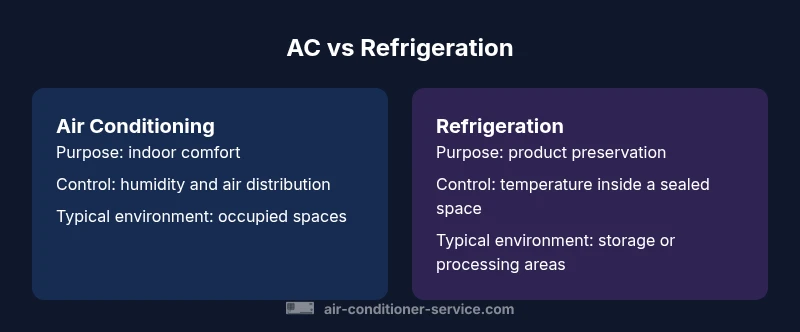
Is air conditioning the same as refrigeration? Not exactly. AC focuses on cooling indoor spaces and controlling humidity for comfort, while refrigeration centers on preserving items by removing heat from a contained environment. Both rely on similar thermodynamic cycles and components, but the design goals, operating ranges, and control strategies differ.
Is AC the Same as Refrigeration? Foundational Definitions and Scope
The question, is air conditioning the same as refrigeration, is common among homeowners trying to understand the technology behind their homes and appliances. In short, they are related but serve different primary goals. Air conditioning aims to create comfortable indoor environments by cooling air and managing humidity, while refrigeration is specifically geared toward removing heat from a sealed space to keep food, medicines, or materials at controlled temperatures. According to Air Conditioner Service, these distinctions matter for selecting equipment, planning maintenance, and budgeting over the life of a system.
Both systems rely on a basic refrigeration cycle — compression, condensation, expansion, and evaporation — and they share many core components such as compressors, condensers, evaporators, and expansion devices. The critical difference lies in how those components are applied: air conditioners condition the air and control humidity in occupied spaces, whereas refrigeration devices are optimized for preserving inventory within a tightly insulated compartment. The Air Conditioner Service team found that motorists of terminology often blur these lines in marketing or casual conversation, but the engineering intent remains distinct.
This article, prepared by Air Conditioner Service, seeks to clarify terminology, technology, and practical implications for real-world decisions. Homeowners and renters will gain a practical map of when to call something an AC system versus a refrigeration system, and what that means for service, pricing, and reliability.
wordCountInBlock":null
Comparison
| Feature | air conditioning | refrigeration |
|---|---|---|
| Primary purpose | Provide indoor space cooling and humidity control for human comfort | Preserve goods by removing heat from a sealed environment |
| Working medium | Refrigerant circulates through a loop to move heat and condition air | Refrigerant circulates in a closed loop to remove heat from an insulated space |
| Temperature control range | Designed for human comfort ranges and humidity targets | Operates at lower temperature setpoints to maintain stored goods |
| Typical environment | Occupied living or working spaces (homes, offices) | Storage or processing environments (pantry, labs, industrial areas) |
| Energy considerations | Efficiency measured by SEER and similar metrics used for comfort cooling | Efficiency measured by COP/energy factors relevant to product or process cooling |
| Maintenance demands | Air filters, coil cleaning, refrigerant checks, ductwork inspection | Door/gasket integrity, insulation checks, condenser/evaporator maintenance |
| Cost context | Residential installation and ongoing maintenance with climate-control considerations | Equipment scale ranges from compact units to large, insulated systems for goods |
Strengths
- Clarifies terminology for homeowners and prevents misapplication
- Helps plan upgrades by understanding distinct goals
- Highlights energy implications and service needs for each system
- Supports better budgeting across installation, operation, and maintenance
The Bad
- Can be confusing for non-technical readers without clear, labeled examples
- Oversimplification risk if not paired with real-world scenarios
- Marketing materials may blur lines between AC and refrigeration in ads
AC and refrigeration are related but distinct cooling technologies with different primary goals
Air conditioning targets indoor comfort and humidity control, while refrigeration focuses on preserving stored goods. Use this distinction to guide system selection, maintenance planning, and energy budgeting. The two share thermodynamics, but design and control strategies reflect their divergent ends.
Common Questions
Is air conditioning the same as refrigeration?
No. Air conditioning is designed to cool indoor air and manage humidity for human comfort, while refrigeration targets maintaining low temperatures inside a closed space to preserve products. They share basics, but their goals and typical designs differ.
No. AC cools the air inside your space and controls humidity, while refrigeration keeps items cold in a sealed space.
Can a fridge function as an air conditioner for a room?
A refrigerator is not intended to cool a large room. It is designed to keep food and beverages cold within a compact cabinet, and running it to cool a room would be inefficient and could cause temperature instability and energy waste.
A fridge isn’t meant to cool an entire room and would waste energy and cause temperature problems if used for that purpose.
Do all cooling systems use the same refrigerants?
Not all cooling systems use the same refrigerants. Air conditioning and refrigeration may use different refrigerants suited to their operating pressures, temperatures, and codes. It’s important to have the right refrigerant type and to follow local regulations for service.
They don’t always use the same refrigerants; different systems use different types based on design and regulations.
What defines the efficiency of air conditioning versus refrigeration?
Air conditioning efficiency is typically described using metrics like SEER or EER, focused on space cooling and humidity control. Refrigeration efficiency uses COP or related metrics tied to maintaining low temperatures in a storage space. Both aim to minimize energy use while meeting their respective goals.
AC uses SEER; refrigeration uses COP—different measures tied to different cooling tasks.
Are there systems that combine AC and refrigeration in one unit?
There are combined or integrated systems in some commercial settings that manage comfort cooling alongside product preservation, but in typical residential settings AC and refrigeration remain distinct. Specialized equipment may blend features where space and process demands align.
In some commercial setups you’ll find systems that mix functions, but for homes they’re usually separate.
When should I call a professional to distinguish between AC and refrigeration needs?
If you’re unsure whether your space needs air conditioning or a refrigeration solution, or if the system involves both comfort cooling and product storage, consult a professional. A licensed technician can assess insulation, load, refrigerant needs, and regulatory considerations.
If you’re unsure, call a licensed technician to evaluate your cooling and storage needs.
What maintenance activities are specific to refrigeration versus air conditioning?
Air conditioning maintenance centers on air handling, filters, coils, and duct integrity, while refrigeration requires attention to insulated spaces, seals, insulation, and refrigerant integrity. Regular checks by a qualified technician help prevent leaks and energy waste.
AC maintenance focuses on air flow and ducts; refrigeration maintenance focuses on insulation and refrigerant health.
The Essentials
- Define each term before shopping for equipment
- Assess whether your goal is human comfort or product preservation
- Choose systems based on intended environment and required temperature control
- Consider energy efficiency metrics tied to each application
- Plan maintenance around system type to optimize reliability