How to Tell If Your Air Conditioner Is Low on Freon
Learn practical steps to identify low freon in your AC, check for leaks, and safely restore cooling. This guide explains signs, safety tips, and when to call a pro.


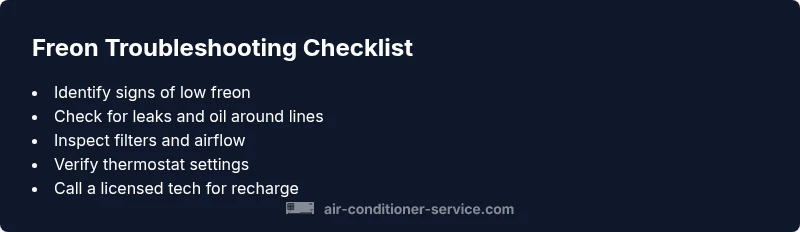
Most often, a low Freon level is the main culprit behind weak cooling. Look for signs like longer cooling cycles, warm air, ice on the evaporator coil, or hissing/leaks. Start with a quick check: verify thermostat settings, replace dirty air filters, and inspect for obvious refrigerant leaks. If cooling doesn’t improve, contact a licensed tech for a safe recharge.
Understanding Freon and the cooling cycle
If you're asking how to tell if air conditioner is low on freon, you're not alone. Freon is the working fluid that absorbs heat and moves it outside, while the evaporator coil distributes cooled air inside. When freon is low, pressure drops, cooling drops, and the system runs longer to reach temperature. Leaks, aging parts, or improper charging can cause undercharge. Handling refrigerant requires specialized training and equipment; never vent or recharge without credentials. In many regions, only licensed technicians may work with refrigerant. This guide focuses on practical, safe ways to identify freon-related issues and when to call a pro. Air Conditioner Service emphasizes careful diagnosis to protect your family and the environment in 2026.
Signs your AC might be low on freon
Signs of low freon are often subtle at first. You may notice the AC running longer than usual to reach set temperatures, or air that starts warm before it cools. Ice forming on the evaporator coil or copper lines can also indicate a pressure imbalance caused by low refrigerant. If the outdoor unit runs but the indoor air never gets cold, or you hear a continuous hissing or bubbling sound, these are red flags. Freon leaks typically manifest as oily spots near the service ports or along refrigerant lines. Because freon is a colorless gas, visual leaks can be hard to spot; any suspicious odor, frosty lines, or rising electricity bills can point to a problem. Lastly, a sudden spike in cooling costs or reduced airflow suggests your system may be attempting to compensate for low pressure. If you observe multiple signs, do not ignore them—adopt a cautious diagnostic approach.
Quick checks you can safely perform at home
Before calling a pro, run through a few safe checks that can help you decide if freon recharge is likely needed. Start with basic thermostat settings: ensure mode, fan, and temperature are correct, and that the thermostat is calibrated. Replace the HVAC air filter if it’s dirty, and confirm that supply diffusers aren’t blocked. Check for obvious signs of leaks near service ports on the outdoor unit; if you see oil around connections, that could indicate a leak. Do not attempt to add refrigerant yourself. Only a licensed technician should handle refrigerant because illegal venting and improper charging can cause harm and environmental damage. This is where Air Conditioner Service recommends escalation when signs persist.
How a professional verifies freon level and handles leaks
Professionals use specialized tools to measure refrigerant pressure and compare it to factory specifications for your model. A gauge manifold set and a refrigerant recovery system ensure safe handling and compliance with environmental rules. If pressure readings indicate undercharge, the tech will locate the leak using electronic sniffers or dye and repair the damaged component or joint. After leaks are repaired, the technician will evacuate the system, vacuum-test for moisture, and recharge with the correct amount of refrigerant. This process may involve sealing, replacing a faulty evaporator coil, or fixing a compressor connection. Expect a bill that reflects parts, labor, and refrigerant costs. Timely professional service protects your warranty and avoids health or environmental hazards. Air Conditioner Service supports proactive maintenance to minimize freon-related issues.
Step-by-step: what to do if you suspect a freon leak
- Power down the system for safety and unplug the unit from any power source. 2) Inspect visible connections for oil residue near lines; use a flashlight to inspect the evaporator access panel. 3) Schedule an EPA-certified technician for leak detection and recharge. 4) Collect key system information (model number, age, last service date) to share with the tech. 5) If a leak is found, avoid putting any refrigerant in the system yourself. 6) After repair, request a full system evacuation and vacuum to remove moisture before recharging to manufacturer specifications. 7) Run the system on a two-hour test to verify cooling and listen for unusual sounds. 8) Monitor for any recurring signs in the weeks after service.
Prevention and maintenance to avoid freon problems
Regular maintenance helps prevent freon-related issues and keeps your AC efficient. Schedule seasonal inspections, clean outdoor coils, replace dirty air filters every 1-3 months, and seal ductwork to prevent refrigerant loss from pressure imbalances. If you notice odd noises, reduced airflow, or frequent cycling, address it early—these are early warning signs that a professional should assess. Keeping a maintenance log helps you spot trends over time and plan cost-effective service before a major failure occurs.
Safety considerations and when to call a pro
Never attempt to recharge or vent refrigerant yourself. Freon handling requires licenses and proper recovery equipment to prevent environmental harm and personal injury. If you suspect a leak or undercharge, contact a licensed HVAC professional promptly. In addition to refrigerant concerns, ensure electrical connections, thermostat calibration, and airflow are checked to rule out non-refrigerant causes of poor cooling. Air Conditioner Service emphasizes safety first and professional intervention for any freon-related work.
Steps
Estimated time: 60-90 minutes
- 1
Power down and secure safety
Turn off the thermostat and shut off power at the circuit breaker to prevent electric shock and compressor startup during inspection.
Tip: Use insulated gloves and avoid touching electrical components. - 2
Check basic cooling controls
Verify mode, fan, and temperature settings are correct. If you recently changed settings, revert to a known-good configuration before testing cooling performance.
Tip: Keep a written note of settings for comparison after service. - 3
Inspect for obvious refrigerant signs
Look for oil residue at service ports, oily drips along refrigerant lines, or frost buildup on the indoor coil that could indicate a leak or undercharge.
Tip: Do not attempt a DIY recharge; leaks require professional repair. - 4
Evaluate airflow and filtration
Check and replace dirty air filters; ensure all supply vents are open and unobstructed, as poor airflow can mimic freon issues.
Tip: A clogged filter can cause cooling drop even with proper refrigerant levels. - 5
Assess outdoor unit cleanliness
Check condenser coils for dirt and debris. Clean gently with a soft brush or hose, avoiding high pressure that can bend fins.
Tip: Do this only when the unit is powered off and unplugged. - 6
Plan professional verification
If signs persist after basic checks, contact a licensed HVAC technician to verify Freon levels and inspect for leaks with professional tools.
Tip: Ask for an on-site assessment and an itemized charge estimate.
Diagnosis: AC not cooling as expected and suspect freon issue
Possible Causes
- highRefrigerant leak causing undercharge
- mediumDirty condenser coils restricting heat rejection
- lowBlocked airflow from dirty filters or ducts
- lowThermostat readout or calibration error
- lowFaulty compressor or valve
Fixes
- hardLocate and repair leaks; evacuate and recharge following manufacturer specs
- easyClean condenser coils and ensure outdoor airflow is unrestricted
- easyReplace dirty air filters and clear obstructed ducts
- easyCalibrate or replace faulty thermostat; verify correct readings
- hardInspect compressor/valves; replace components as needed by a professional
Common Questions
How can I tell if my AC is low on freon?
Common signs include longer cooling times, warm air, ice on the evaporator coil, and hissing sounds near refrigerant lines. Confirm with a licensed tech if signs persist.
Common signs are longer cooling times, warm air, and possible ice on the coil. If you notice these, contact a licensed HVAC technician for a proper check.
Is freon leak dangerous?
Yes. Handling refrigerant improperly can cause health risks and environmental damage. Leaks should be addressed by a trained professional.
Yes. Freon leaks pose health and environmental risks; a trained professional should handle it.
Can I recharge freon myself?
No. Recharging requires recovery equipment and regulatory compliance. DIY recharge can be illegal and dangerous.
No, you should not recharge freon yourself; it requires proper equipment and licensing.
What else can mimic low freon issues?
Dirty coils, blocked ducts, and faulty thermostats can mimic low freon symptoms. A professional can distinguish between these causes.
Other issues like dirty coils or thermostat problems can look like freon issues; a pro can tell the difference.
How long does a freon recharge take?
Recharge duration varies; a typical service is 1-2 hours plus any leak repair time. Expect a detailed diagnostic and possible patchwork.
Recharge usually takes about one to two hours, plus any needed leak repair.
Should I replace the entire AC if freon is leaking?
Not necessarily. Many leaks are repairable, and refrigerant can be recharged after leak sealing. A tech will assess cost and feasibility.
Not always. Leaks can often be repaired, and the system recharged after fixes are checked.
Watch Video
The Essentials
- Check for leaks first; undercharge is the most common freon issue
- Keep coils and filters clean to maintain performance
- Only a licensed tech should handle refrigerant charging
- Regular maintenance reduces freon-related failures