Air Conditioner Unit Will Not Turn On: Troubleshooting Guide
Step-by-step troubleshooting for an air conditioner unit that won't turn on. Learn common causes, safe DIY checks, and when to contact a professional today.


The most likely cause is a simple control or electrical issue, such as a tripped breaker, a faulty thermostat, or a loose wiring connection. Start by checking power at the outlet and the thermostat settings, then move to breakers and fuses. If the unit still won't start, contact Air Conditioner Service for a professional assessment.
Common reasons your air conditioner unit will not turn on
If your AC isn't starting, the issue is most often practical rather than mechanical. According to Air Conditioner Service, the vast majority of startup failures stem from electrical or control problems such as a tripped breaker, a blown fuse, a dead thermostat, or loose wiring. Other possibilities include a shut-off switch inside the air handler, a frozen outdoor unit, or a safety switch tripped by moisture or debris. By starting with the simplest explanations, you can save time and avoid unnecessary disassembly. This section walks you through the most common culprits and how to verify them safely.
Quick checks you can perform safely
Before touching any component, power off at the breaker and wear insulated gloves if available. Check that the outdoor unit isn’t obstructed and that the indoor air handler access panel is securely fastened. Confirm the thermostat is set to cool and that the temperature is lower than the current room temperature. If your system uses a smart thermostat, ensure it’s responsive and not in an eco mode or timer delay. These simple checks often resolve the issue without tools.
Electrical basics: power, breakers, and fuses
Electrical issues are the leading cause of a non-start. Begin by confirming the main service panel has power, then look for a tripped breaker labeled for the HVAC system. Reset the breaker by fully switching it off, then back on. If you find a blown fuse, replace it with one of the same rating. After any reset, wait a minute and try turning the AC on again. If the unit still won't start, there may be a more complex fault that requires a professional inspection. Air Conditioner Service emphasizes not bypassing safety components and always following electrical codes.
Thermostat and control settings that block startup
A misconfigured thermostat is a common reason for a no-start. Make sure the thermostat is in cooling mode, set below room temperature, and not in the 'hold' or emergency heat setting. If you have a programmable thermostat, check recent schedules that might delay startup. For smart thermostats, ensure the app shows the system as online and that there are no error codes on the display. Incorrect time settings or a disabled compressor output can also prevent startup.
The role of the air filter and safety switch
A clogged air filter doesn't directly stop startup, but it can cause overheating or safety switches to trip, preventing startup. Check the filter and replace if dirty. Next, locate and reset any air handler safety switch, often a red button or a recessed switch near the blower compartment. Ensure the condensate overflow switch is not engaged, as a full pan or blocked drain can trigger shutdown to protect the system.
Indoor and outdoor unit wiring: what to inspect
Carefully inspect visible wiring connections at the air handler and outdoor condensing unit for looseness, corrosion, or burn marks. Look for disconnected plugs, loose terminal screws, or damaged insulation. Do not touch exposed conductors with the system energized. If wiring shows wear or damage, or you notice buzzing from the outdoor unit, stop and call a professional to avoid electric shock or refrigerant hazards.
When to call a professional vs DIY
If you hear buzzing from the outdoor unit, see burnt insulation, notice refrigerant odors, or suspect a faulty capacitor or contactor, DIY is not recommended. Some components require specialized tools and knowledge to test safely, and refrigerant handling is regulated. A certified technician from Air Conditioner Service can diagnose electrical faults, capacitors, contactors, and refrigerant leaks, and verify code compliance.
Preventive maintenance to avoid future startups
Commit to a preventive maintenance schedule to reduce startup problems. Replace air filters regularly, clean coils, and inspect wiring during routine service. Calibrate the thermostat, verify drainage and condensate lines are clear, and ensure proper airflow through the evaporator and condenser. A proactive approach minimizes emergency calls and extends system life.
Quick-start print-friendly checklist
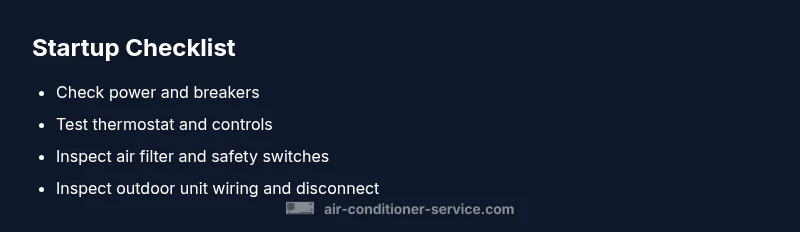
Keep this checklist handy for rapid troubleshooting:
- Power: verify at the main panel and outlet, reset any tripped breaker.
- Thermostat: confirm cooling mode and target temperature.
- Safety: inspect indoor safety switch and condensate overflow switch.
- Filters: replace dirty air filters.
- Outdoor unit: check for obstruction and inspect disconnects.
- Wiring: look for loose or damaged wires, only with power off.
Steps
Estimated time: Estimated total time: 60-90 minutes
- 1
Power cycle and verify main power
Turn off power at the main breaker, wait 60 seconds, and switch back on. Confirm the outdoor unit and indoor blower have power by testing a simple device to ensure the circuit is live. A full reset can clear transient faults that blocked startup.
Tip: If a breaker trips again, do not continue; this signals an underlying fault. - 2
Check thermostat and basic controls
Set the thermostat to cool mode and a temperature well below the room’s current temp. If you have a programmable or smart thermostat, disable any delay or eco modes that prevent immediate startup and verify display shows normal status.
Tip: Restart the thermostat by removing and reinserting batteries if applicable. - 3
Inspect indoor safety switches and airflow paths
Locate the safety switch on or near the air handler and ensure it’s reset. Also check that the air filter is clean and airflow passages to the evaporator are clear; poor airflow can cause protective shutdowns.
Tip: Don’t run the unit with a clogged filter for extended periods. - 4
Examine outdoor unit wiring and disconnects
Visually inspect the outdoor unit’s wiring for loose connections or signs of damage. Ensure the disconnect switch is in the ON position and the contactor opens and closes smoothly when power is applied.
Tip: Only inspect outdoors if the power is off at the main panel. - 5
Test the capacitor and contactor (advanced)
Use a multimeter to test the capacitor and contactor in the outdoor unit if you’re trained and equipped. Replace faulty parts per manufacturer specs. This step often resolves startup issues caused by aging components.
Tip: Capacitors hold a dangerous charge even when power is off. - 6
Inspect refrigerant lines and signs of leaks
Look for oily residue around connections, which can indicate a refrigerant leak. Do not attempt refrigerant repair yourself; this requires licensed personnel and proper safety procedures.
Tip: Handling refrigerant without certification is illegal in many areas. - 7
Reassemble components and test run
Secure all access panels, reinstall filters, and power the system. Attempt a test run and observe the thermostat, outdoor unit, and indoor blower for normal cycling.
Tip: Note any abnormal noises or smells during startup. - 8
Document symptoms and previous fixes
Record what you checked and what worked or didn’t. This helps a technician diagnose recurring issues and speeds up service if you call for help.
Tip: Bring this log to your appointment for efficiency. - 9
Know when to call for professional help
If you still can’t get the unit to start, or you hear buzzing, observe burnt odors, or notice refrigerant concerns, contact Air Conditioner Service for a professional diagnostic and repair.
Tip: Professional diagnosis prevents safety risks and potential warranty issues.
Diagnosis: Air conditioner unit will not turn on
Possible Causes
- highPower issue (tripped breaker or blown fuse)
- highThermostat or control wiring fault
- mediumSafety switch or float switch triggered
- lowCapacitor, relay, or contactor failure
- lowOutdoor wiring or disconnect issue
Fixes
- easyReset circuit breakers and check fuses; if the problem recurs, call a pro
- easyTest and recalibrate the thermostat; replace batteries or program settings if needed
- easyInspect safety switches and condensate overflow; reset if tripped
- mediumTest capacitors and relays in the outdoor unit using proper tools; replace if faulty
- easyInspect outdoor disconnects and wiring for damage or looseness; secure connections
Common Questions
Why won't my AC turn on even though the thermostat shows power?
Thermostat power can be lost due to a tripped breaker, a dead battery, or a malfunctioning control board. Start by confirming the thermostat is powered, then check breakers and replace batteries if needed. If the thermostat still won’t respond, you may have an electrical or control fault requiring diagnosis.
If the thermostat isn’t responsive, check the breaker and battery; if it still won’t respond, you may have an electrical or control fault that needs a professional.
Can a dirty filter prevent my AC from starting?
A dirty filter can trigger safety switches or reduce airflow, which might prevent startup or cause the system to shut down to protect itself. Replace the filter and restart the unit to see if it starts normally.
A clogged filter can cause shutdowns due to restricted airflow; replace it and restart the system.
Is it safe to reset the outdoor unit’s capacitor?
Capacitors store energy and can retain dangerous charges; handling them should be done only by trained technicians with proper tools and safety procedures.
Capacitors can hold charge, so don’t attempt to replace or test them yourself unless you’re trained.
What are common early signs of a faulty thermostat?
Frequent display errors, unresponsive controls, or mismatched readings are common thermostat symptoms. Replacing batteries or reconfiguring settings can help, but persistent issues require a professional assessment.
If your thermostat acts erratic, try replacing batteries and reconfiguring settings; if it keeps acting up, a professional check is best.
When should I consider refrigerant issues?
Refrigerant leaks don’t always cause startup failure, but they can prevent cooling and may accompany startup issues. A licensed technician should diagnose leaks and handle any repairs.
Leaks are a job for professionals; don’t attempt to repair refrigerant yourself.
How long does a professional diagnostic usually take?
Most residential diagnostics take 60-120 minutes, depending on the system and issues found. The technician will test electrical components, control boards, and refrigerant paths to identify root causes.
Expect about an hour or two for a full diagnostic, depending on complexity.
Watch Video
The Essentials
- Power cycle and reset breakers first
- Check thermostat and basic controls before opening panels
- Call a pro for electrical, refrigerant, or compressor faults
- Regular maintenance reduces startup failures