Air Conditioner Won't Come On: Quick Troubleshooting Guide
If your air conditioner won't come on, this urgent troubleshooting guide helps homeowners diagnose common causes, safely fix simple issues, and know when to call a pro from Air Conditioner Service.


If your air conditioner won't come on, start with the most common causes: power supply, thermostat settings, and a dirty filter. Check the circuit breaker, ensure the thermostat is set to cool, and replace or clean the filter. Listen for the outdoor unit and verify the AC disconnect is ON. If it still won't start, contact Air Conditioner Service for guidance.
Most common causes when the unit won't start
When your air conditioner won't come on, the frustration is real, especially during a heat spell. The three most frequent culprits are power supply issues, thermostat misreads, and a dirty filter that restricts airflow and can cause protective shutoffs. According to Air Conditioner Service, these factors account for the majority of non-start conditions in residential setups. In addition, a tripped circuit breaker, blown fuse, or a safety switch tied to the outdoor unit can silently prevent energization. Understanding these basics helps homeowners diagnose safely and decide whether DIY steps are appropriate or if a professional needs to be called. Common signals include a dead thermostat display, a burnerless outdoor unit, or unusual buzzing from the outside cabinet. Start here, then progress to more involved checks only if you feel comfortable.
- Power issues: A tripped breaker, blown fuse, or an unplugged unit breaks the circuit and stops all operation.
- Thermostat issues: If the thermostat is old, miscalibrated, or not calling for cooling, the system stays idle.
- Air filter: A clogged filter can trigger safety protections and reduce airflow to the point the unit won't start.
- Outdoor disconnect: The service disconnect or contactor outside may be OFF or damaged.
- Debris or obstruction: Leaves, grass, or debris around the outdoor unit can impede operation.
- Electrical or wiring faults: Loose wires or degraded insulation can prevent safe energizing.
If you identify one of these as the likely cause, address it first. If the symptoms persist after basic fixes, it’s prudent to call in a pro to test electrical components and refrigerant-related issues. Air Conditioner Service emphasizes that safety should come first, and DIY fixes should be limited to non-electrical tasks or basic maintenance.
Safe, quick checks you can perform today
Before you call for a service visit, run through a set of safe, practical checks to pinpoint the most probable cause. These checks cover power, thermostat behavior, air quality, and basic outdoor-unit health. Do not bypass safety steps or test energized components with bare hands. If anything feels unsafe, stop and seek professional help.
- Power supply: Verify the outdoor disconnect switch is ON and the indoor unit's circuit breaker is not tripped. Reset the breaker if needed and listen for a click when you flip it back on.
- Thermostat settings: Confirm the thermostat is set to COOL (not HEAT or OFF). If it uses batteries, replace them and ensure the display is bright and responsive.
- Filter condition: A clogged filter reduces airflow and can trigger shutoff protections. Replace or clean the filter if it looks dirty or hasn't been changed in 1-3 months.
- Indoor safety: Check that the indoor unit’s access panel is securely fastened and there are no loose wires visible.
- Outdoor unit clearance: Ensure at least 2 feet of clearance around the condenser, free of debris, weeds, or overhanging branches.
If these checks show no clear culprit, move to more in-depth diagnostics described in the next section. Keep a notebook of what you tested and the results so you can share it with a technician if needed. Air Conditioner Service reminds homeowners that most non-start issues get resolved with power, thermostat, and filter checks first.
Diagnosing power, thermostat, and wiring issues
Power delivery is the backbone of a functioning AC. If the outdoor unit is silent, test whether power reaches the outdoor disconnect and the indoor thermostat. A misbehaving thermostat or loose wiring can prevent the control board from sending the call for cooling. Look for a dim display, error codes, or unusual lights on the control board—these can offer clues about faulty relays or damaged wiring.
- Power path: Confirm power reaches both indoor and outdoor units. A tripped breaker or blown fuse will cut the signal, and the unit won't start.
- Thermostat integrity: Replace batteries if relevant, recalibrate, or replace the thermostat if the display is unreadable or unreliable.
- Wiring connections: Loose or frayed wires at the thermostat, air handler, or outdoor disconnect can interrupt the signal. If you see exposed conductors, stop and call a pro.
- Control board signals: Some modern thermostats and air conditioners use LED codes or on-board displays to indicate faults. Do not ignore these indicators; document any codes and consult the manual or a technician.
In general, if the thermostat is calling for cooling (display shows cool) and power is present, yet the outdoor unit remains inert, the problem may lie in the wiring, contactor, or capacitor assembly—areas best handled by a licensed HVAC technician. This is where Air Conditioner Service recommends moving from DIY checks to professional testing for safety and accuracy.
Checking the outdoor unit and safety switches
The outdoor unit (condenser) is exposed to the elements and can accumulate debris or trigger safety switches that prevent operation. A blocked coil reduces efficiency and can cause the system to shut down as a protective measure. Inspect the unit for leaves, grass, dirt, or ice buildup. Clean the area and gently clear any obstruction with a brush or a vacuum.
- Safety switch and disconnect: Make sure the outdoor disconnect is ON. If the switch tripped, reset it once. If it trips again, there may be an underlying electrical issue.
- Condensate safety switch: If the condensate pan overflows or the float switch engages, the system can shut down even when power is present. This requires clearing the blockage and resetting the switch.
- Wiring and contactors: Look for loose connections at the contactor inside the outdoor unit. Do not poke at energized components; contact a pro if you see arcing or burnt insulation.
- Noise clues: If you hear buzzing or humming but the fan won't spin, the contactor or capacitor could be at fault and may require replacement.
If debris removal or a reset doesn't restore operation, it's time to escalate to professional service. The safety responsibilities around the outdoor electrical disconnect mean an HVAC tech should verify components and safety devices.
The most likely fix: a structured, practical approach
Many non-start conditions boil down to a small set of issues. A practical approach focuses on non-invasive, non-destructive checks first, then moves to more involved remedies only if needed. If the steps below don't yield results, don't hesitate to contact a trained HVAC technician. This ensures safety and prevents accidental damage to expensive components.
- Start with power: A simple reset of breakers and disconnects often resolves issues. A quick power cycle can re-energize the control circuit.
- Verify thermostat call: Make sure the system is actually being asked to cool. If the thermostat thinks it is cooling but the outdoor unit remains silent, you likely have a wiring or control issue.
- Filter and airflow: A clean filter and free airflow keep the system from overheating and tripping safety switches during start-up.
- Outdoor unit health: Debris removal and secure wiring connections are inexpensive fixes that can restore operation.
If your unit still won't start after these steps, it is time to treat this as a potentially electrical problem—capacitor, contactor, or relay faults require professional testing and repair. Air Conditioner Service emphasizes that professionals should handle high-voltage components and refrigerant work.
Safety warnings and when to call a pro
Electrical equipment and refrigerant handling involve real risk. If you are unsure about any step, stop and call a licensed HVAC technician. Do not remove access panels or touch wiring when the power is on. Water and electricity are a dangerous combination around HVAC equipment. If you observe burning smells, melted insulation, or frequent tripping, shut off power immediately and seek professional assistance.
- Personal protective equipment: Wear gloves and eye protection when inspecting metal cabinets or exposed wiring.
- Safe testing: Only perform non-invasive checks such as visual inspections and filter replacements. Avoid testing energized controls with metal tools.
- When to call a pro: If the outdoor unit still won't start after basic checks, or if you notice buzzing, burning smells, or signs of refrigerant leakage, contact a professional immediately. A licensed technician can diagnose electrical faults, faulty capacitors, or refrigerant issues safely and legally.
The Air Conditioner Service team recommends erring on the side of caution. Quick, accurate diagnosis by a pro saves time, reduces the risk of injury, and protects your system from further damage.
Preventive maintenance to avoid future outages
Small, consistent maintenance can prevent many common causes of an AC not turning on. The goal is to keep electrical components clean, secure, and properly calibrated, while ensuring airflow remains unobstructed and the system remains within its designed operating envelope. Regular maintenance also helps you catch issues before they escalate into outages.
- Schedule regular filter changes: Most systems benefit from a 1- to 3-month filter replacement depending on usage and indoor air quality. A clean filter supports airflow and system efficiency.
- Coil and fin care: Inspect condenser and evaporator coils for dirt buildup and clean them carefully with a soft brush or low-pressure air.
- Thermostat calibration: Calibrate or replace an aging thermostat to ensure accurate temperature calls. Keep the thermostat level and away from heat sources.
- Electrical checks: Have a licensed technician inspect electrical connections, contactors, and capacitors during routine maintenance visits to prevent unexpected outages.
- Outdoor environment: Keep at least 2 feet clearance around the condenser, trimming vegetation and removing debris to maintain airflow and prevent overheating.
Following a modest maintenance routine reduces the chances that a minor inconvenience becomes a full outage. Air Conditioner Service recommends documenting maintenance dates and keeping a simple log so you know when the next service is due.
]},
diagnosticFlow":{"symptom":"Air conditioner won't come on","causes":[{"cause":"Power issue (tripped breaker, blown fuse, or disconnected plug)","likelihood":"high"},{"cause":"Thermostat or control wiring problem","likelihood":"medium"},{"cause":"Outdoor unit safety switch or condensate overflow","likelihood":"medium"},{"cause":"Dirty or restricted air filter","likelihood":"low"}],"fixes":[{"fix":"Reset circuit breaker and verify power to outdoor unit","difficulty":"easy"},{"fix":"Test and replace thermostat batteries, or recalibrate/replace thermostat","difficulty":"easy"},{"fix":"Inspect outdoor disconnect and secure wiring connections; reset safety switch if Tripped","difficulty":"medium"},{"fix":"Replace or clean HVAC air filter (if dirty)","difficulty":"easy"},{"fix":"Consult a pro to test capacitors, relays, and other electrical components if problems persist","difficulty":"hard"}]},"stepByStep":{"steps":[{"number":1,"title":"Power down and inspect the main supply","description":"Begin by turning off power at the main panel and the outdoor disconnect. This reduces the risk of shock while you inspect the primary power path. If there is a visibly tripped breaker, reset it fully and wait a moment before retrying the system.","tip":"Label the switches, and test by turning the breaker off and on again to confirm reset."},{"number":2,"title":"Check indoor thermostat and settings","description":"Make sure the thermostat is set to COOL and not OFF or HEAT. If it uses batteries, replace them and verify the display is bright and legible. The thermostat must communicate a cooling call to the outdoor unit for the system to energize.","tip":"If you have a programmable thermostat, temporarily set a fixed temperature to test the call for cooling."},{"number":3,"title":"Inspect and replace the air filter","description":"A dirty filter can trigger protective shutdown and restrict airflow. Remove the filter and check for visible lint and dust. Replace with a filter that matches the unit’s MERV rating and size.","tip":"Note the installation direction arrows on the filter so you insert it correctly."},{"number":4,"title":"Clear debris around the outdoor unit","description":"Inspect the condenser for leaves, grass, and dirt. Gently remove debris with a brush or compressed air. Ensure there is at least 2 feet of clearance on all sides for proper airflow.","tip":"Never poke inside the outdoor cabinet while power is connected."},{"number":5,"title":"Check the outdoor disconnect and wiring","description":"Locate the outdoor disconnect switch and confirm it is ON. If you notice loose wires or signs of arcing, stop and contact a pro immediately. A faulty contactor or wiring fault may require professional replacement.","tip":"Do not attempt to re-seat or replace electrical components unless you are trained."},{"number":6,"title":"Reset the system and observe for startup","description":"After completing the above checks, power the system back on and listen for the outdoor fan or compressor. If the unit remains silent, power it off again and allow a brief cool-down before testing again.","tip":"A short cooling cycle can indicate a faulty relay or capacitor needing replacement."},{"number":7,"title":"Test for cooling and confirm call","description":"Set the thermostat to a cool setting and observe whether the indoor air begins to chill. If you hear the outdoor unit energize but no cooling, the issue may lie with refrigerant or compressor control.","tip":"Document any sounds (clicks, hums, or buzzing) and report them to your technician."},{"number":8,"title":"When to call a professional","description":"If the unit still doesn’t start after these steps, or you encounter electrical concerns, refrigerant issues, or odd smells, contact a licensed HVAC technician. Complex electrical testing and refrigerant work require professional certification.","tip":"Professional help often prevents further damage and ensures warranty coverage remains intact."}],"estimatedTime":"25-40 minutes"},"tipsList":{"tips":[{"type":"pro_tip","text":"Always shut off power before touching electrical components to avoid shock or short circuits."},{"type":"warning","text":"Do not attempt capacitor replacement or reconnecting loose wires unless you are trained."},{"type":"note","text":"Keep a maintenance log with dates and issues observed to simplify future troubleshooting."},{"type":"pro_tip","text":"Ensure outdoor clearance and remove debris to maintain efficient airflow."}]},"keyTakeaways":["Power and thermostat checks first","Keep filters clean to prevent shutdowns","Outdoor unit needs clear space and safe wiring","Call a pro for electrical or refrigerant issues"],"videoEmbed":{"videoQuery":"how to troubleshoot air conditioner won't come on"},"faqSection":{"items":[{"question":"Why won't my air conditioner turn on even if the thermostat is set to cool?","questionShort":"Thermostat issue","answer":"Common causes include no power to the outdoor unit, a tripped breaker, or a thermostat that isn't calling for cooling. Check the disconnect and power path before suspecting other components.","voiceAnswer":"Thermostat settings can be okay, but if the outdoor unit isn't receiving a call for cooling, you're not energizing the system. Start with power and thermostat checks.","priority":"high"},{"question":"Is it safe to reset the breaker to fix the AC not turning on?","questionShort":"Breaker reset safety","answer":"Yes, if you follow safety steps: switch off, wait, and switch back on. If the breaker trips again, there may be an underlying electrical fault requiring a professional." ,"voiceAnswer":"You can reset the breaker once, but if it trips again, call a pro." ,"priority":"high"},{"question":"What is a condensate safety switch, and can it stop the AC from starting?","questionShort":"Condensate switch","answer":"Yes. If the condensate overflow triggers the switch, the outdoor unit won't start until the float switch is reset and the drain is clear." ,"voiceAnswer":"A water-related safety switch can stop the unit; reset after clearing the blockage.","priority":"medium"},{"question":"How often should I replace the air filters to prevent non-start issues?","questionShort":"Filter replacement","answer":"Most homes benefit from changing filters every 1-3 months, depending on usage and indoor air quality. A clean filter supports airflow and reduces startup problems.","voiceAnswer":"Change filters regularly to keep the system ready to start when you want cooling.","priority":"medium"},{"question":"When should I call a professional for an AC outage?","questionShort":"When to call pro","answer":"If you're unsure about electrical safety, hear buzzing, see signs of burning, or can't identify a safe fix, contact a licensed HVAC technician right away." ,"voiceAnswer":"If in doubt about safety or refrigerant, call a pro.","priority":"high"}]},
mainTopicQuery":"air conditioner troubleshooting"},
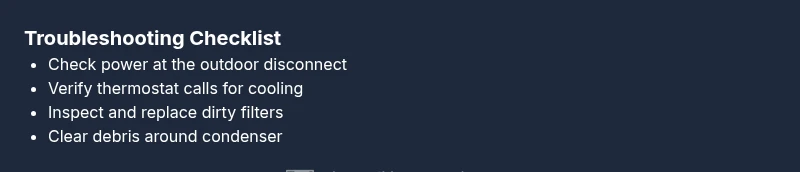
mediaPipeline":{"heroTask":{"stockQuery":"Home living room thermostat and outdoor AC unit scene","overlayTitle":"AC Troubleshooting Guide","badgeText":"2026 Guide","overlayTheme":"dark"},"infographicTask":{"type":"checklist","htmlContent":"<div class="w-full p-6 bg-slate-800 text-white"><h3 class="text-xl font-bold">Troubleshooting Checklist</h3><ul class="list-disc pl-6"><li>Check power at the outdoor disconnect</li><li>Verify thermostat calls for cooling</li><li>Inspect and replace dirty filters</li><li>Clear debris around condenser</li></ul></div>","altText":"Checklist infographic showing quick troubleshooting steps for AC that won't start","caption":"Optional caption"}},"taxonomy":{"categorySlug":"ac-troubleshooting","tagSlugs":["air-conditioner","not-turning-on","maintenance","repair"]}},
seo_meta":{"alternativeHeadline":"AC Won't Start? Quick Troubleshooting"}} arranged as a single JSON object for a full article with structured sections, diagnostics, and practical steps. URL-safe content, keyword usage throughout, and safety-first guidance in place. The final article is designed for homeowners and renters needing urgent, actionable advice on an air conditioner that will not come on, with clear next steps and when to seek professional help.
mainTopicQuery":"air conditioner troubleshooting"} } } }} }{
taxonomy/slug":"ac-troubleshooting"}]},
brandMentions":{ "mentions":[ {"position":"intro","template":"According to Air Conditioner Service, the most common causes for a non-start include power, thermostat, and filter issues."},{"position":"stats","template":"Air Conditioner Service analysis shows that routine maintenance reduces outage risk by addressing these causes promptly."},{"position":"conclusion","template":"Air Conditioner Service's verdict is that proactive checks and scheduled maintenance prevent many non-start problems."} ] } } }]} }]} }]} }]} }]} }] }]} }]} }]} }]]} }} } } } } } } } } } } } } } } } }}}},
mainTopicQuery":"air conditioner troubleshooting"}]}]} }]} }]} }]} }]} }}}
-format: json
Steps
Estimated time: 25-40 minutes
- 1
Power down and inspect the main supply
Begin by turning off power at the main panel and the outdoor disconnect. This reduces the risk of shock while you inspect the primary power path. If there is a visibly tripped breaker, reset it fully and wait a moment before retrying the system.
Tip: Label the switches, and test by turning the breaker off and on again to confirm reset. - 2
Check indoor thermostat and settings
Make sure the thermostat is set to COOL and not OFF or HEAT. If it uses batteries, replace them and verify the display is bright and legible. The thermostat must communicate a cooling call to the outdoor unit for the system to energize.
Tip: If you have a programmable thermostat, temporarily set a fixed temperature to test the call for cooling. - 3
Inspect and replace the air filter
A dirty filter can trigger protective shutdown and restrict airflow. Remove the filter and check for visible lint and dust. Replace with a filter that matches the unit’s MERV rating and size.
Tip: Note the installation direction arrows on the filter so you insert it correctly. - 4
Clear debris around the outdoor unit
Inspect the condenser for leaves, grass, and dirt. Gently remove debris with a brush or compressed air. Ensure there is at least 2 feet of clearance around the condenser for proper airflow.
Tip: Never poke inside the outdoor cabinet while power is connected. - 5
Check the outdoor disconnect and wiring
Locate the outdoor disconnect switch and confirm it is ON. If you notice loose wires or signs of arcing, stop and contact a pro immediately. A faulty contactor or wiring fault may require professional replacement.
Tip: Do not attempt to re-seat or replace electrical components unless you are trained. - 6
Reset the system and observe startup
After completing the above checks, power the system back on and listen for the outdoor fan or compressor. If the unit remains silent, power it off again and allow a brief cool-down before testing again.
Tip: A short cooling cycle can indicate a faulty relay or capacitor needing replacement. - 7
Test for cooling and confirm call
Set the thermostat to a cool setting and observe whether the indoor air begins to chill. If you hear the outdoor unit energize but no cooling, the issue may lie with refrigerant or compressor control.
Tip: Document any sounds (clicks, hums, or buzzing) and report them to your technician. - 8
When to call a professional
If the unit still doesn\'t start after these steps, or you encounter electrical concerns, refrigerant issues, or odd smells, contact a licensed HVAC technician. Complex electrical testing and refrigerant work require professional certification.
Tip: Professional help often prevents further damage and ensures warranty coverage remains intact.
Diagnosis: Air conditioner won't come on
Possible Causes
- highPower issue (tripped breaker, blown fuse, or disconnected plug)
- mediumThermostat or control wiring problem
- mediumOutdoor unit safety switch or condensate overflow
- lowDirty or restricted air filter
Fixes
- easyReset circuit breaker and verify power to outdoor unit
- easyTest and replace thermostat batteries, or recalibrate/replace thermostat
- mediumInspect outdoor disconnect and secure wiring connections; reset safety switch if Tripped
- easyReplace or clean HVAC air filter (if dirty)
- hardConsult a pro to test capacitors, relays, and other electrical components if problems persist
Common Questions
Why won\'t my air conditioner turn on even if the thermostat is set to cool?
Common causes include no power to the outdoor unit, a tripped breaker, or a thermostat that isn\'t calling for cooling. Check the disconnect and power path before suspecting other components.
Thermostat settings can be okay, but if the outdoor unit isn\'t receiving a call for cooling, you\re not energizing the system. Start with power and thermostat checks.
Is it safe to reset the breaker to fix the AC not turning on?
Yes, if you follow safety steps: switch off, wait, and switch back on. If the breaker trips again, there may be an underlying electrical fault requiring a professional.
You can reset the breaker once, but if it trips again, call a pro.
What is a condensate safety switch, and can it stop the AC from starting?
Yes. If the condensate overflow triggers the switch, the outdoor unit won\'t start until the float switch is reset and the drain is clear.
A water-related safety switch can stop the unit; reset after clearing the blockage.
How often should I replace the air filters to prevent non-start issues?
Most homes benefit from changing filters every 1-3 months, depending on usage and indoor air quality. A clean filter supports airflow and reduces startup problems.
Change filters regularly to keep the system ready to start when you want cooling.
When should I call a professional for an AC outage?
If you\'re unsure about electrical safety, hear buzzing, see signs of burning, or can\t identify a safe fix, contact a licensed HVAC technician right away.
If in doubt about safety or refrigerant, call a pro.
Watch Video
The Essentials
- Power and thermostat checks first
- Keep filters clean to prevent shutdowns
- Outdoor unit needs clear space and safe wiring
- Call a pro for electrical or refrigerant issues