Air Conditioner Outside Unit Not Turning On: Troubleshooting Guide
A practical, step-by-step guide to diagnose and fix an air conditioner outside unit that won't turn on. Safety-first tips, diagnostic flow, and professional help when needed from Air Conditioner Service.


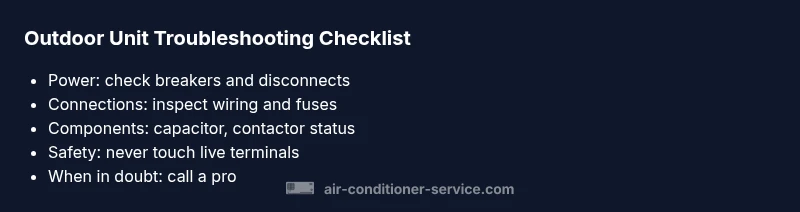
An outside unit not turning on typically points to a power issue, a blown fuse, or a faulty capacitor/contactor. Start by checking the outdoor disconnect and the main breaker, then inspect wiring for obvious damage and listen for a humming sound indicating power reaches the unit. If it still won’t start, contact Air Conditioner Service for a professional diagnosis.
Understanding the air conditioner outside unit not turning on and why it matters
When your air conditioner outside unit not turning on, the problem is almost always solvable without a full system replacement. The outdoor component houses the compressor and condenser, which work with the indoor blower to move refrigerant through your home. If the outdoor unit fails to start, you may hear nothing, or only a faint click or hum, and your home may not cool evenly. According to Air Conditioner Service, most outside-unit failures begin with power issues—trips, blown fuses, or a disconnected or damaged conductor. Before assuming a major component failure, begin with a careful power check and a simple visual inspection. This approach keeps you from unnecessary interventions and helps you diagnose safely and quickly. In this guide, we walk through the most common culprits and a practical, step-by-step flow so you can decide whether a DIY fix is feasible or a technician is needed. Safety stays at the center of every step.
tipTypeAllowedOmniitem_shim
-safe-keep-
Steps
Estimated time: 30-60 minutes
- 1
Ensure power is shut off to the outdoor unit
Before touching any wiring, switch off the outdoor disconnect and the main breaker. This eliminates shock risk while you inspect components.
Tip: Use a non-contact voltage tester to verify power is off. - 2
Inspect the outdoor disconnect and wiring
Look for signs of damage, corrosion, or loose connections at the disconnect. Tighten terminals if you see looseness and ensure the box is properly sealed against the elements.
Tip: If a fuse is visibly blown, do not reuse it; replace with the correct amperage. - 3
Check the breaker and electrical panel
Reset the breaker and observe if it trips again. A repeated trip indicates a broader electrical problem in the circuit that needs professional attention.
Tip: If you hear buzzing or notice a burning smell, stop and call a professional immediately. - 4
Test the capacitor and contactor safely
If you have the right tools, carefully discharge and test the capacitor. Replace if bulging or leaking. Inspect the contactor for pitting or welding.
Tip: Capacitors store dangerous charge; never touch terminals with metal tools. - 5
Power the unit back on and observe
Turn power back on and listen for the compressor humming. If it starts, monitor for smooth operation. If not, proceed with professional service.
Tip: Note any humming vs. no sound to guide diagnosis.
Diagnosis: Air conditioner outside unit not turning on.
Possible Causes
- highTripped breaker or blown disconnect switch
- mediumBlown fuse in outdoor disconnect or main panel
- mediumFaulty capacitor in the outdoor unit
- lowStuck or burned contactor/relay
Fixes
- easyReset the outdoor disconnect and main breaker
- easyReplace any blown fuse in the disconnect box or panel
- hardTest capacitor and replace if swollen or leaking
- mediumReplace contactor/relay if it does not pull in when powered
Common Questions
What is the most common cause if my outside unit won’t start?
The most common cause is a power issue, such as a tripped breaker or blown fuse in the outdoor disconnect. Other frequent causes include a faulty capacitor or contactor. A systematic power check usually resolves the issue.
Most often, it’s a power issue. Start by checking breakers and fuses, then move to components if power is confirmed.
Can a dirty filter cause the outside unit to fail to start?
A dirty filter doesn’t directly prevent the outdoor unit from starting, but it can reduce system airflow and cause overheating that trips safety limits. Ensure indoor filters are clean and the outdoor coil isn’t restricted.
A dirty filter can cause overheating and tripping, but it won’t usually stop the outdoor unit from starting immediately.
Is it safe to touch the outdoor wiring to test the unit?
No. It’s dangerous to touch energized outdoor wiring. If you’re not trained in electrical safety, avoid DIY voltage testing and call a licensed technician.
Do not touch any wiring unless power is fully shut off and you’re trained.
When should I replace an outdoor unit component vs the whole system?
If a single component (like a capacitor or contactor) fails repeatedly, replacing the part can be economical. For chronic failures or poor efficiency, evaluate system age and consider a full replacement.
If components fail repeatedly, consider replacing the part or the whole unit depending on age and efficiency.
Watch Video
The Essentials
- Power check first: reset breakers and disconnects.
- Inspect for obvious damage before testing components.
- Call a pro if you’re unsure or if breakers trip again.
- Regular maintenance helps prevent outdoor-unit failures.