Air Conditioner Not Running Outside: Troubleshooting Guide
Practical, step-by-step troubleshooting for an outdoor AC unit that won’t run. Safety-first checks, common causes, and when to call a professional.


An outdoor unit that won’t run is usually a power or control issue. Start with the basics: verify the outdoor disconnect is ON, reset any tripped breakers, and ensure the thermostat is calling for cooling. If power is present, check that the condenser coil is clean and the fan spins freely. If it still doesn’t run, call a licensed technician.
Why the Outside Unit Stops Running
If your air conditioner not running outside, the outdoor unit that houses the condenser is often the culprit. According to Air Conditioner Service, most outdoor-unit failures begin with power or control issues rather than mechanical faults. The outdoor unit only runs when the indoor thermostat calls for cooling, so a mismatch between signals or a safety trip can prevent it from starting. Start with the basics: check that the outdoor disconnect switch is ON and that the circuit breaker for the unit has not tripped. A blown fuse in the disconnect or a tripped breaker is a common reason the unit stays idle. Do a quick visual inspection of the condenser and fan: are the fins clear, and can the fan blade spin freely by hand (with power safely disconnected)? If the unit feels unusually hot, this can indicate an overload condition. Finally, remember that high outdoor temperatures or blocked airflow can trigger safety protections that pause operation. These early checks set the stage for more targeted diagnoses without sacrificing safety.
Quick Checks You Can Do Right Now
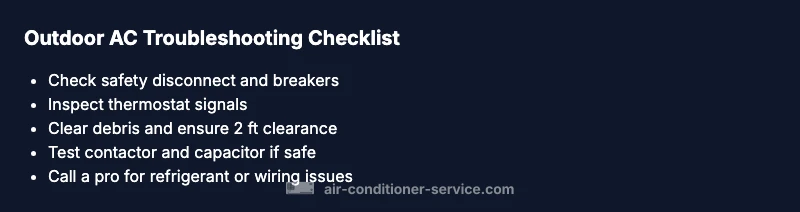
Before calling for service, run through these simple checks you can perform safely. If the outdoor unit is not running, start by confirming the disconnect switch by the meter or on the wall is in the ON position. Then, reset or test the outdoor circuit breaker; even if it looks upright, a reset can clear a latent trip. Verify indoor thermostat settings: is it set to cool, and is the setpoint lower than the current room temperature? Next, inspect the area around the unit for debris, excessive heat, or grass and weed growth that blocks airflow. Ensure the condenser coil is free of dirt and leaves; a dirty coil reduces cooling efficiency and can trigger protective shutoffs. Finally, listen for the condenser kicking in or the fan running when you switch the thermostat to cooling. If you hear nothing, power or signal is the likely issue, not the refrigerant or indoor components. If any of these checks resolve the problem, you may have a quick fix; if not, continue with diagnostic steps or contact support.
Common Causes and How to Diagnose Them
Air Conditioner Service analysis shows that while many outdoor-unit failures are power or control related, other frequent culprits include a faulty contactor, a failed capacitor, a clogged or dirty condenser coil, or a blocked airflow path. Diagnosing begins with power: test voltage at the outdoor disconnect or the contactor terminals with a multimeter, ensuring you follow safety guidelines. If voltage is present but the unit won’t start, the issue may be the contactor coil not pulling in, a burnt-out capacitor, or a failed start relay. Visual signs include a humming sound without compressor starting, or a swollen capacitor. A dirty coil or debris around the unit can also cause overheating and safety shutoffs. Weather or wildlife can contribute too; pests may chew wiring or nest around the outdoor unit, causing intermittent faults. Throughout diagnosis, verify that the thermostat is calling and indoor fan is functioning to rule out indoor issues.
Steps
Estimated time: 40-60 minutes
- 1
Power down and isolate the unit
Begin by turning off the main service disconnect and the outdoor disconnect to ensure you won’t be exposed to live electrical parts. This is the foundation for safe inspection of the outdoor unit.
Tip: Always verify power is off with a non-contact tester before touching any wires. - 2
Check the disconnect and breakers
Inspect the outdoor disconnect switch; confirm it is in the ON position. If the breaker has tripped, switch it off and then back to ON to reset the circuit.
Tip: A quick reset can restore power if the trip was temporary. - 3
Inspect thermostat and indoor signals
Make sure the thermostat is set to cool and that the indoor unit is calling for cooling. If the thermostat is unresponsive, replace batteries or recalibrate it.
Tip: Even a simple wiring loose at the thermostat can cause outdoor units to stay idle. - 4
Clear the outdoor unit area
Remove leaves, grass, and debris from around the condenser. Ensure at least 2 feet of clearance on all sides and that the fins are clean for proper airflow.
Tip: A blocked unit overheats and may shut down to protect itself. - 5
Inspect the condenser and fan visually
With power still isolated, look for bent fins, ice on the coils, or a stuck fan. A fan that won’t spin may indicate a seized motor or an electrical fault.
Tip: Do not force a stuck fan; the motor can burn out if forced. - 6
Test for voltage at the contactor
Reconnect power and use a multimeter to verify voltage at the outdoor contactor terminals when the thermostat calls for cooling. If voltage is present but the unit doesn’t engage, the contactor or capacitor may be faulty.
Tip: Only perform voltage testing if you’re comfortable; otherwise skip to step 7. - 7
Inspect/replace the capacitor and contactor
A bulging or leaked capacitor or a burnt contactor coil is a common failure point. Replace only with the correct part and follow safety procedures.
Tip: Capacitors store dangerous charges even after power is removed. - 8
Test operation and plan next steps
Power the system back on and observe for proper starting and cycling. If it starts but runs poorly or intermittently, schedule professional service for a deeper diagnosis.
Tip: If it doesn’t start after basic steps, professional diagnosis is recommended.
Diagnosis: Outdoor AC unit won’t run
Possible Causes
- highPower issue (disconnected switch, tripped breaker, blown fuse)
- mediumThermostat not calling for cooling
- mediumFaulty outdoor components (contactor, capacitor, start relay)
- lowBlocked airflow or dirty condenser coil
Fixes
- easyReset outdoor disconnect and main circuit breaker
- easyReplace blown fuse or repair wiring as needed by a professional
- mediumTest voltage at contactor and check for proper coil operation
- hardReplace faulty capacitor or contactor if diagnosed
Common Questions
Why won't my outdoor AC unit start even though the thermostat is calling for cooling?
Commonly, power issues or a faulty outdoor component prevent starting even if the thermostat is signaling cooling. Check the disconnect and breaker first, then inspect the contactor and capacitor.
Often the problem is power or a faulty outdoor component; start with the disconnect and breaker, then check the contactor and capacitor.
Can dirt or debris cause the outdoor unit to stop running?
Yes. A dirty condenser coil or blocked airflow reduces cooling efficiency and can trigger protective shutoffs. Clean the coils and ensure clearance around the unit.
Dirt and debris can block airflow and cause the unit to shut down for safety.
Is it safe to reset the outdoor breaker myself?
Yes, resetting the breaker is generally safe if you follow proper steps and power is off. If the breaker trips again, there may be an underlying electrical fault that needs a pro.
You can reset the breaker if you’ve turned off the power, but if it trips again, call a professional.
When should I replace the capacitor or contactor?
Replacement is recommended when testing shows a weak or burnt capacitor or a failed contactor coil. A professional should perform refrigerant and electrical work.
If testing shows a bad capacitor or contactor, replacement is needed. Have a pro handle it for safety.
What are signs I should call a professional immediately?
If you smell burning, hear buzzing, see smoke, or the outdoor unit won’t engage after basic checks, stop and call a technician.
Call a professional if you smell burning or hear buzzing, or the unit won’t start after quick checks.
Can outdoor unit problems be caused by wildlife?
Yes. Animals can nest near the unit, chew wiring, or block airflow. Inspect and trim vegetation away from the unit, and have a pro check electrical connections if you suspect damage.
Wildlife can interfere with wiring and airflow; keep the area clear and have a pro check any damage.
Watch Video
The Essentials
- Power and control checks first—often the fix.
- Maintain clear airflow around the outdoor unit.
- Don’t ignore safety risks; call a pro for electrical work.
- Regular maintenance prevents outdoor-unit outages.
- If the unit still won’t run after basics, schedule professional service.