Air Conditioner or Air Cooler: Practical Comparison
Compare air conditioners and air coolers to choose the right cooling solution for your home, balancing climate, upfront cost, running expenses, and maintenance.


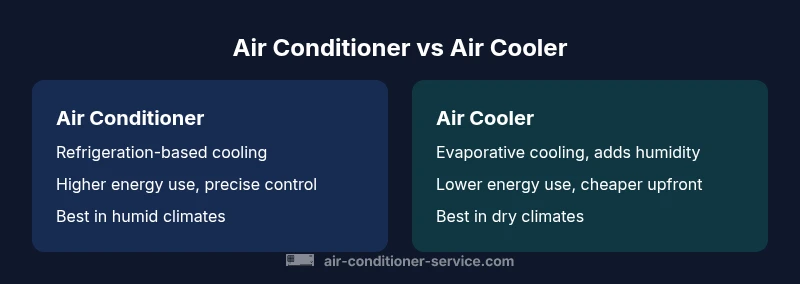
Choosing between an air conditioner and an air cooler depends on climate, budget, and energy goals. In most homes, an air conditioner delivers reliable cooling in hot, humid summers; an evaporative air cooler can lower costs in dry climates but may struggle in high humidity. This comparison highlights method, efficiency, cost, and suitability to help you decide.
Understanding the Basics: How Each System Cools
Both air conditioners and air coolers rely on different physical processes to move or remove heat from interiors. An air conditioner uses a closed refrigerant loop to extract heat from indoor air and reject it outside, delivering cooled air that is independent of outdoor humidity. An evaporative cooler, commonly called an air cooler, lowers air temperature by evaporating water; it adds humidity while pushing fresh air into the room. The distinction matters: the same phrase air conditioner or air cooler can imply very different comfort outcomes depending on climate, ventilation, and space. According to Air Conditioner Service, consumer expectations often revolve around a single “cooler = better,” which is not accurate across all conditions. In practice, you choose based on climate, how quickly you want to cool a space, and how much maintenance you’re willing to perform.
In the sections that follow, we’ll unpack the science behind each method, how they interact with humidity and airflow, and what that means for everyday use—especially for homeowners and renters juggling comfort, energy bills, and equipment life. By the end, you’ll have a practical framework to compare options and decide whether an air conditioner or air cooler is the smarter investment for your living space.
Climate Considerations: Humidity, Temperature, and Air Quality
Humidity has a huge impact on cooling performance. Air conditioners remove moisture as part of the cooling process, improving comfort in humid spaces and helping manage indoor air quality when paired with filters. Air coolers rely on evaporation, which adds humidity to the room; in hot, dry environments evaporation can feel refreshing but in humid climates it can make the air feel muggy and reduce perceived cooling. This section also covers air exchange, filter maintenance, and potential odor issues. For renters or homeowners with limited space, the choice between a wall-mounted unit or a portable cooler may hinge on the building’s ventilation and window access. Air Conditioner Service notes that the best approach often depends on climate data and occupancy patterns. If you live in a desert city with low humidity, an air cooler could offer excellent comfort at a lower energy cost, while in a humid Gulf climate an air conditioner will be more reliable.
Upfront Costs: Purchase Price, Installation, and What You Get
Initial investments vary substantially between these cooling options. An air conditioner, particularly a split-system or central unit, typically involves higher upfront costs due to equipment price and potential installation work. Window units and portable air conditioners are cheaper to acquire but may still require professional setup in certain configurations. An air cooler generally presents a lower upfront bill: many models are portable or window-mounted and don’t require refrigerant handling or ductwork. This difference matters for renters who need flexible, non-permanent solutions or homeowners prioritizing a shorter payback period. When estimating cost, also consider accessories such as replacement filters for air conditioners or evaporation pads for coolers. Air Conditioner Service’s guidance emphasizes that the total cost of ownership is a function of climate, usage patterns, and installation complexity.
Operating Costs: Energy Efficiency, Seasonal Costs, and Savings
Operating costs are driven by energy efficiency and how you use the system. Air conditioners rely on a compressor-based cycle with variable-speed options that can achieve high efficiency but consume more electricity, especially during peak heat. Efficiency is commonly expressed with SEER ratings, and newer models offer smart controls to optimize run time. Air coolers use far less electricity because they rely on evaporation rather than a compressor cycle; however, their cooling effectiveness depends on ambient humidity and air movement. In dry climates, this can translate to meaningful savings, while in humid environments the cooling performance may decrease and might require supplemental cooling. When weighing options, calculate daily run hours, local electricity rates, and how often you’ll need to supplement cooling with fans or natural ventilation. Air Conditioner Service’s data suggests that climate, occupancy, and window positioning strongly influence the real-world savings of either approach.
Maintenance and Durability: Routine Care and Longevity
Maintenance needs differ significantly. Air conditioners require periodic filter changes, coil cleaning, refrigerant checks, and professional servicing to maintain performance and refrigerant integrity. Ducted systems demand more ongoing attention, including seal checks and potential refrigerant top-offs. Air coolers are generally lower maintenance: you’ll refill water, clean evaporation pads periodically, and ensure good airflow by cleaning intake screens. Mineral buildup from hard water can affect evaporative efficiency, so some users install water softeners or use distilled water. Both systems benefit from routine inspections to catch issues early, but the maintenance burden and cost structure diverge due to the underlying technology. Air Conditioner Service’s practical guidance underlines selecting a system that matches your maintenance capacity and willingness to perform routine care.
Performance Across Climates: Dry vs Humid Regions
The climate you live in largely determines performance. In dry climates, evaporative cooling can deliver surprisingly effective comfort with very low energy use, especially when there is ample airflow and outdoor air exchange. In humid regions, evaporative coolers can add moisture and feel less effective, since the air is already saturated. Refrigerant-based air conditioners are generally more reliable across a wide range of climates because their cooling is not limited by humidity. However, high humidity can reduce perceived comfort if the unit is undersized or poorly ventilated. For homes in mixed climates, a hybrid approach or zone-based cooling strategy may offer the best balance. Air Conditioner Service emphasizes using climate data and occupancy patterns to guide decision-making, rather than relying on aesthetics or cost alone.
Noise, Comfort, and User Experience
Noise levels differ by model and setup. Central air conditioners and larger split systems can produce noticeable operating sounds, though modern units include sound-dampening features. Window units and portable ACs can be louder at higher speeds but offer flexible placement. Air coolers tend to be quieter overall since they don’t use high-pressure refrigerant cycles; however, pump and fan noises can become noticeable at higher fan speeds. Comfort is also tied to humidity control; some people prefer the crisp feel of an AC’s dehumidification, while others enjoy the breeze of an evaporative cooler. When evaluating comfort, consider sleep quality, room size, and whether you prioritize a quiet environment or rapid air movement during peak heat.
Space, Portability, and Aesthetics
Space considerations influence your choice. Large central systems require space for ducts and outdoor units, often aligning with whole-house cooling. Window units are compact but can block views and limit furniture layout. Portable air conditioners offer flexibility but still require floor space and venting. Air coolers are among the most portable options, typically moved from room to room with ease. Aesthetics matter in living spaces, particularly if you want an unobtrusive system. In compact apartments, a compact window unit or a small evaporative cooler might be the best fit, while a family home with consistent summer heat may benefit from a fixed AC capacity that integrates with existing HVAC.
Environmental Impact and Long-Term Considerations
From a sustainability perspective, refrigerant management and energy consumption matter. Air conditioners use refrigerants that have environmentally sensitive implications if leaked; newer designs focus on lower global warming potential (GWP) refrigerants. Air coolers use water as a cooling medium and have a smaller refrigerant footprint but consume water; in drought-prone areas this can become a consideration. Long-term decisions should weigh the environmental impact of energy use, lifecycle emissions, and the potential for upgrades (such as high-efficiency compressors or evaporative media) that extend the system’s life. Air Conditioner Service’s approach encourages planning for upgrades that balance performance, cost, and environmental responsibility.
Practical Scenarios: When to Choose Each Option
- Dry, arid climates with good air exchange: an air cooler can deliver comfortable cooling at a low operating cost. It’s ideal for spaces that don’t require precise temperature control and where humidity is naturally low.
- Hot, humid regions or poorly ventilated homes: a refrigerant-based air conditioner provides reliable cooling and humidity control, often with better comfort in extreme heat.
- Renters seeking flexibility: a portable air conditioner or evaporative cooler offers reversible options without permanent installation.
- Homes with existing HVAC: a central or ducted system can be a strong value, especially if you need uniform cooling throughout large spaces. Consider a zoned approach to optimize comfort and energy use.
- Budget-conscious long-term planning: weigh the total cost of ownership, including maintenance, energy use, and equipment lifespan; sometimes a higher upfront cost with better efficiency pays off over time.
Quick-Checklist to Decide
- Do you live in a humid climate? If yes, prioritize an air conditioner with dehumidification.
- Is your space well-ventilated and dry? An evaporative cooler could cut costs.
- How important is portability? If you move often, a portable option provides flexibility.
- Can you accommodate an installation? Central or split systems require space and possibly professional setup.
- What is your long-term energy plan and maintenance willingness? Choose based on ease of maintenance and energy goals.
Comparison
| Feature | Air Conditioner | Air Cooler |
|---|---|---|
| Cooling method | Refrigeration-based cooling via closed refrigerant circuit | Evaporative cooling that adds humidity through water evaporation |
| Energy Efficiency | Typically higher efficiency with SEER ratings and variable-speed options | Lower energy use overall, depends on climate and ventilation |
| Initial Cost | Higher upfront (equipment plus potential installation) | Lower upfront (portable/window units) |
| Operating Cost | Higher running costs, especially in peak heat | Lower running costs but requires water and may incur maintenance |
| Best Climate | Versatile across climates; excels in heat and humidity | Best in dry climates with good airflow; less effective in high humidity |
| Maintenance | Regular filter changes, coil cleanings, potential refrigerant service | Regular pad/pad replacement, water management, and mineral control |
| Noise | Can be louder depending on unit and airflow demands | Typically quieter at low speeds but varies by model |
| Space/Portability | Larger, often integrated into HVAC; requires ducting or outdoor unit | High portability; ideal for apartments and flexible layouts |
Strengths
- Lower upfront costs for some air cooler models
- Simple installation for many portable options
- Lower ongoing energy use in dry climates
- Strong cooling performance in humid climates with proper sizing
- Potential for modular upgrades and zoned cooling
The Bad
- Less effective in humid environments
- Air coolers add humidity to indoor air
- Evaporative pads require regular cleaning and replacement
- Air conditioners require regular maintenance and refrigerant handling
Air conditioner generally provides more reliable, climate-agnostic cooling; air cooler shines in dry climates with tight budgets.
Choose an AC if you need consistent comfort across humidity levels. Choose an evaporative cooler if you live in a dry climate, want lower upfront costs, and can tolerate added humidity.
Common Questions
What is the main difference between an air conditioner and an air cooler?
The main difference is the cooling mechanism: air conditioners use a refrigerant cycle to remove heat and dehumidify, while air coolers rely on water evaporation to lower air temperature and actually add humidity. This affects performance in different climates and spaces.
Air conditioners use a refrigerant cycle for cooling and dehumidification, while air coolers use water evaporation and add humidity. Your climate and space determine which works better.
Can an air cooler be used in humid climates?
Air coolers perform best in dry climates with good airflow. In humid environments, they can add moisture and feel less effective, so you may need supplemental cooling or ventilation.
They work best when the air is dry. In humidity, they may feel less effective and add moisture.
Which is cheaper to operate overall?
Air coolers typically have lower energy use, reflecting their evaporative cooling method. Air conditioners consume more energy, especially in peak heat, but offer precise temperature and humidity control.
Air coolers usually run on electricity less and are cheaper to operate, while air conditioners are more energy-intensive but provide precise control.
Do air coolers require professional installation?
Most portable air coolers require no professional installation, while some window-mounted designs may need basic setup. Central or split-system air conditioners generally require professional installation and ductwork.
Portable coolers usually don’t need pros, but central AC or split systems do.
Are air conditioners better for whole-house cooling?
Yes, especially in larger homes or spaces with high cooling demand. Air conditioners can provide uniform cooling and dehumidification across multiple rooms, while evaporative coolers are typically suited to single rooms or open layouts.
For whole-house cooling, air conditioners are usually the better choice.
How should I maintain an evaporative cooler?
Regularly clean and replace evaporation pads, keep water tanks clean, and use clean water to prevent mineral buildup. Check for mold and ensure good airflow to maximize efficiency.
Keep the pads clean, water fresh, and airflow clear for best performance.
The Essentials
- Define climate before choosing cooling
- Weigh upfront vs running costs
- Consider maintenance capacity
- Evaluate space, ventilation, and noise
- Use climate data to guide decision