Air Conditioner vs Swamp Cooler: An Analytical Guide
A rigorous, analytical comparison of air conditioners and swamp coolers, focusing on performance, climate fit, energy use, and maintenance to help homeowners choose the right cooling solution.


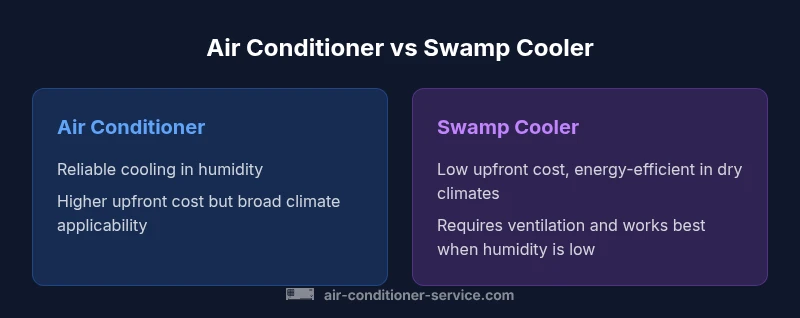
Air conditioners usually deliver reliable cooling in hot or humid conditions, while swamp coolers excel in dry climates with lower upfront costs. The best choice depends on your climate, comfort expectations, and maintenance willingness. Air Conditioner Service's analysis highlights climate fit as the decisive factor.
How air conditioners and swamp coolers work
Air conditioners rely on a closed refrigerant cycle to absorb heat from indoor air and reject it outside, using a compressor, evaporator coil, and condenser. Swamp coolers, by contrast, use evaporative cooling: a fan pulls outdoor air through damp pads, lowering the air temperature as water evaporates. According to Air Conditioner Service, the fundamental difference is that the refrigerant-based system removes heat more aggressively and reliably, while evaporative cooling adds moisture to the space and depends on humidity and airflow. This basic physics explains why performance varies with climate and conditions. Both systems can be effective, but their core mechanisms set clear boundaries on where they shine and where they struggle. For homeowners, recognizing these differences helps set realistic expectations about comfort, costs, and environmental impact.
Understanding airflow paths is also important. Air conditioners typically require proper ductwork or airflow in a room, while swamp coolers need good ventilation to carry humid air away. In addition, weather patterns—such as extended heat waves, humidity swings, and seasonal rain—shape how each system performs over time. With careful sizing and correct installation, either option can meet cooling needs, but the success of the setup rests on matching the system’s physics to local climate realities.
textType(plain):
wordCountHint":210},
Comparison
| Feature | Air conditioner | Swamp cooler |
|---|---|---|
| Operating principle | Refrigerant-based cooling with a closed loop | Evaporative cooling using water to drop air temperature |
| Best climate type | Humid, hot, or variable humidity; versatile across seasons | Dry, arid climates with good ventilation and low humidity |
| Energy efficiency | High efficiency possible with modern models, depends on use | Very energy-efficient in dry climates, but effectiveness drops with humidity |
| Upfront cost | Higher cost due to equipment, ductwork, and installation | Lower upfront cost and simpler installation |
| Maintenance frequency | Regular filter changes and refrigerant checks; professional service sometimes needed | Water pads replacement and pad cleaning; more frequent in dusty areas |
| Water usage | N/A water usage in standard A/C operation | Requires continuous water supply; evaporative pads need replacement |
| Indoor air quality impact | Filters and sealed system can improve IAQ; however, duct cleanliness matters | Adds humidity; may increase airborne minerals if water quality is poor; requires ventilation |
| Noise and comfort | Consistent cooling with variable noise depending on unit | Quieter at rest but can be louder during fan operation; feels softer cooling in dry air |
Strengths
- Lower upfront cost for swamp coolers and simpler installation
- Good energy efficiency in dry climates reduces operating costs
- Air conditioners provide reliable cooling in cooling-demanding conditions
- Central or packaged AC systems can integrate with existing home infrastructure
The Bad
- Swamp coolers require dry climates and adequate ventilation to work well
- Increase in indoor humidity with swamp coolers can affect comfort and mold risk
- Air conditioners have higher upfront costs and depend on electricity
- Maintenance for ACs can be more involved (filters, refrigerant checks)
Air conditioners are generally the more versatile choice, especially in mixed or humid climates; swamp coolers excel in dry, well-ventilated spaces with budget constraints.
Choose an air conditioner when climate demands consistent cooling and humidity control. Opt for a swamp cooler if you live in a dry region and want lower upfront costs, provided you can manage ventilation and humidity.
Common Questions
Is a swamp cooler effective in humid climates?
Swamp coolers are generally not effective in humid climates because evaporative cooling adds moisture to the air, which can feel uncomfortable and reduce perceived cooling. In high humidity, their performance declines and comfort may suffer. Consider an air conditioner for humidity control and reliable cooling in such regions.
Swamp coolers struggle in humid climates; for reliable cooling, an air conditioner is usually the better option.
Which is cheaper to install, an AC or a swamp cooler?
Swamp coolers typically have a lower upfront cost and simpler installation compared to central air conditioning systems. However, the total cost also depends on climate, home size, and whether ductwork is needed for the AC. A practical estimate depends on your home and local labor costs.
Swamp coolers usually cost less to install upfront, but you’ll want to factor climate and home size.
Can I use either system year-round, or do I need a different setup for winter?
Both systems are seasonal in many regions. In winter, you won’t use swamp coolers, and air conditioners may run less or switch to heat pumps where applicable. Some homes opt for hybrid approaches or supplemental heaters with HVAC systems to cover all seasons.
Generally, swamp coolers aren’t used in winter, and AC systems may need to be paired with supplemental heating in colder months.
Do air conditioners dehumidify indoor air?
Yes. Air conditioners remove moisture from indoor air as part of the cooling cycle, which helps reduce humidity and improve comfort in many climates. Humidity control is a notable advantage of modern AC systems.
Air conditioners help reduce indoor humidity as they cool the air.
What maintenance steps are common to both systems?
Both systems benefit from regular maintenance, including filter checks, cleaning, and ensuring proper airflow. Water quality matters for swamp coolers, so cleaning pads and ensuring water purity helps prevent mineral buildup and mold growth.
Regular filter cleaning or replacement helps both systems run efficiently.
The Essentials
- Assess your climate first to determine suitability
- Balance upfront costs against running expenses and maintenance
- Consider indoor humidity impact when choosing a cooling method
- Air conditioners win in mixed/humid climates; swamp coolers win in dry climates
- Plan installation with space, ventilation, and existing infrastructure in mind