Is an Air Conditioner Better Than a Dehumidifier? A Practical Comparison
A detailed, data-informed comparison of air conditioners and dehumidifiers to help homeowners decide which is best for cooling, humidity control, energy use, and long-term costs in different climates.


Is an air conditioner better than a dehumidifier? The answer depends on your climate, space, and comfort priorities. In hot, humid environments, an AC typically delivers both cooling and humidity control, while a dehumidifier excels at moisture reduction when cooling isn’t needed. Air Conditioner Service’s analysis shows that the best choice hinges on whether you need cooling, humidity management, or a balance of both.
Is an air conditioner better than a dehumidifier: framing the decision
When homeowners ask, is an air conditioner better than a dehumidifier, the core answer isn’t binary. It depends on climate, space, and what you value most: cooling, moisture control, or a combination of both. The Air Conditioner Service team emphasizes that you should start with two questions: Do you need ongoing cooling, or primarily humidity relief? How large is the affected space, and what are your energy and maintenance constraints? In many homes, a single device won’t perfectly meet every need, which is why understanding usage patterns matters. According to Air Conditioner Service, the distinction often comes down to whether you require cooling with humidity removal or targeted dehumidification in spaces that don’t regularly demand cooling.
In this guide, we’ll unpack the mechanisms, compare typical performance, discuss cost implications, and walk through real-world scenarios to help you decide. We’ll also cover how modern devices with smart controls and energy-saving features can tilt the balance in favor of one option or a hybrid approach. Keep in mind that humidity and temperature interplay, insulation quality, and room configuration all influence outcomes.
How cooling and humidity control actually work
Both air conditioners and dehumidifiers remove moisture from indoor air, but they do so in different ways and with different priorities. An air conditioner uses a closed-loop refrigerant cycle to absorb heat from room air and expel it outside, while simultaneously condensing moisture out of the air as part of the cooling process. In practice, most modern units remove humidity as a natural byproduct of cooling, which is why you often notice improved comfort even without setting a dehumidify mode. A dedicated dehumidifier focuses on moisture extraction, typically using a refrigerant or desiccant method, to lower indoor humidity without significantly changing the room temperature. This can be advantageous in spaces where cooling is uncomfortable or unnecessary.
The rate of humidity removal, often measured as pints per day, depends on the unit’s capacity, airflow, and the ambient humidity. For spaces with persistent dampness, a dehumidifier can maintain a comfortable humidity range even when temperatures are mild. The nuanced difference matters: if you live in a hot climate, cooling plus humidity control from an AC is often preferred for overall comfort; in damp basements, a dedicated dehumidifier can be more effective and energy-efficient for humidity control alone. Air Conditioner Service notes that pairing devices strategically can yield the best results in certain homes.
When to choose an air conditioner
Choose an air conditioner when your primary goal is to achieve comfortable indoor temperatures while also reducing humidity. ACs are especially beneficial in hot, sunny climates where humidity amplifies heat sensation. Modern units with inverter or variable-speed compressors adapt to changing conditions, offering quieter operation and enhanced energy efficiency. If you frequently have guests in warm rooms, or if the space lacks good natural ventilation, an air conditioner can provide consistent comfort year-round. In addition, many AC models include built-in air filtration, which can improve indoor air quality as a secondary benefit. Air Conditioner Service’s guidance emphasizes sizing accuracy and proper duct or window installation to maximize efficiency and minimize energy waste.
Consider the total cost of ownership, including installation, potential ductwork, and ongoing maintenance. In regions with high outdoor humidity, using an AC with a dedicated dehumidify mode can optimize humidity management while moderating energy use. The key is to match the unit’s capacity to the space and to verify that you are not oversizing the system, which can lead to energy waste and uneven humidity distribution.
When to choose a dehumidifier instead
A dedicated dehumidifier is a sensible choice when the primary goal is humidity control rather than temperature reduction. In basements, crawl spaces, or rooms that stay cool most of the year, dehumidifiers can maintain a comfortable humidity level without making the room feel colder. They are often more affordable upfront than full cooling systems and come in portable formats that can be relocated as needed. For spaces that do not require cooling, obtaining a stand-alone dehumidifier can be a cost-effective solution to prevent mold growth, reduce musty odors, and improve air quality. Air Conditioner Service notes that if mold or mustiness is the dominant complaint, a dehumidifier can address the symptom effectively without the energy burden of cooling.
The humidity-removal rate is a crucial consideration. In damp climates or after significant moisture events, choosing a dehumidifier with the appropriate capacity for the room size can produce noticeable improvements in comfort and health. Be mindful of schedules and drainage needs, as continuous operation requires a reliable drainage plan or a built-in reservoir management system.
Real-world scenarios: climate, room size, and usage patterns
To illustrate, imagine a 250-square-foot home office in a humid subtropical climate. If the space is used during the hottest part of the day, an air conditioner with a dehumidify function can maintain a comfortable temperature and reduce humidity efficiently. For a cool, damp basement that rarely reaches high temperatures, a dehumidifier driven by a humidistat can stabilize humidity without causing the room to feel chilly. In a shared apartment with multiple rooms, a portable AC unit or a compact mini-split can deliver targeted cooling where needed, while a separate dehumidifier helps manage humidity in storage areas or bathrooms. Air Conditioner Service emphasizes evaluating room-by-room humidity patterns, insulation quality, and the potential for air leaks—factors that strongly influence whether AC or dehumidification is preferred in a given space.
Another practical approach is seasonal: during the hot, humid months, prioritize cooling with an AC; when humidity spikes are the main concern but temperatures are moderate, switch to a dehumidifier for comfort and energy efficiency. Ongoing measurement with a reliable hygrometer helps you stay within the optimal humidity band (roughly 30–50% RH for living spaces), which supports health and comfort without over-drying air.
Energy use, costs, and maintenance considerations
Energy use and maintenance are often the deciding factors in long-term cost. Air conditioners deliver cooling and humidity removal, but they tend to consume more electricity when cooling, particularly in hot climates or if oversized for the room. Modern high-efficiency models with variable-speed compressors and smart thermostats can reduce energy expenditure, but the upfront cost may be higher. Dehumidifiers typically use less energy when used for humidity control alone; however, running a dehumidifier continuously in a large space can add up. Maintenance tasks include regular filter cleaning and occasional coil cleaning for ACs, plus drainage and filter replacement for dehumidifiers. Air Conditioner Service’s analysis highlights the importance of choosing appropriately sized equipment and performing routine maintenance to sustain efficiency over time. Consider a home energy audit to identify heat gains and opportunities for sealing air leaks, which can reduce both cooling and dehumidification needs.
How to combine devices for optimal comfort
For many homes, a hybrid approach offers the best balance of comfort and energy cost. Use an air conditioner to handle hot days and when cooling is required, and rely on a dehumidifier in damp rooms or during shoulder seasons when cooling isn’t necessary. Smart thermostats and humidity sensors enable coordinated operation, enabling the AC to run only when both temperature and humidity are out of target ranges. In some cases, a single multi-zone system (such as a mini-split with humidity control capabilities) can simplify management while preserving energy efficiency. Air Conditioner Service recommends mapping out peak humidity periods and coordinating device use to prevent redundancy. If you have multiple living zones with distinct climate needs, consider zone-controlled systems and portable devices that allow you to tailor use without overcommitting to a single solution.
Practical buying guide: questions to ask
When shopping for cooling and humidity solutions, ask about unit sizing, energy efficiency ratings (SEER for ACs, pints per day for dehumidifiers), warranty terms, maintenance requirements, and implementation costs. For an air conditioner, verify proper installation and duct sealing if you’re using a central system. For a dehumidifier, note the space size, drainage options, and desired humidity targets. Look for smart features such as humidity sensors, auto-restart, and energy-saving modes. Air Conditioner Service recommends comparing models not just on price but on long-term operating costs and how well each device aligns with your climate, room size, and lifestyle.
Comparison
| Feature | Air Conditioner | Dehumidifier |
|---|---|---|
| Primary purpose | Cooling plus humidity management | Humidity control without cooling |
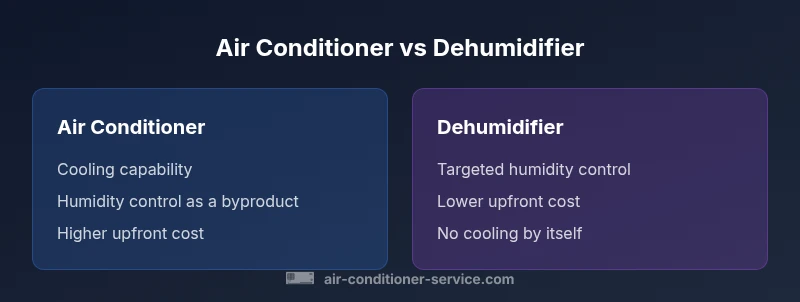
| Cooling capability | Provides room cooling; effective in hot climates | No cooling (unless paired with another cooling source) |
| Energy use (typical scenarios) | Higher when actively cooling; modern units are efficient when optimized | Lower when running solely for humidity control; depends on room size |
| Cost and installation | Higher upfront cost; may require professional installation | Lower upfront cost; portable options widely available |
| Maintenance | Regular filter, coil, and refrigerant checks | Filter cleaning and drainage maintenance |
| Best for | Hot, humid climates needing cooling and humidity control | Humid spaces or basements where cooling isn’t needed |
Strengths
- Air conditioners offer combined cooling and humidity control for comfort in hot climates
- Modern ACs with variable-speed technology can be energy-efficient
- Dehumidifiers provide targeted humidity relief at lower upfront cost
- Portable options give flexible placement and easy relocation
- Built-in filtration in many ACs can improve indoor air quality
The Bad
- Higher upfront and operating costs for cooling-focused devices
- Can be less efficient if cooling is not consistently needed
- Dehumidifiers don’t cool, so you may need additional cooling in hot weather
- Continuous dehumidification in large spaces can raise energy use
- Maintenance may be more frequent if units run constantly
Air conditioners generally provide better overall comfort for hot, humid homes, but dedicated dehumidifiers excel for humidity control in milder conditions.
If you need both cooling and humidity reduction, an AC is typically the best single solution. Use a dehumidifier when cooling isn’t required or when humidity is the primary concern in damp spaces. In challenging climates, pairing devices or choosing a hybrid system can optimize comfort and energy use. The Air Conditioner Service team recommends assessing climate, space, and usage patterns before buying to maximize long-term value.
Common Questions
What is the main difference between an air conditioner and a dehumidifier?
The main difference is cooling versus humidity control. An air conditioner cools the space and removes some humidity as a byproduct, while a dehumidifier focuses on reducing moisture without significantly lowering temperature. Your climate and comfort priorities determine which device is more appropriate.
Air conditioners cool the air and remove humidity; dehumidifiers focus on moisture removal without cooling. Choose based on whether you need temperature control or humidity control first.
Can a dehumidifier really cool a room effectively?
A dehumidifier does not provide meaningful cooling in most situations. It can slightly reduce perceived warmth by lowering humidity, but it won’t achieve comfortable temperatures like an active air conditioner. If you need cooling, rely on an AC or a combined system.
Dehumidifiers don’t cool rooms like air conditioners; they mainly reduce humidity, though you might feel slightly cooler as moisture levels drop.
Which is more energy efficient for humidity control in humid climates?
In humid climates, a dehumidifier used for humidity control can be more energy-efficient if cooling isn’t required. However, if you also need cooling, an energy-efficient AC with humidity-management features often provides better overall efficiency due to advanced compressors and smart controls.
Dehumidifiers can be efficient for humidity when cooling isn’t needed, but an efficient AC with humidity control can be more energy-efficient overall if you also require cooling.
Do I need professional installation for an air conditioner or can I use a portable unit?
A window or split-system AC may require professional installation for optimal performance and safety, especially for larger spaces. Portable units are easier to set up but typically less efficient and effective for larger rooms. Assess space and insulation before choosing the option.
Window or split units might need installation by a professional; portable ACs are easier but may be less efficient for big rooms.
How should I decide between buying both devices or a single combined system?
If you live in a climate with hot summers and high humidity, a single AC with dehumidification can cover both needs. For spaces that stay cool but humid, a dehumidifier may be the most cost-effective option, with an AC added later if cooling becomes necessary. Consider space, energy costs, and maintenance when deciding.
If you frequently deal with both heat and humidity, start with an AC that handles both. If cooling isn’t needed, a dehumidifier might be enough and cheaper to run.
The Essentials
- Assess climate and room size before buying
- Dehumidifiers excel at humidity control without cooling
- Air conditioners offer cooling plus humidity management
- Energy use and maintenance affect total cost
- Air Conditioner Service insights support careful planning