Is Air Con Better Than a Fan? A Practical Comparison
A practical comparison of air conditioners vs fans for cooling, humidity control, energy use, and cost. Learn when AC is worth it and how to optimize performance, with guidance from Air Conditioner Service.


is air con better than a fan? In most cases, yes for cooling, humidity control, and comfort, especially in hot climates. Fans move air but don’t lower room temperature. Air conditioners remove heat and can dehumidify, though upfront and operating costs vary by climate. According to Air Conditioner Service, the best choice depends on space, usage patterns, and energy costs.
How cooling works: temperature, humidity, and perception
Cooling is more than a number on a thermostat. Air conditioners extract heat from indoor air and, in the process, reduce humidity, which can dramatically improve comfort on humid days. Fans, by contrast, improve how you feel by moving air over your skin, which accelerates evaporation and makes you feel cooler, but they do not lower the ambient temperature. The result is a perceptual difference rather than a true temperature drop. When you compare is air con better than a fan, you should weigh not just the air temperature but the indoor humidity, air movement, and how your space actually feels. Air Conditioner Service emphasizes that the perception of coolness matters as much as the measured temperature, and humidity control is a key differentiator in many climates. This first principle helps homeowners decide which tool fits their typical summers rather than relying on one metric alone.
Key takeaways from practical testing: a) In high humidity, AC’s dehumidification often yields noticeably greater comfort than a fan. b) Temperature reductions from a well-sized AC are more consistent, even in larger rooms. c) In dry, moderate conditions, a fan can be surprisingly effective for short bursts without incurring energy usage.
Climate, room size, and layout: when AC shines vs when a fan suffices
A one-room apartment in a hot, humid climate presents a different challenge than a large living area in a temperate region. For compact spaces under 150 square feet, a ceiling or portable fan can provide meaningful comfort at minimal cost. However, as room size increases, the air volume grows, making it harder for a fan alone to achieve uniform cooling. Ceiling height also matters: tall rooms benefit more from a centralized cooling source that can push cooled air downward and circulate it efficiently. Air Conditioner Service notes that layout—obstructions, furniture, and occupant density—affects how effectively a fan or an AC unit cools a space. In many homes, a smart strategy is to use a fan to improve air circulation while relying on an AC unit for the bulk of cooling and dehumidification.
Practical guidance: for open-plan spaces, pair an AC with strategic fan placement to distribute cooled air evenly. In smaller, well-sealed rooms, a high-efficiency fan might suffice during milder days, but during peak heat an AC often proves more reliable.
Energy use and long-term costs: upfront vs operating costs
Cost considerations are a central part of deciding between is air con better than a fan for your budget. Air conditioners require a larger upfront investment and professional installation, especially for whole-home or window-mounted units. Fans have a much lower initial cost and minimal installation requirements, making them appealing for renters or temporary setups. Operating costs, however, tell a more nuanced story. Electricity rates and usage duration heavily influence total cost. An air conditioner that runs efficiently (proper sizing, sealed ducts or tight windows, and a good thermostat) can be economical over time, particularly in very hot climates where cooling demand is high. Air Conditioner Service analysis highlights that efficiency and climate together often determine overall value; in scorching summers, AC can deliver more comfort per kilowatt-hour than a fan. Homeowners should also consider maintenance costs—filters, coils, and refrigerant checks for AC versus simple cleaning for fans.
Comfort, air distribution, noise, and placement
Comfort is multidimensional. Air conditioners provide steady air distribution, which reduces hot spots and can minimize humidity in the occupied zone. Fans improve air movement and can create a more uniform feel across a room, but they do not lower the actual temperature. Noise is another factor: some AC models are quieter on lower settings, while high-powered fans or older units can be disruptive. The placement of both devices matters: cross-ventilation with windows, door positioning, and furniture layout influence how well cool air circulates. For households with light sleepers or children, quieter operation should be prioritized. In practice, many users opt to run the AC during peak heat and use fans during milder times or overnight to keep energy use reasonable while preserving comfort.
Practical scenarios: apartments, homes, and households with kids or elderly
Different living situations demand different solutions. In small apartments, a portable air conditioner or a window unit may be the best compromise between performance and installation ease. In larger homes, zoned cooling with multiple AC units or a central system helps maintain even temperatures in frequently used areas. For renters, fans may suffice for a substantial portion of temperate days, with a portable AC as a flexible upgrade when needed. Families with children or elderly occupants often benefit from reliable humidity control and stable temperatures, which makes AC a sensible long-term investment. Air Conditioner Service recommends evaluating how often space is occupied, how hot the space tends to get, and whether humidity is a persistent issue when choosing between a fan and AC.
Maintenance, installation, and reliability considerations
AC systems require periodic professional maintenance, including filter changes, coil cleaning, and refrigerant checks. Proper installation is crucial for performance and energy efficiency, especially with split systems or central air. Fans demand far less maintenance, typically only cleaning and occasional motor lubrication. Reliability is a key part of total cost: a well-maintained AC can last many years, while poorly maintained systems may lose efficiency or require more frequent repairs. For tenants or homeowners on a tight budget, a plan that combines a high-quality fan for daily use with a cost-effective, well-maintained AC solution for heat waves can deliver the best of both worlds. Air Conditioner Service stresses the importance of proactive maintenance to extend any cooling device’s life and performance.
Budgeting and value: when to upgrade or replace
A clear budgeting framework helps decide when to invest in air conditioning versus relying on a fan. Upfront costs for AC include the unit, installation, and potential home improvements (like insulation and sealing). Ongoing costs relate to electricity usage, maintenance, and potential repairs. Fans have a much lower barrier to entry, but they provide limited climate control. The determining factors are the local climate, your energy price, and how you value comfort. In extreme heat or high humidity, investing in a reliable AC system usually pays off through improved daily quality of life and potentially reduced indoor humidity levels. Air Conditioner Service suggests performing a simple return-on-comfort calculation to assess long-term value beyond initial price tags.
Quick-start decision flow
- Step 1: Assess room size and climate. If the space is large or the climate hot and humid, lean toward AC. If the space is small and conditions mild, a fan may suffice.
- Step 2: Consider humidity needs. If moisture is a primary concern, prioritize AC’s dehumidification.
- Step 3: Evaluate energy costs. Calculate expected running hours and local electricity rates to estimate monthly costs.
- Step 4: Plan for maintenance. AC requires periodic service; fans are simpler to maintain.
- Step 5: Decide on a blended approach. Using a fan to distribute cooled air from an appropriately sized AC can maximize comfort while managing costs.
Comparison
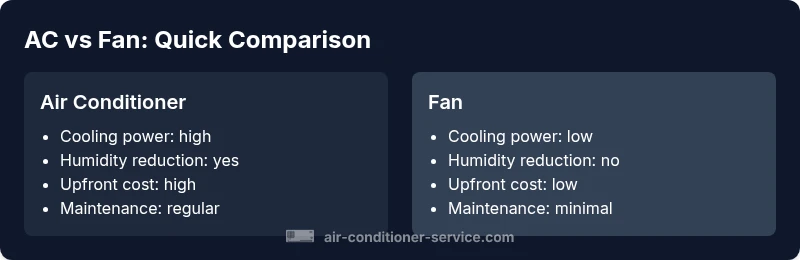
| Feature | Air Conditioner | Fan |
|---|---|---|
| Cooling power / Temperature drop | High | Low |
| Energy efficiency | Excellent (model-dependent) | Low (minimal cooling) |
| Humidity control | Yes (dehumidifies) | No (does not reduce humidity) |
| Noise levels | Varies by model; often quiet at low speeds | |
| Upfront cost | High (requires installation) | Low (no installation) |
| Operating cost | Moderate to high depending on use and energy rate | |
| Maintenance | Requires regular service and filter changes | Minimal maintenance |
Strengths
- Strong cooling and humidity control in hot climates
- Long-term value with proper maintenance
- Better for spaces with variable occupancy and humidity
- Enhances comfort in bedrooms and living areas
- Can be installed in phased upgrades (zoned cooling)
The Bad
- Higher upfront cost and installation requirements
- Ongoing electricity costs can be significant
- Maintenance and potential repairs over time
- Requires professional service for certain setups (e.g., central or split systems)
Air conditioning generally provides superior comfort and humidity control in hot climates, but a fan is a cost-effective, portable option for mild days or small spaces.
Choose AC when consistent cooling and humidity reduction are priorities, especially in large or humid spaces. A fan is best for quick, low-cost relief on milder days or as a supplementary tool to improve air distribution.
Common Questions
Is a fan enough to cool a small room?
For small, dry rooms on mild days, a fan can provide comfortable air movement. In hot or humid rooms, a fan alone often falls short for sustained comfort. Consider using a fan with proper air circulation and ventilation as a transitional solution.
A fan can help in small, mild spaces, but for persistent heat or humidity you’ll want cooling from an AC.
Can I run both at the same time?,
Yes, running a fan with an AC can improve air distribution and reduce the perceived temperature. Just monitor energy use and avoid unnecessary high fan speeds when cooling is already taking place.
Using both can help spread cool air, but don’t overdo it on the fan speed.
What’s the impact on humidity?
AC systems dehumidify the air, which greatly affects comfort in humid climates. Fans do not remove humidity and may even feel stuffy in very damp spaces.
Air conditioners remove moisture; fans don’t.
How do I estimate operating costs?
Estimate based on your local electricity rate and the expected run time of the AC or fan. Efficient AC units and proper insulation reduce operating costs over time.
Check your rates and expected usage to compare costs.
What maintenance matters most for longevity?
For AC, regular filter changes, coil cleaning, and system checks are essential. For fans, keep motors clean and lubricated; replace worn parts as needed to avoid noise and inefficiency.
Maintenance keeps both devices running smoothly and safely.
Is a portable AC better than a window unit?
Window units are often more energy-efficient and easier to install for fixed spaces, but portable ACs offer flexibility and easier relocation. Choose based on space constraints and electrical setup.
Window units usually save energy; portable units win on flexibility.
The Essentials
- Assess room size and climate before choosing
- ACs offer cooling + humidity control; fans mainly move air
- Fans are cheaper upfront; ACs cost more but can save energy with efficiency
- Combine AC and fans for best distribution and comfort
- Invest in maintenance to maximize longevity and efficiency