Does an air conditioner work like a dehumidifier? A practical comparison
Explore how air conditioners manage humidity versus a dedicated dehumidifier, with practical guidance for homeowners on when to rely on cooling humidity and when to add a standalone dehumidifier.


Does an air conditioner work like a dehumidifier? In most homes, the AC reduces humidity as it cools, but it is not a dedicated dehumidifier. The Air Conditioner Service team notes that moisture is removed when warm, humid air passes over cold coils, condensing water, yet humidity control depends on settings, airflow, and space. This quick comparison highlights when you can rely on cooling for humidity and when a separate dehumidifier is more effective.
Does an air conditioner work like a dehumidifier? Understanding the core question
At first glance, an air conditioner appears to regulate both temperature and humidity. The fundamental process is that warm, humid indoor air is drawn across cold evaporator coils. Water condenses on those coils and drips away, which lowers the humidity of the air that eventually circulates back into the room. This dehumidification happens as a byproduct of cooling, not as a primary design purpose. Air conditioners are engineered to maintain a comfortable indoor temperature efficiently, and humidity reduction is a consequential benefit rather than a guaranteed outcome in every scenario. According to Air Conditioner Service, humidity control improves as the cooling load increases and indoor air circulates more slowly, which means the humidity impact is strongest when outdoor humidity is moderate rather than extreme. In practice, you will notice drier air during comfortable summer days, but in very damp spaces you may still feel humid despite a cooled space.
The physics behind humidity removal in AC systems
Humidity management in an air conditioner relies on thermodynamics. When warm air passes over a cold surface, moisture condenses and exits as liquid water. The rate of dehumidification depends on the surface area of the coil, the air velocity, indoor humidity, and the system’s cooling goal. Larger or high-SEER units tend to remove more moisture than small window units, but the effect is still tied to cooling demand. It’s important to note that the dehumidification effect is a function of temperature setpoints, airflow, and the overall design of the HVAC system. Air Conditioner Service analysis shows that most residential units can reduce RH by a few percentage points under typical daytime conditions, but the exact numbers vary by space, load, and ventilation.
When humidity control falls short for AC alone
In spaces with high humidity or poor air exchange, the AC may not reduce moisture to the level needed for comfort or mold prevention. If the space is consistently damp, condensation on walls or a lingering musty smell can persist even when temperatures feel comfortable. In such cases, relying on cooling alone for humidity control can lead to overcooling, higher energy consumption, or insufficient dehumidification. This is where a dedicated dehumidifier shines: it targets latent humidity removal, runs independently of cooling temperature, and often achieves lower relative humidity levels that improve overall comfort.
Dedicated dehumidifier vs. AC: What changes in practice
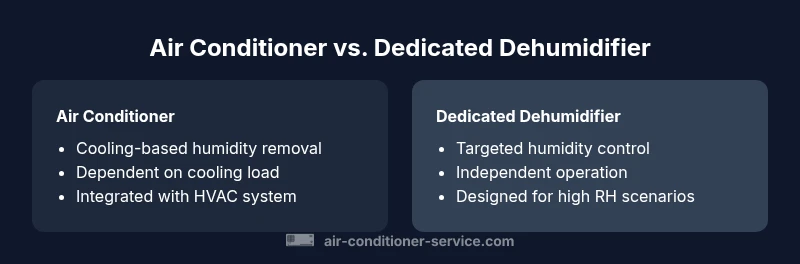
A standalone dehumidifier is designed to remove moisture without primarily cooling the air. It operates at a fixed humidity setpoint and can extract moisture more aggressively at specific RH targets. This makes it well-suited for damp basements, laundry rooms, or spaces with persistent humidity issues. In contrast, an air conditioner aims to balance temperature and humidity as a byproduct of cooling. For many homes, the combination of cooling and occasional dehumidification achieves satisfactory comfort, but there are scenarios where a separate dehumidifier provides a more precise RH control and faster moisture removal. Air Conditioner Service emphasizes choosing based on space conditions and comfort goals.
Practical strategies to optimize humidity with an AC system
If you’re optimizing humidity using your air conditioner, consider the following steps:
- Set the thermostat to a moderate cooling level to avoid overcooling while promoting moisture removal.
- Run the fan on auto rather than on continuous to improve sensible cooling without dispersing damp air.
- Ensure proper air distribution and filtration so that all rooms participate in humidity control rather than just a single zone.
- Use timed operation or a humidity-sensing function if your system supports it, to boost dehumidification during peak humidity without excessive cooling.
- Maintain the system properly; clean filters and coils allow more efficient moisture removal. The interplay between temperature and humidity means that good airflow is as important as a cold coil.
Real-world scenarios: when to use which solution
In mild to moderate humidity, an AC may suffice for most days, especially if you value cooling alongside humidity reduction. In spaces like basements or laundry rooms with frequent dampness, a dedicated dehumidifier can provide targeted moisture extraction without overcooling. For new homes or renovations, consider a whole-home dehumidification approach integrated with the HVAC system for consistent humidity control alongside temperature. Air Conditioner Service advises homeowners to assess humidity levels in the space and test RH with a simple hygrometer to guide decisions on adding a dehumidifier or upgrading the AC system.
Cost, energy, and maintenance considerations
Humidity control has associated energy implications. An air conditioner uses energy primarily for cooling; dehumidification adds a latent energy cost, which varies with humidity levels and space. A dedicated dehumidifier typically has its own maintenance needs, such as filter changes and occasional coil cleanup. The combined approach can optimize energy use by avoiding overcooling while achieving comfortable humidity. Consider the long-term costs and potential energy savings when evaluating whether to add a separate dehumidifier, upgrade the HVAC system, or install a whole-home solution. The Air Conditioner Service team notes that your choice should align with comfort goals, not just the desire to dry the air.
Comparison
| Feature | Air Conditioner (standard operation) | Dedicated Dehumidifier |
|---|---|---|
| Primary function | Cools space; humidity reduction is a byproduct | Removes humidity primarily; no cooling focus |
| Humidity removal rate | Moderate, tied to cooling load | High, designed for moisture extraction |
| Energy use for humidity control | Dependent on cooling demand | Independent dehumidification energy use |
| Best for | General comfort with cooling | Damp spaces requiring strong RH control |
| Noise and footprint | HVAC unit; noise depends on system size | Standalone unit with its own noise profile |
Strengths
- Consolidates systems by using existing HVAC equipment
- Provides cooling with incidental humidity reduction
- Lower upfront equipment count for some homes
- Then-active humidity control can be achieved with modest adjustments
The Bad
- Less effective humidity control at very high RH levels
- May require cooling to overperform to achieve humidity targets
- Potentially higher energy use if cooling is intensified solely for humidity
For most homes, AC plus targeted dehumidification offers balanced comfort; a dedicated dehumidifier is best when humidity is consistently high.
An AC handles cooling and modest humidity reduction, but a separate dehumidifier provides more aggressive RH control in damp spaces. Consider space-specific needs and energy use when deciding.
Common Questions
Does an air conditioner remove humidity?
Yes, an air conditioner removes some moisture as air passes over cold coils, condensing water. However, this humidity removal is a byproduct of cooling and is not as aggressive as a dedicated dehumidifier. Consider RH targets to determine if extra dehumidification is needed.
Yes. An AC dehumidifies as it cools, but it’s not a dedicated dehumidifier. For strong humidity control, you may want an additional dehumidifier.
Can I run my AC to dry out a humid room?
Running the AC can lower humidity somewhat, but it may lead to overcooling if you push temperatures too low. For persistent humidity, combining cooling with targeted dehumidification is often more effective.
You can, but it may overcool the room. A separate dehumidifier is usually more effective for persistent humidity.
What settings maximize humidity control on an AC?
Use the Auto fan setting, avoid continuous fan on high, and maintain a reasonable temperature to avoid overcooling while maximizing air exchange. If your system has a humidity or dry mode, use it during peak damp periods.
Set the fan to Auto and avoid overcooling; use any humidity-dedicated mode if available.
When is a separate dehumidifier a better option?
A separate dehumidifier is a better option when RH remains high despite cooling or in spaces with poor ventilation, such as basements or laundry rooms. It targets moisture directly without forcing the space to cool.
Use a dehumidifier when humidity stays high even after cooling, especially in damp spaces.
Is humidity control more important than temperature for comfort?
Both matter for comfort, but optimal RH (roughly 40-60%) often has a bigger impact on perceived comfort than a moderate temperature alone. Balancing RH with temperature improves overall comfort and reduces mold risk.
Humidity level can matter more than a slight temperature difference for comfort and mold prevention.
How does energy use compare between AC dehumidification and a standalone dehumidifier?
An AC uses energy to cool while removing moisture as a byproduct, which can be efficient for cooling and humidity. A dedicated dehumidifier consumes energy specifically for moisture removal and may run more continuously in damp spaces.
Energy use depends on conditions; both can be efficient when used appropriately, but a separate dehumidifier may add ongoing energy cost in damp environments.
The Essentials
- AC cools and dehumidifies by design, but not primarily.
- In very damp spaces, a dedicated dehumidifier improves RH control.
- Balance cooling goals with humidity targets for best comfort.
- Test RH with a hygrometer to guide decisions.
- Maintenance matters; clean coils and filters to sustain dehumidification potential.