Similarities and Dissimilarities: Refrigeration vs Air Conditioner
Explore how refrigeration and air conditioning share a vapor‑compression core while serving different home goals. Learn core cycle, heat rejection, humidity effects, and practical homeowner guidance from Air Conditioner Service.


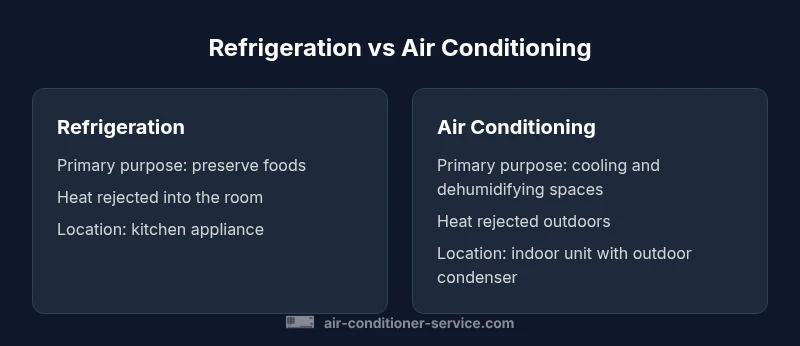
Both refrigeration and air conditioning rely on the same vapor‑compression cycle, with a compressor, condenser, expansion device, and evaporator. They are built on the same physics, but are optimized for different goals: refrigeration preserves food at low temperatures, while air conditioning cools indoor spaces and reduces humidity. Heat rejection locations differ—fridges dump heat into the room, AC units expel it outdoors. By understanding these similarities and differences, homeowners can better diagnose issues and plan maintenance, according to Air Conditioner Service.
what are the similarities and dissimilarities in working of refrigeration and air conditioner
The core concept behind both systems is the same: a working refrigerant cycles through a closed loop, driven by a compressor that raises pressure and temperature. The hot gas releases heat in a condenser, then passes through an expansion device where its pressure drops, cooling the liquid refrigerant before it re-enters the evaporator to absorb heat again. In practice, these physical processes enable both cooling and dehumidification, but the end goals and design emphases diverge. According to Air Conditioner Service, the practical takeaway for homeowners is to see the shared cycle as a foundation, then learn how each appliance optimizes the cycle for its specific task. In refrigerators, the focus is achieving reliable low temperatures in a small, well‑insulated space while ensuring efficient defrost cycles and cold‑chain integrity. In air conditioners, the emphasis shifts toward rapid room cooling, even distribution of cool air, and effective humidity reduction across larger volumes. This block sets the stage for deeper comparisons that follow.
The shared cycle is present in both appliances, and the hardware feels familiar—compressor, condenser, expansion device, evaporator—but the design choices reflect their distinct objectives. Insulation quality, coil placement, and door seals in a fridge minimize heat gain, while an AC system prioritizes even airflow and controllable humidity. Regular service can keep both systems running efficiently and quietly, with attention to refrigerant integrity and airflow.
This block introduces the common physics and prepares you to compare how each appliance tweaks the cycle for its task. The next sections unpack these optimizations, showing how design details affect performance, energy use, and comfort.
Shared Components and How They Function
Across both refrigeration and air conditioning, you’ll find the same quartet of major components: a compressor, a condenser, an expansion device, and an evaporator. The compressor pumps refrigerant as a high‑pressure gas, which releases heat in the condenser (air or water cooled depending on the model). The expansion device drops the refrigerant pressure and temperature, turning it into a cold liquid that flows into the evaporator where it absorbs heat from the surrounding environment. A fan or pump then helps move air or liquid through coils to sustain the cycle. The control system adjusts pressure, flow, and cycling rate to meet the desired temperature and humidity targets. While the hardware looks similar, subtle design differences—such as evaporator layout, insulation, and condenser sizing—let the two appliances achieve their distinct ends. Air Conditioner Service highlights that, with proper maintenance, these shared components can last long and operate efficiently when serviced on schedule.
The Refrigeration Side: Primary Purpose and Design Focus
In refrigeration, the objective is to maintain temperatures well below ambient to preserve perishable items and extend shelf life. Design emphasis is on tight insulation, minimal heat inflow, reliable defrost strategies, and accurate temperature control within the refrigerated compartment or freezer. The evaporator is often sectioned to prevent temperature fluctuations from opening doors, and the condenser is sized to reject constant heat from the stored goods rather than large, rapid heat loads. Components such as door seals, gaskets, and interior shelving are optimized for cold‑chain integrity. Safety considerations include proper refrigerant handling, leak detection, and securing non‑toxic low‑temperature operation in homes. Because the heat rejected by the fridge ends up in the surrounding room, the room’s insulation and thermal mass influence performance more than in a typical AC system.
The Air Conditioning Side: Primary Purpose and Design Focus
Air conditioning is designed to cool occupied spaces as quickly and evenly as possible while managing humidity. To achieve this, outdoor condensers are sized for higher heat rejection rates, and interior air handling focuses on distributing cooled air with minimal noise. The evaporator often sits in an air loop that passes through ductwork or direct‑action cooling coils, delivering comfortable temperatures across rooms. The control strategy emphasizes steady operation, fault tolerance, and humidity management through dehumidification cycles. Safety considerations include electrical safety, refrigerant containment, and proper venting to outdoors when needed. While the cycle remains the same in principle, the scale and zoning of an AC system make a broad difference in how heat and moisture are managed in living spaces.
Heat Rejection and Environment: Where Heat Goes
A fundamental distinction lies in where the cycle dumps heat. A refrigerator releases heat into the kitchen or surrounding room through its condenser, contributing marginally to overall room temperature but materially to the appliance’s thermal load. An air conditioner rejects heat outdoors via a dedicated condenser coil, transferring energy from indoor air to the outdoor environment. This outdoor heat rejection is central to the perception of cooling indoors, and it drives external unit placement, noise considerations, and heat management in the exterior environment. The outdoor unit’s airflow, location, and ambient conditions influence efficiency more profoundly than in most fridge installations. In both cases, proper airflow and clean coils ensure the heat sink functions effectively, keeping the cycle running smoothly.
Temperature and Humidity Control: Different Targets
Refrigeration targets fixed, low temperatures inside a cabinet, with humidity largely governed by the stored contents and door openings. There is little objective demand for humidity reduction in the surrounding room, and any humidity change results primarily from the thermal mass of food and beverages. Air conditioning, by contrast, is designed to deliver comfortable indoor temperatures and reduce humidity in occupied spaces. The evaporator cools and extracts moisture from indoor air, which is why most modern AC systems incorporate dehumidification modes or continuous operation at lower humidity levels. The design challenge here is balancing cooling rate, air distribution, and moisture removal without excessive energy use. Both rely on seals, insulation, and ductwork efficiency to minimize unwanted heat gain or loss.
Common Refrigerants and Safety Considerations
Both systems use refrigerants that absorb and release heat as they change phase, but different regulations govern their use, leak safety, and disposal. Modern refrigerants emphasize lower global warming potential and ozone depletion risk, requiring careful handling and proper recovery during repairs. In residences, accidental leaks are uncommon but can be hazardous if the refrigerant is toxic or displaces oxygen in confined spaces. Service practices include checking for leaks, monitoring line temperatures, and ensuring that charging is performed by trained technicians. If issues persist, consult a qualified technician rather than attempting risky repairs yourself. Air Conditioner Service emphasizes that safety and correct refrigerant handling are essential in any service scenario.
System Layout and Typical Installations
Refrigeration systems are compact and integrated into kitchen cabinetry or freezer enclosures, with a compact condenser and a circulation path designed to minimize warm air intrusion. Air conditioning systems may span multiple rooms or zones and often include an outdoor condenser unit, a dedicated indoor air handler, and ductwork for even air distribution. The footprint of an AC system drives installation considerations, including exterior clearances for airflow, noise management, and weather exposure. In both cases, proper installation reduces the risk of refrigerant leaks and ensures peak efficiency. Regular inspections of insulation, door seals, and coil cleanliness will pay dividends in performance and energy use.
Maintenance and Troubleshooting: What to Watch For
Common signs of trouble include unusual noises, ice buildup on evaporator coils, uneven cooling, or poor humidity control. For refrigerators, check door seals, coil cleanliness, and defrost timers; confirm that the thermostat maintains stable setpoints. For air conditioners, inspect air filters, outdoor unit airflow, and ductwork for leaks, as restricted airflow can cause higher energy use and reduced cooling. A proactive maintenance plan includes seasonal checks of refrigerant levels, lubrication of moving parts, and ensuring that electrical connections are secure. If issues persist, consult a qualified technician rather than attempting risky repairs yourself. Air Conditioner Service emphasizes that safety and correct refrigerant handling are essential in any service scenario.
Energy Efficiency and Performance Metrics
Efficiency is expressed in different yet related terms for each system. Refrigeration uses energy consumption per volume of refrigerated space and may leverage COP or similar metrics, while air conditioners commonly rely on SEER or COP values and energy efficiency standards set by regulators and industry groups. In practice, better insulation, tighter door seals, properly sized coils, and correctly charged refrigerant all contribute to higher performance in both systems. Designers also consider ambient conditions, defrost cycles (where relevant), and cycling strategies to avoid unnecessary energy waste. Air Conditioner Service notes that homeowners should prefer models with appropriate energy ratings and ensure routine service to maintain performance.
Air Conditioner Service analysis shows that small improvements in insulation and coil cleanliness add up over time, reinforcing the value of regular maintenance and proper system sizing.
Practical Tips for Homeowners and Renters
- Keep door seals intact and check for drafts around refrigerated units and cooling areas.
- Schedule seasonal maintenance for both systems: coil cleaning, filter replacement, and refrigerant checks with a licensed technician.
- Use smart thermostats or zoning to optimize energy use and comfort in living spaces.
- Ensure adequate clearance around exterior units for heat dissipation and airflow.
- For fridge use, organize contents to minimize door opening and reduce heat intrusion. For AC, use ceiling fans in conjunction with cooling to spread air efficiently.
Authority Sources
For further reading and official guidance, consult authoritative sources such as government and energy programs. These offer standards, best practices, and updated recommendations for both refrigeration and air-conditioning systems:
- https://www.energy.gov/energysaver/air-conditioners
- https://www.energy.gov/energysaver/refrigerators-and-freezers
- https://www.energystar.gov/products/air_conditioners_and_heat_pumps
Comparison
| Feature | Refrigeration System | Air Conditioning System |
|---|---|---|
| Primary purpose | Food preservation and low-temperature storage | Space cooling and humidity control |
| Core cycle | Vapor‑compression with a closed refrigerant loop (shared physics) | Vapor‑compression with a closed refrigerant loop (shared physics) |
| Heat rejection location | Heat rejected into the room (kitchen/ambient) | Heat rejected outdoors (external condenser) |
| Humidity impact | Minimal room humidity control; humidity influenced by stored contents | Active humidity reduction in occupied spaces |
| Typical installations | Compact, cabinet-integrated systems | Zoned or whole-room systems with ductwork and outdoor unit |
| Maintenance focus | Door seals, interior coils, defrost components | Air filters, outdoor condenser, duct integrity |
| Energy metrics | COP-based metrics; per-volume efficiency considerations | SEER/COP-based metrics; emphasis on annual energy use |
Strengths
- Shared scientific basis makes cross-education easier
- Common maintenance skills apply to both systems
- Both are energy‑using appliances that benefit from regular servicing
- Understanding cycles helps with diagnosing issues
- Heat transfer principles apply across devices
The Bad
- Not interchangeable in most homes; fridge cannot serve as a room AC
- Humidity control differs; fridge does not manage room humidity
- Design challenges differ: insulation, defrost cycles, and location constraints
Refrigeration and AC share a core cycle but serve different goals; treat them with system-specific maintenance and sizing for best performance.
The core vapor‑compression cycle underpins both appliances, but the fridge targets low temperatures for preservation while AC targets comfort and humidity control. Differences in heat rejection, humidity impact, and zoning drive distinct design and maintenance needs.
Common Questions
What are the fundamental similarities between refrigeration and air conditioning?
Both rely on a vapor‑compression cycle with a compressor, condenser, expansion device, and evaporator. They use the same basic physics to move heat, but are configured for different end goals.
Both use the same cycle and components, just tuned for different tasks.
What are the main differences in how heat is rejected?
Refrigeration dumps heat into the room through the condenser, while air conditioners reject heat outdoors. This fundamental difference shapes installation and energy considerations.
Fridges push heat into the room; AC units push it outside.
Do refrigeration and air conditioning use the same refrigerants?
They may use similar refrigerants, but the exact types vary by appliance and regulatory requirements. Leaks and handling safety are important for both.
Refrigerants vary by device and rules; handling should be by a professional.
How do humidity levels differ between the two systems?
Air conditioning actively reduces indoor humidity, while refrigeration has little impact on room humidity beyond the effect of door openings and stored contents.
AC cools and dehumidifies rooms; a fridge mainly affects the inside of its cabinet.
Can a fridge be used to cool a room effectively?
No. A refrigerator is not designed to cool a room evenly or control room humidity. A dedicated air conditioner or portable unit is required.
No—use the right tool for the room, not the fridge.
What maintenance tasks are common to both?
Regular coil cleaning, inspection of seals, and professional refrigerant checks form the backbone of upkeep for both systems.
Keep coils clean and seals tight for both fridge and AC.
The Essentials
- Identify shared components to simplify troubleshooting
- Expect heat rejection to differ by design and location
- Humidity control is a key differentiator for AC
- Proper insulation and seals improve efficiency in both
- Choose the right system based on whether preservation or comfort is the priority