How Much Is Air Conditioning for Home: Costs, Types, and Savings
Explore typical upfront costs, operating expenses, and value when buying home air conditioning. Learn price ranges for central, ductless, and window units, plus tips to save on installation and long-term energy bills.


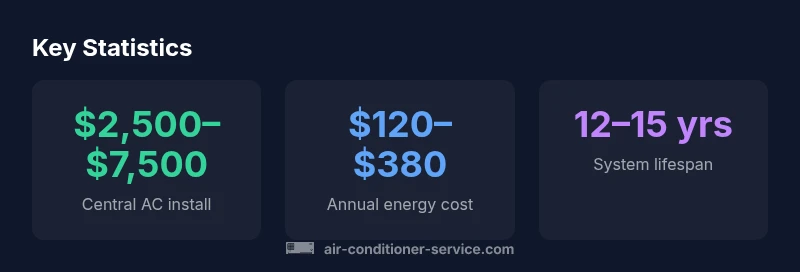
On a typical home, the upfront installed cost for central air usually falls in the $2,500 to $7,500 range, depending on house size, existing ducts, and climate. Window units and ductless mini-splits can cost significantly less per zone, though expansion or multi-zone setups push prices higher. Ongoing operating costs depend on efficiency ratings (SEER) and how often you run the system.
Cost Landscape: How much is air conditioning for home?
Determining 'how much is air conditioning for home' starts with recognizing that upfront costs hinge on system type, home size, existing ductwork, climate, and installation labor. In practice, most homes see central air installation fall into a broad band, with sizable variations. The numbers you’ll see in the wild are ranges because each project has unique constraints: retrofits, new construction, and local permit rules all influence the final price.
Central air systems typically carry the largest upfront ticket. When ducts exist and the home is a straight-forward retrofit, installed costs commonly land in the $2,500–$7,500 range. If the house requires substantial ductwork, or if airflow balancing and zone controls are added, costs trend higher. In contrast, ductless mini-splits offer modular cooling for specific rooms or zones, often in the $3,000–$8,000 per zone range, with multiple zones adding to the total. Window units are the least expensive option, generally priced from about $150 to $700 per unit, but they provide limited cooling and are best suited for smaller spaces or supplemental cooling. Finally, heat pumps (air-source) can bridge heating and cooling, with installed costs typically in the $4,000–$12,000 range, depending on climate and the number of zones.
System Types and Price Bands
Homeowners have several reasonable pathways for cooling a dwelling. Central AC with existing ductwork remains common, offering uniform comfort across large spaces at a higher upfront installation cost. Ductless mini-splits provide targeted cooling for additions or older homes without ducts, typically priced per zone and scalable as needed. Window units can be a quick fix for single rooms, while heat pumps offer year-round climate control by combining heating and cooling in a single system. When assessing prices, consider the total cost of ownership, not just the sticker price, including potential rebates, maintenance, and long-term energy usage. As you compare options, keep in mind that efficiency improvements (higher SEER) often raise upfront costs but reduce operating expenses over time. Air Conditioner Service’s analysis suggests that the best value often comes from systems sized correctly for your home and installed by qualified technicians, balancing upfront spend with annual energy savings.
What Drives the Price Up or Down
The final price is driven by several key factors. Ductwork complexity, the need for zoning or smart thermostats, and the number of zones all push costs higher. The size and layout of the home influence equipment capacity, while climate and local labor markets affect installation charges. Efficiency ratings and refrigerant type impact upfront price; higher SEER units cost more to purchase, but offer energy savings that can offset the extra spend over several years. Upgrades like improved filtration, variable-speed blowers, or advanced controls can also contribute to price variation. Remember that a proper load calculation (Manual J) and duct inspection are essential components of a fair quote, ensuring you don’t pay for more capacity than your home requires.
How to Get Accurate Estimates
To obtain reliable estimates, start with a detailed site survey from licensed installers. Ask for a Manual J load calculation, a duct leakage test, and a written breakdown of equipment, labor, permits, and warranties. Compare at least three quotes, and ensure each includes start-to-finish work, including electrical upgrades if needed and thermostat installation. Request multiple options (central AC, ductless, heat pumps) for a complete comparison. Inquire about potential rebates, financing, and seasonal promotions. A thorough estimate helps you understand not only the upfront cost but the long-term savings tied to efficiency and proper sizing.
Operating Costs and ROI of Efficiency Upgrades
Beyond the upfront price, ongoing energy costs depend on how you use and maintain the system. Higher efficiency units (higher SEER) typically yield lower annual bills, especially in hotter climates. The ROI on efficiency upgrades varies by climate, electricity prices, and your usage patterns, but many homeowners see meaningful savings within the first 4–8 years. Consider also potential demand response programs or utility rebates that can shorten payback periods. While the initial investment may be higher for premium equipment, long-term operating costs are the critical factor in total cost of ownership.
Financing, Warranties, and Maintenance
Financing options, extended warranties, and maintenance plans can significantly impact overall affordability. Many installers offer financing with reasonable terms, along with maintenance packages that cover filter changes, coil cleaning, and refrigerant checks. Budget for annual service to maintain efficiency and prevent refrigerant leaks, which keeps operating costs predictable. Finally, look for a system with a solid warranty (compressor and parts) and a clear service policy; a good warranty can be a meaningful shield against unexpected repair costs over the life of the unit.
Smart Shopping: Timing and Negotiation Tips
Timing your upgrade can influence price: early spring and late fall are common windows for promotions. Don’t hesitate to negotiate on labor, disposal fees, and the inclusion of basic ancillary items like programmable thermostats. Ask installers to show credentials, verify they perform a proper load calculation, and provide references. A well-priced proposal with transparent line items allows you to compare apples to apples and avoid sticker shock when the project begins.
Cost ranges by system type and their typical operating costs
| Option Type | Typical Installed Cost Range | Typical Operating Cost Range per Year | Pros | Cons |
|---|---|---|---|---|
| Central air conditioning (with ducts) | $2,500-$7,500 | $120-$380 | Uniform cooling of entire home; relatively durable | Requires ductwork; higher upfront cost |
| Ductless mini-split (per zone) | $3,000-$8,000 | $90-$250 per zone | Zoned cooling; no ductwork | Higher per-zone price; multiple outdoor units may be needed |
| Window unit (single room) | $150-$700 | $50-$150 | Low upfront; easy install | Limited cooling; noisy; less efficient |
| Air-source heat pump (AC + heating) | $4,000-$12,000 | $150-$400 | Heating and cooling in one system; energy efficient | Higher upfront; climate-dependent |
Common Questions
What is the typical upfront cost to install central air in a home?
Typical central-air installation lands in a broad range depending on ductwork, home size, and climate. For many homes with existing ducts, expect a ballpark of the mid-range figures; without ducts, costs rise due to ductwork and potential electrical upgrades. Always demand a detailed, line-item quote.
Expect a broad range depending on ductwork and home size. Get a detailed line-item quote from multiple installers.
Do prices vary by climate or region?
Yes. Climate affects equipment size and efficiency choices, while regional labor markets influence installation costs. Utilities and rebates can also shift the overall affordability picture.
Absolutely—climate and local labor costs change total price. Check rebates in your area.
What factors affect ductwork costs?
Duct length, complexity, insulation, and leakage all influence price. If ducts require sealing or replacement, expect higher labor and material costs but better long-term efficiency.
Duct length and condition drive cost. Sealing ducts improves efficiency and can save money later.
Are financing options available for AC installation?
Yes. Many installers offer financing plans, and local banks may provide home-improvement loans. Compare terms and interest rates, and consider rebates or utility incentives when evaluating total cost.
Financing is commonly available—check terms and rebates to boost affordability.
How long does installation typically take?
Most installations take one to three days depending on system type, permits, and any ductwork modifications. A well-planned schedule minimizes disruption.
Usually one to three days with good planning.
How can I lower my ongoing operating costs?
Choose a high-efficiency unit, ensure proper sizing, seal ductwork, install a programmable thermostat, and schedule regular maintenance. Small changes can add up to meaningful annual savings.
Pick an efficient unit, seal ducts, and stay on maintenance to cut costs.
“A properly sized, professionally installed system delivers reliable comfort and meaningful energy savings over its lifetime.”
The Essentials
- Get multiple quotes from licensed HVAC pros
- Consider total cost of ownership, not just upfront price
- Prioritize energy efficiency (SEER) to reduce long-term costs
- Account for ductwork, zoning, and labor in quotes
- Explore financing and rebates to improve affordability