How Much Is a Central Air Conditioner in 2026? A Practical Price Guide
Explore realistic price ranges for central air conditioners, factors driving total cost, and tips to compare quotes and financing options for 2026.


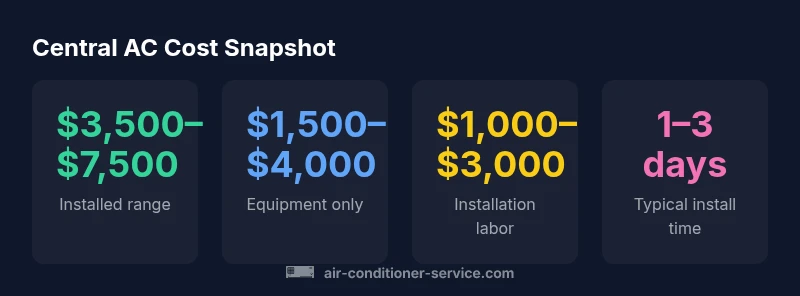
The total installed cost typically ranges from about $3,500 to $7,500 for a full central air conditioner system, depending on unit size (tons), efficiency (SEER), ductwork, and local labor. Equipment alone can range roughly $1,500 to $4,000, with installation often adding $1,000 to $3,000.
What determines the total installed cost for a central air conditioner
If you're wondering how much is a central air conditioner, the answer varies widely. The total installed price for a typical home is influenced by system size (tons), efficiency (SEER), ductwork, climate, and contractor labor. According to Air Conditioner Service, budget plans should account for the entire package—not just the equipment price—to avoid surprises. In 2026, realistic installed ranges tend to span several thousand dollars, reflecting both equipment choices and site-specific challenges. Beyond the base price, homeowners should factor permits, disposal fees, and any required upgrades to electrical or ventilation that can impact the bid. The most cost-effective path often starts with obtaining multiple quotes that break out equipment, labor, and add-ons, then comparing long-term costs such as energy use and maintenance.
Equipment vs. installation cost: where the money goes
A central air conditioner price breaks down into two primary buckets: equipment (the unit itself) and installation (labor, ductwork, and ancillary work). Equipment costs hinge on size (measured in tons) and efficiency (SEER rating). Higher efficiency units deliver lower operating costs but come with higher upfront prices. Installation costs cover labor, refrigerant charging, testing, duct sealing, and any modifications to existing ductwork. When you see a bid, verify whether the price includes permits, disposal fees, and any required electrical work. Air Conditioner Service recommends treating installation as a value driver: a clean, properly sized system reduces future maintenance and energy bills over time.
Tonnage, SEER, and efficiency: price levers
System size (tonnage) is a primary driver of price. Larger homes or spaces that require more cooling capacity demand higher-priced units. SEER rating reflects efficiency; higher SEER units cost more upfront but offer substantial long-term energy savings. When evaluating bids, compare similarly sized units with equivalent SEER ratings to isolate other cost drivers. Maintenance needs, warranty terms, and compatibility with smart thermostats also influence the overall value. The key is to balance upfront cost with projected energy savings over the system’s lifetime.
Ductwork condition and home layout influence
If your existing ductwork is leaky or poorly insulated, installation costs rise due to the need for sealing, insulating, or even replacing sections. In some homes, retrofitting ducts to reach new equipment locations adds to labor and materials. Conversely, homes with well-maintained ducts and straightforward routing experience lower bids. Duct sealing and testing can also improve system performance, reducing operating costs by reducing air loss. When planning a purchase, consider a professional duct assessment as part of your initial quote to avoid surprise upgrades later.
Regional labor markets and permitting: what to expect
Labor costs vary significantly by region, city, and contractor availability. Some jurisdictions require building permits and safety inspections, adding time and cost to the project. Local code requirements may necessitate electrical panel upgrades or gas-line considerations that influence total price. In areas with high demand for HVAC work, expect bids to be higher but with potentially faster scheduling. Air Conditioner Service notes that timing your project with favorable seasons or promotions can save on both labor and equipment.
Financing options and long-term savings
Many contractors offer financing or payment plans to help spread the upfront cost. Compare interest rates, repayment terms, and any promotional offers. While financing can lower immediate out-of-pocket costs, it may increase the total cost over time. Weigh this against long-term energy savings from a more efficient unit. In some cases, a higher-efficiency unit with a longer warranty may justify the upfront expenditure through reduced utility bills and maintenance costs over a 10–15 year horizon.
How to compare quotes and avoid common upsells
Request written, itemized quotes from multiple contractors and verify the inclusions: equipment, installation, ductwork, permits, and disposal. Watch for add-ons that aren’t essential, such as extended warranty packages or unnecessary duct modifications. Ask about duct cleaning, air sealing, and refrigerant charging specifics. Get a clear estimate of maintenance costs and filter replacements. If a quote seems unusually low, probe for hidden costs or inferior workmanship. A thorough comparison helps you maximize value and minimize future service calls.
Maintenance costs and annual operating expenses
A central air conditioner’s ongoing costs include electricity, routine maintenance, and occasional component replacements (filters, capacitors, or coils). Regular maintenance—such as annual tune-ups and filter changes—helps sustain efficiency and prevent expensive repairs. Over the system’s life, energy savings from a higher SEER unit can offset higher upfront costs, particularly in hot climates with longer cooling seasons. Budget for maintenance intervals and potential minor repairs as part of the total ownership cost.
Typical cost components for central air conditioner installation
| Component | Typical price range | Notes |
|---|---|---|
| Equipment price (central unit) | $1,500–$4,000 | Depends on tonnage and efficiency (SEER) |
| Installation labor | $1,000–$3,000 | Labor varies by region and duct access |
| Ductwork/retrofits | $0–$3,000 | Duct condition can raise or lower costs |
Common Questions
What affects the price of a central air conditioner?
Key factors include unit size (tons), SEER rating, ductwork condition, installation difficulty, and local labor costs. Equipment price varies, but the total installed cost reflects all components and services.
Price mainly depends on size, efficiency, ductwork, and local labor.
Is installation included in the price?
Most bids separate equipment and installation, but many contractors quote installed price. Always confirm what’s included and if permits or removal fees are charged separately.
Check whether installation is included and what extras apply.
Can I finance a central AC installation?
Yes, many HVAC contractors offer financing or payment plans. Compare interest rates, terms, and any promotional offers before committing.
Financing is commonly available; compare terms.
What is SEER and why does it matter for price?
SEER measures cooling efficiency. Higher SEER units cost more upfront but usually reduce annual energy bills more over time.
Higher efficiency often lowers operating costs but costs more upfront.
How long does central AC installation take?
Most installations take 1–3 days depending on home layout, ductwork, and permit requirements.
Typically a day or two, sometimes longer.
“Pricing for central air is driven by system size, efficiency, and installation complexity; a clear estimate requires inspecting your home’s ductwork and insulation.”
The Essentials
- Get multiple quotes to compare price and service
- Consider total installed cost, not just equipment price
- Higher SEER saves energy but requires upfront investment
- Ductwork condition largely controls installation costs
- Financing options can spread the cost over time