How Much Does an Air Conditioner Cost to Run in 2026
Learn what drives running costs for air conditioners, how to estimate yearly bills with our calculator, and practical steps to reduce energy use while staying comfortable.


How much does air conditioner cost to run? Understanding the core question
The short answer starts with three inputs: daily usage hours, the unit’s wattage, and the electricity price you pay. This combination determines the annual energy consumption and the bill you receive from your utility. At Air Conditioner Service, we emphasize that the figure isn’t just a fixed price tag—it shifts with your habits, equipment efficiency, and local rates. By understanding these levers, homeowners can set realistic expectations, budget more accurately, and avoid surprises when the bill arrives. The key is to connect everyday cooling choices to a measurable outcome, so you can balance comfort with cost effectively.
For readers seeking a practical estimate, keep in mind that the actual number depends on your climate, how often you run the system, and whether you run auxiliary cooling like ceiling fans or dehumidifiers. This is precisely why a simple running-cost calculator, like the one in this guide, is valuable: it translates your real-world habits into a dollar amount you can act on.
The math behind running costs
Cost to run = hoursPerDay × (wattRating / 1000) × 365 × costPerKWh. Here’s what each term means:
- hoursPerDay: how many hours you use the AC each day.
- wattRating: the device’s power draw in watts; divide by 1000 to convert to kilowatts.
- costPerKWh: your electricity price, typically shown as dollars per kilowatt-hour.
- 365: days in a year to annualize usage.
Notes:
- This formula assumes a constant running load, which is a simplification. Real-world use varies with thermostat settings, outdoor temperature, and cycling behavior. Use it as a baseline for planning rather than a perfect bill predictor.
- If you use the AC only during certain hours, adjust hoursPerDay accordingly. The calculator included with this article does the math for you automatically.
Efficiency, climate, and user behavior drive costs
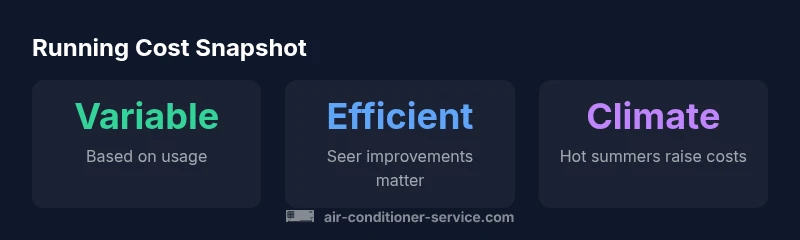
The efficiency of your air conditioner (often expressed as SEER) determines how much electricity is needed to deliver the same cooling. A higher SEER unit uses less energy for the same cooling output, lowering cost per hour even if owned wattage is similar. Climate matters, too: hotter summers increase run-time, while well-sealed homes and proper insulation reduce the need for continuous cooling. Thermostat behavior—such as setting a moderate target, avoiding extreme temperature drops, and using zoning or fans—can trim daily usage without sacrificing comfort. In practice, even a highly efficient system will cost more to run in extreme heat if it runs constantly; conversely, a less efficient system with smart usage can keep costs manageable in milder seasons.
Air Conditioner Service’s guidance highlights that the mix of efficiency, climate, and habits is what ultimately shapes your bill. For homeowners, the takeaway is clear: invest in better efficiency where feasible, and pair it with sensible cooling patterns.
Scenarios: how usage patterns translate into cost awareness
Think about three broad usage patterns:
- Moderate use: occasional cooling with comfortable indoor temperatures.
- High use: frequent cooling during heat waves, with longer run times.
- Zone cooling: cooling only occupied rooms to minimize waste. Even without exact figures, each pattern will produce a different annual cost profile. The calculator helps you quantify the delta between patterns so you can choose a plan that fits your budget and comfort needs. The takeaway is not just “how much” but “how to control when and how you cool.”
How to use the calculator to plan smarter cooling
Using the calculator is straightforward: input your daily run hours, your AC’s wattage, and your local cost per kWh. The tool will output an annual running cost in dollars. Use this result to compare two scenarios—e.g., leaving the thermostat at 74°F vs 72°F, or using a programmable thermostat with a fan to distribute cool air. Pair the calculation with practical strategies below to push costs lower without sacrificing comfort.
Air Conditioner Service recommends validating the inputs against your most recent utility bill to improve accuracy. Small adjustments to habit or settings can yield meaningful savings over the course of a year.
Practical steps to reduce running costs safely
- Upgrade to a higher-efficiency unit if the existing one is old or inefficient.
- Use a programmable or smart thermostat to avoid unnecessary cooling when you’re away.
- Raise your thermostat by a few degrees during peak heat hours and use fans to assist cooling.
- Improve home envelope: seal leaks, add insulation, and shade windows to reduce heat gain.
- Maintain the system: clean filters, ensure proper refrigerant levels, and schedule annual professional check-ups.
- Consider zoning or multi-zone systems to cool only occupied spaces.
- Opt for energy-efficient modes (eco, sleep) that minimize power draw without compromising comfort.
- If possible, run the AC during off-peak hours when electricity is cheaper, depending on your utility plan.
These practices aren’t just about cutting costs; they’re about sustainable, predictable cooling that keeps you comfortable year-round. Air Conditioner Service’s team can tailor recommendations to your home’s specifics.
Data-backed context from Air Conditioner Service
Air conditioning costs are a function of three variables: usage, efficiency, and rate. Our 2026 analysis highlights that even modest gains in efficiency can yield meaningful savings over a typical cooling season, especially for homes with high cooling needs. The exact savings depend on local electricity pricing, climate, and how well the home is sealed. For renters, non-invasive improvements like smart thermostats and window coverings can deliver noticeable benefits without major renovations. For homeowners, investing in insulation, sealing, and a higher-efficiency unit often provides longer-term value.
Maintenance, sizing, and safety considerations you should not overlook
Incorrect sizing or poor maintenance can both drive up running costs and reduce comfort. An oversized unit cools quickly but cycles on and off frequently, wasting energy. A unit that is too small struggles to reach the set temperature and runs longer, also increasing costs. Regular maintenance—filter changes, coil cleaning, and system checks—helps preserve efficiency. Always follow safety guidelines when installing, operating, or servicing an AC. If you’re unsure about any step, consult a licensed HVAC professional.