How Much Electricity Does an Air Conditioner Use? A Practical Guide
Discover how much electricity an air conditioner consumes, what drives energy use, and practical steps to estimate and reduce cooling costs across window, split, and central systems.


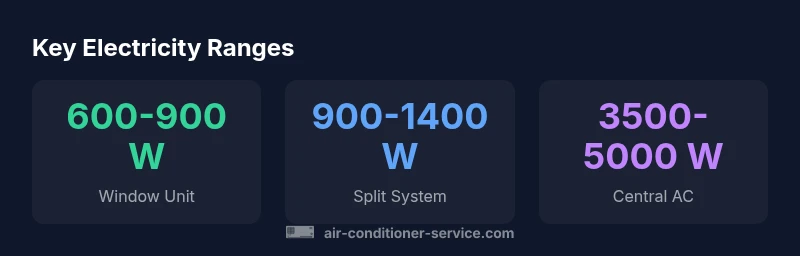
How much air conditioner consume electricity varies by type, size, climate, and usage. On running, most window units pull roughly 600–900 watts, while split systems commonly operate in the 900–1,400 W range and central air can run 3,500–5,000 W during peak cooling. Annually, consumption often lands in broad ranges: window units 200–900 kWh, split systems 800–1,500 kWh, central systems 3,000–7,000 kWh, depending on SEER, settings, and occupancy.
Why understanding electricity consumption matters
When homeowners ask how much air conditioner consume electricity, the answer hinges on multiple factors: unit type, cooling load, climate, and how often you run the system. At a high level, electricity use translates to comfort delivered per kilowatt-hour. In practical terms, knowing the rough power draw helps you estimate monthly and seasonal costs, compare efficiency upgrades, and decide when to run the AC versus alternative cooling methods. The Air Conditioner Service team emphasizes that even small efficiency gains can compound over a hot season, especially if you live in a climate with long cooling seasons. This article uses practical ranges and widely accepted calculations to help you plan without needing specialized equipment.
What drives electricity use in air conditioners
Energy consumption is driven by several levers: the cooling load (how much heat needs to be removed), the unit’s efficiency rating (SEER or EER), the thermostat setpoint, and runtime. Other contributors include ductwork losses, inverter vs. traditional compressors, outdoor temperature, humidity, and airflow. A smaller unit running at a lower thermostat setting can consume more energy than a larger, efficient system set closer to your comfort needs. Regular maintenance—clean filters, sealed ducts, and refrigerant health—keeps the system from working harder than necessary. The key is to size, optimize, and monitor usage rather than rely on a one-size-fits-all assumption.
Energy usage by cooling system type
Different AC types have distinct energy footprints. Window units are typically lower in upfront cost and power draw but can be inefficient for larger spaces. Split systems offer higher efficiency and better zoning but require proper installation. Central air delivers uniform cooling for multiple rooms but demands more energy, especially in larger homes or hotter climates. In all cases, a higher SEER rating generally means lower energy per cooling output, while maintaining comfort. When evaluating options, compare not just watts but the seasonal energy performance ratio (SEER) or energy efficiency ratio (EER) figures published by manufacturers.
Estimated energy ranges by air conditioner type
| AC Type | Typical Power (W) | Estimated Running Hours/Day | Estimated Annual Energy (kWh) | Notes |
|---|---|---|---|---|
| Window Unit (8k BTU) | 600-900 | 4-6 hours | 200-900 | Compact room cooling |
| Split System (1.5–2 ton) | 900-1400 | 4-8 hours | 800-1500 | Popular for mid-size homes |
| Central AC (3–4 ton) | 3500-5000 | 6-12 hours | 3000-7000 | Whole-house cooling |
Common Questions
What is the typical wattage range for a window air conditioner?
Most window units operate around 600–900 watts when actively cooling. The exact figure depends on BTU rating, compressor type, and age. Look for the label on the unit for the running wattage at rated conditions.
Most window air conditioners run about six to nine hundred watts when cooling. Check the label for your exact running wattage.
How can I calculate my monthly electricity cost for AC?
Estimate cost with: cost = (Wattage/1000) × hours per day × days per month × local rate. Use a thermostat scheduling to avoid cooling when you don’t need it.
To estimate monthly cost, multiply the running kilowatts by hours and days, then by your rate per kilowatt-hour.
Does SEER rating affect consumption?
Yes. SEER measures cooling output per watt. Higher SEER generally means lower energy use for the same cooling load, but up-front cost and climate matter.
Higher SEER means more efficient cooling per watt, saving energy over time.
Is it cheaper to run a ceiling fan instead of AC?
For comfort on mild days or when you’re active, fans use far less energy. Use AC for extreme heat or when you need consistent cooling in a space.
Fans use much less energy; use them for mild conditions or when you don’t need full cooling.
How often should I maintain my AC to keep consumption low?
Schedule seasonal maintenance: replace filters regularly, inspect ducts, and ensure refrigerant levels are correct. Proper maintenance reduces energy waste and extends equipment life.
Regular seasonal maintenance helps your unit use less energy and perform better.
What signs indicate high energy consumption?
Unusually high bills, uneven cooling, warm air from registers, or strange noises can signal inefficiencies or issues like dirty coils or refrigerant leaks.
If bills spike or cooling drops, get a check for dirty coils or leaks.
“Energy efficiency is about delivering comfort with the least energy per degree of cooling. Start with proper sizing and an efficient system, then optimize usage to sustain savings.”
The Essentials
- Estimate consumption by type and climate, not one-size-fits-all.
- Higher SEER ratings reduce energy per cooling output.
- Regular maintenance lowers hidden energy waste.
- Use programmable thermostats to avoid energy during idle times.
- Compare annual energy estimates, not just running watts.