Do Air Conditioners Use a Lot of Electricity? A Practical Guide
Explore how much electricity air conditioners use, what factors influence usage, and practical steps to lower bills without sacrificing comfort. Includes real-world ranges, tips, and maintenance basics.


Do air conditioners use a lot of electricity? It depends on the unit type, climate, efficiency, and how you use it. On average, small window units draw a few hundred watts, while central systems run in the kilowatt range when active. By comparing running power (watts) with runtime (hours), you can estimate consumption and identify practical ways to cut bills.
Do air conditioners use a lot of electricity?
Do air conditioners use a lot of electricity? The short answer is that electricity consumption depends on several variables, including the type of unit, the climate where you live, how efficiently the system is sized and installed, and how you operate it. The Air Conditioner Service team emphasizes that the most meaningful comparison is between running power (in watts) and the number of hours the unit runs each day. In many homes, a modern, properly sized system can deliver reliable cooling with a manageable incremental increase in electricity use—especially when it replaces older, less efficient equipment. The real truth is that electricity use scales with demand: hotter weather and longer cooling seasons raise consumption, while better efficiency and smarter use lower it. If you’re trying to budget, think in terms of watts and hours rather than the nameplate wattage alone.
According to Air Conditioner Service, a practical approach is to compare how many watts your unit draws while running to the number of hours it runs per day. This helps you estimate monthly and annual energy costs more accurately than simply looking at the label. Modern units, when properly installed and maintained, often deliver comfortable cooling with a comparatively modest impact on bills—especially in homes with decent insulation and efficient ductwork. You’ll find that the big savings often come from how you use the system, not just the unit’s advertised power draw.
How electricity usage is measured
Electricity usage is measured in watts (W) for instantaneous power and kilowatt-hours (kWh) for energy over time. A standard formula is kWh = (W × hours) / 1000. When you see a label like 3,000 W for a central air system, that number represents the running load when the compressor and fans are active. The actual energy use depends on how many hours per day the system runs and how efficiently it operates. Efficiency is expressed through indicators such as SEER (Seasonal Energy Efficiency Ratio) and EER (Energy Efficiency Ratio) in the U.S. market. If you want to estimate costs, multiply the kWh by your electricity rate (per kWh) and then multiply by the number of days in the billing cycle. For households with variable rates or seasonal usage, keeping a running log of temperatures and run times can help you build a more accurate forecast.
To make this concrete: determine your unit’s running wattage, estimate daily runtime, and multiply to obtain daily energy use. Then compare across different thermostat settings or operating modes (cooling versus auto or fan-only). The takeaway is practical: you can predict your costs by tracking how long the AC runs and how much power it draws rather than guessing from one-off measurements.
Typical electricity ranges by unit type
Different types of air conditioners consume electricity at different rates, and understanding these ranges helps you set realistic expectations. Here are typical ballparks to help you compare, keeping in mind that actual figures vary with climate, insulation, and unit efficiency:
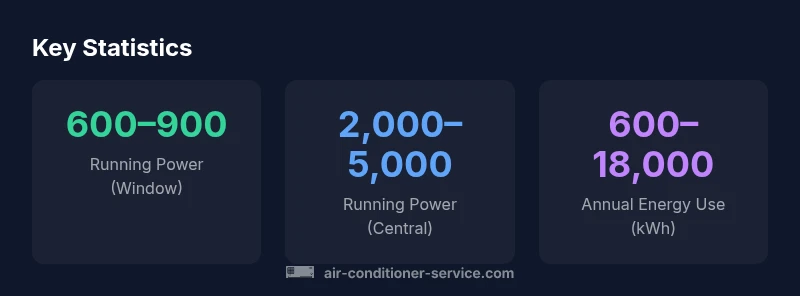
- Window or through-the-wall units: These compact units commonly run in the 600–900 W range when cooling. In mild climates or with light cooling loads, actual consumption may be lower; in hot climates with long cooling seasons, daily energy use increases.
- Portable air conditioners: Portable models generally fall in the 700–1,200 W range. They provide flexible cooling but can be less efficient than dedicated wall units due to exhaust routing and fixed airflow paths.
- Central (ducted) air systems: When operating, central systems typically draw between 2,000–5,000 W (2–5 kW). Although they serve larger spaces, their efficiency hinges on proper duct sealing, refrigerant charge, and outdoor unit performance. High-end, properly sized systems with modern compressors and variable-speed fans can deliver the most efficient results.
To put these numbers into perspective, a central system running at 3 kW for 1,000 hours per year would consume about 3,000 kWh. A window unit running at 750 W for 1,000 hours would use about 750 kWh. As with any estimate, the actual difference hinges on your climate, the home’s thermal envelope, and the unit’s efficiency rating. The key takeaway is that central systems, while more powerful, can be highly efficient if correctly sized and maintained, whereas smaller units can be cost-effective in smaller spaces or occasional use.
How climate, usage, and efficiency affect the bill
Climate and usage patterns strongly influence electricity bills. In hot climates with longer cooling seasons, even efficient systems run more hours, increasing total energy consumption. Conversely, in milder climates, even a less efficient unit may spend less time cooling, limiting energy use. Efficiency improvements, measured by SEER, EER, and COP (coefficient of performance) for heat pumps, can dramatically cut energy consumption for the same cooling output. Inverter-driven, variable-speed compressors adjust output to the load, reducing power draw during partial-load conditions and in mild weather.
Beyond unit efficiency, the home’s thermal envelope matters. Well-insulated ceilings and walls, reflective roofing, energy-efficient windows, and properly sealed ducts minimize heat gain and reduce the cooling load. Duct leakage can significantly worsen energy use, sometimes by a noticeable margin, especially in older homes. Thermostat settings play a huge role as well; higher indoor temperatures and longer run times often negate the efficiency gains of a high-SEER unit. Real-world data from the Air Conditioner Service team shows that combining efficient equipment with good building practices yields the best savings, especially when you pair it with smart or programmable thermostats that align cooling with occupancy patterns.
Estimated running power, runtime, and energy use by AC unit type
| Unit Type | Typical Running Power (W) | Estimated Annual Runtime (hours) | Estimated Annual Energy Use (kWh) |
|---|---|---|---|
| Window unit | 600–900 | 800–1,400 | 480–1,260 |
| Portable AC | 700–1,200 | 1,000–1,500 | 700–1,800 |
| Central/Whole-house | 2000–5000 | 2,000–4,000 | 4,000–20,000 |
Common Questions
Do all air conditioners use the same amount of electricity?
No. Energy use varies by unit type, efficiency rating (SEER/EER), climate, and how you operate the system. A central system often draws more power when cooling a larger area, but a high-efficiency unit can use less energy than an older, undersized model.
No—energy use depends on the unit type, efficiency, and your cooling habits.
How can I estimate my AC’s electricity usage?
Check the running wattage on the label, estimate daily run hours, and multiply to get daily kWh. Use this with your electric rate to forecast monthly bills. A simple method is to log run times in a few hot weeks and scale to a yearly estimate.
Look at the wattage, track run time, and multiply to estimate your costs.
Will upgrading to a higher-SEER unit save money?
Upgrading to a higher-SEER model generally reduces energy use for the same cooling output, but the payback depends on climate, usage, and upfront costs. In very hot climates, savings can be meaningful over the unit’s lifetime.
Yes, higher SEER often saves energy, but consider climate and cost.
Do smart thermostats reduce electricity usage?
Smart thermostats optimize cooling times and temperatures based on occupancy. They can reduce energy use, especially if you automate schedules and coordinate with fans and dehumidification.
Smart thermostats help by cooling when needed and avoiding wasted run time.
What maintenance steps reduce electricity use?
Regularly replace filters, seal ducts, clean coils, and ensure proper refrigerant charge. Schedule annual professional checkups to maintain efficiency and catch issues before they waste energy.
Keep filters clean and ducts sealed to cut waste.
Are big differences between small window units and central air?
Yes, central systems typically move more air and cover larger spaces, which can mean higher power draw, but efficient central systems can outperform undersized or aging window units. Sizing and efficiency matter more than the type alone.
Central systems can be more powerful, but efficiency and sizing determine energy use.
“Energy efficiency isn’t a single feature; it’s the result of proper sizing, installation, and maintenance working together.”
The Essentials
- Estimate energy use with watts × hours to forecast bills
- Choose higher SEER for long-term savings
- Ensure proper installation and duct sealing to reduce waste
- Tune thermostat settings and use smart controls for efficiency