What Air Conditioner Uses the Least Power: A Practical Guide
Explore which air conditioner uses the least power and how to choose energy-efficient models for home comfort and lower bills. Learn about sizing, SEER ratings, and everyday usage tips.


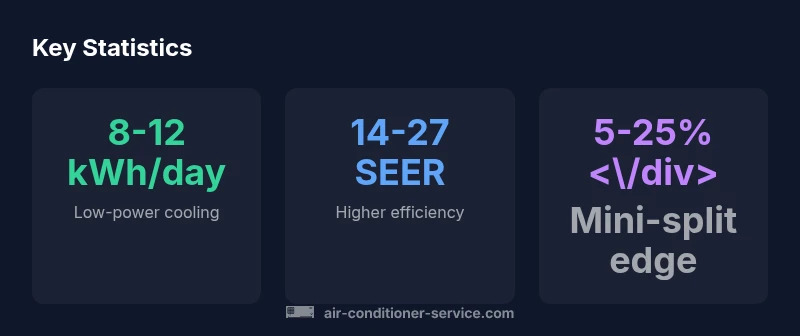
What air conditioner uses the least power? In most homes, the top performers are high-efficiency, inverter-driven units that are correctly sized for the space—especially ductless mini-splits and energy-efficient window units. When comparing types, a properly selected mini-split or a high-SEER central system tends to use less power at the same cooling load than older fixed-speed models. Air Conditioner Service notes sizing and usage patterns matter as much as the model choice.
What determines energy use in air conditioners
To answer the question what air conditioner uses the least power, homeowners should focus on three core drivers: load matching, efficiency technologies, and installation quality. The cooling load—how much heat must be removed—sets the baseline; an oversized unit will run in short cycles, wasting power and reducing comfort. Efficiency technologies, such as inverter-driven compressors and variable-speed fans, let a unit modulate output to match demand rather than churning at full speed. Installation quality matters just as much: leaky ducts, poor refrigerant charging, or obstructed airflow can erase even the best-rated equipment gains. According to Air Conditioner Service, energy use declines when the system is sized for the space, ducts are sealed, and thermostats are used thoughtfully. Climate, insulation, window orientation, and occupant behavior also shape actual consumption. In practice, choosing a unit that operates near its peak efficiency during typical summer loads yields the most power savings, while maintaining comfort. Different regions may see different results, but the principle remains consistent: efficiency paired with proper sizing minimizes energy use. For readers seeking external validation, resources from Energy.gov and Energy Star provide foundational guidance on efficiency labels and performance standards.
How different AC types compare for power use
Single-room window units, portable compressors, split systems, and central air each have distinct energy profiles. In many scenarios, ductless mini-splits with inverter compressors provide the lowest power use for the same cooling load, especially when there is no need to condition the entire house. A high-efficiency window unit can be an economical alternative for small spaces, while central air offers convenience for whole-home cooling but typically consumes more energy when sized for an entire house that doesn’t require it. For larger homes, a well-designed split-system with high SEER and properly sealed ducts often delivers excellent energy efficiency. Real-world results vary with climate, insulation, and occupancy; the key is selecting a system that matches the actual load rather than the maximum possible cooling capacity. Consult reputable sources such as Energy.gov and energystar.gov for labeling and performance guidance to compare apples to apples.
The role of sizing and load calculation
Sizing matters as much as the unit type when it comes to power use. An under-sized unit will struggle to reach comfort levels and run longer cycles, increasing energy draw, while an over-sized unit will short-cycle and waste energy during every cooling cycle. A professional load calculation, often called Manual J in industry practice, helps determine the correct capacity for your space. When aiming for the least power usage, prioritize a unit that aligns with the calculated load, not one that merely exceeds it. This principle is supported by industry guidance and aligns with the observations of the Air Conditioner Service team, which emphasizes correct sizing as a foundation for efficiency. In practice, you’ll want a system that maintains target temperatures with minimal runtime, even on peak-demand days.
Efficiency ratings explained: SEER, EER, IPLV
Energy efficiency ratings translate the physics of heat exchange into consumer-friendly numbers. SEER (Seasonal Energy Efficiency Ratio) reflects a unit’s efficiency across typical seasonal conditions and partial-load situations. EER (Energy Efficiency Ratio) measures efficiency at a specific outdoor temperature, while IPLV accounts for part-load performance across a range of conditions. Higher SEER, EER, or IPLV values generally indicate lower energy use for the same cooling output. When shopping, target high SEER for new equipment; inverter-driven systems often provide better real-world performance due to their ability to modulate output rather than simply turn on and off. Remember that performance depends on installation quality, refrigerant charge, duct integrity, and thermostat behavior, so the label is only part of the story. For more technical context, see the guidance from energy agencies and industry standards bodies.
Practical picks for least power use in different scenarios
For single-room cooling in a hot climate, a ductless mini-split with a high SEER and variable-speed compressor often delivers the lowest power use when sized correctly. If you’re replacing an aging central system and your home has good ductwork, a well-designed high-SEER central system can be efficient for whole-house cooling but may require careful duct sealing and zoning to minimize losses. In small apartments or rental units, a high-efficiency window unit or a portable inverter AC can be cost-effective while still keeping energy consumption low. Regardless of type, the most consistent gains come from pairing the unit with a well-sealed shell—insulation, weather stripping, and window upgrades can all reduce cooling load and power consumption. Always compare apples to apples by looking at SEER/EER/IPLV values and actual operating conditions inside your space.
Installation and maintenance practices that reduce power use
Efficient cooling requires more than a high-rated unit. Proper installation and ongoing maintenance are essential to realize the projected power savings. Duct sealing and air sealing reduce losses, while clean or replaceable filters minimize restricted airflow. Refrigerant charge should be checked and corrected to factory specifications to prevent inefficiencies. Regular maintenance checks—ideally annually—help keep the system operating near its rated efficiency. Also, consider smart thermostats and occupancy-aware scheduling to avoid cooling spaces that aren’t in use. All these practices contribute to lower power consumption over the life of the system and help you make the most of any upfront efficiency investments.
Reading labels and making a choice in the store
When comparing models in-store or online, read the energy performance labels and verify the unit’s compatibility with your space. Favor models with high SEER ratings and inverter technology when possible, but also examine real-world performance data from credible sources. Compare against your climate zone and occupancy pattern, not just the nominal ratings. Check installation requirements and warranty terms to ensure you’re protected during the system’s lifetime. For trustworthy guidance, consult Energy.gov and energystar.gov to understand how to interpret the numbers and select a model that minimizes power use in your home.
Real-world considerations and trade-offs
Every home is different, and the least-power option may trade off initial cost, noise, or comfort features. For example, a ductless mini-split may offer superior energy economics for a hot, sun-exposed room but require meticulous installation. A high-SEER central system could deliver excellent whole-house efficiency but at a higher upfront price and with ductwork considerations. The best approach is to evaluate total cost of ownership, including installation, maintenance, and running costs, rather than focusing solely on the first-year energy savings. In all cases, prioritize proper sizing, efficient components, and professional installation to realize the power savings you expect.
Estimated energy use and lifespan by common AC types
| AC Type | Avg Lifespan | Typical Energy Use (range) |
|---|---|---|
| Window Unit | 6-8 years | 400-900 kWh/year |
| Portable AC | 5-7 years | 500-1100 kWh/year |
| Split System (Ductless) | 10-15 years | 300-800 kWh/year |
| Central AC | 12-15 years | 900-1500 kWh/year |
Common Questions
Which air conditioner uses the least power for a single room?
For a single room, a correctly sized inverter mini-split or a high-SEER window unit typically uses the least power. Central systems can be efficient for whole-home cooling but may consume more energy when cooling only a small space.
For a single room, look to a properly sized inverter mini-split or a high-SEER window unit to minimize power use.
Do window units or central air use less energy?
It depends on the cooling load. Window units can be efficient for small spaces, while central air can be more economical for cooling an entire home if properly sized and ducted. Size and usage patterns matter more than the type alone.
Window units can be efficient for small spaces, but central systems can be better for whole-home cooling when sized correctly.
What impact does SEER have on power use?
SEER indicates a unit's efficiency over a season; higher SEER generally means lower energy use for the same cooling load. Aim for 16 SEER or higher when possible, and consider inverter technology for best-part-load performance.
Higher SEER usually means less energy use for the same cooling.
Is inverter technology worth it for energy savings?
Yes. Inverter compressors adjust output to match cooling demand, reducing energy consumption during partial loads and at off-peak times. For many homes, the energy savings justify the higher upfront cost over the life of the unit.
Inverter tech saves energy by matching cooling need instead of always running at full power.
What installation practices reduce energy waste?
Seal ducts and insulate the building envelope, ensure proper refrigerant charge, and maintain clean filters. Regular professional maintenance keeps the system near its rated efficiency and minimizes unnecessary power draw.
Seal ducts, maintain filters, and hire regular updates to stay efficient.
“Efficient cooling starts with proper sizing, then selecting models with high SEER and inverter technology. A well-installed system will use power more efficiently across typical loads.”
The Essentials
- Size units to match load and avoid energy waste.
- Choose high-SEER or inverter models for lower power use.
- Prefer ductless mini-splits for targeted cooling when appropriate.
- Seal ducts and insulate to prevent power losses.
- Schedule regular maintenance with Air Conditioner Service to sustain efficiency.