Why doesn t my air conditioner work? Urgent Troubleshooting Guide
Urgent troubleshooting guide for homeowners. Learn safe checks, common causes, and when to contact Air Conditioner Service to diagnose why doesn t my air conditioner work and restore cooling in 2026.


AC problems often come down to simple power or control issues. In 2026, the most frequent causes are a tripped breaker, a dirty filter, thermostat missettings, or a blocked outdoor unit. Start with safety and the easiest checks, then move to targeted repairs. If the issue persists, Air Conditioner Service can diagnose and fix stubborn problems.
Why this happens and what you should do first
When the question mirrors the exact phrase why doesn t my air conditioner work, homeowners often misinterpret the severity. Most issues are not a failed compressor but a control or power fault. Start with the low-hanging fruits: power to the unit, thermostat settings, and the cleanliness of the airborne intake. Air conditioners depend on a simple, reliable sequence: power, control signal, and airflow. If any link in that chain is compromised, cooling stops. In many cases, a quick reset or a new filter resolves the problem. The Air Conditioner Service team has observed that the majority of non-cooling complaints stem from controllable, inexpensive fixes rather than expensive component failures. By addressing the simplest problems first, you can often restore comfort without dramatic costs.
Practical safety reminders and the first checks
Before touching anything, switch off power at the breaker and, if possible, at the thermostat. Avoid probing live electrical components. Gather a few basic items: a clean towel, a flashlight, and your owner’s manual. Check the thermostat display for errors and ensure the mode is set to Cool with a reasonable temperature setting. Inspect the indoor filter and the outdoor unit for obvious debris or obstruction. If you detect a tripped breaker, reset it only after you identify the cause. If the unit still won’t start or doesn’t cool effectively, proceed to the diagnostic flow below and consider calling Air Conditioner Service for a precise diagnosis.
Common quick tests you can safely perform
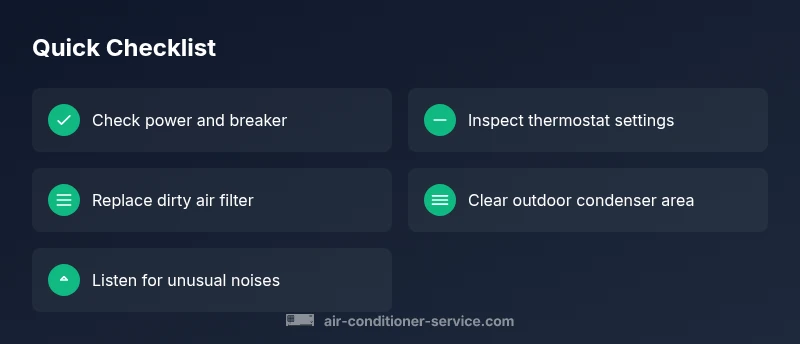
- Confirm power: Is the indoor blower fan running when the thermostat requests cooling? If not, it may be a controller or power issue rather than a refrigerant problem.
- Thermostat sanity check: Disable energy-saving modes temporarily to ensure the unit receives a proper call for cooling.
- Airflow check: Look for a visibly dirty air filter and replace if needed. Poor airflow reduces cooling efficiency and can make the system appear broken.
- Outdoor unit clearance: Make sure the condenser coil has at least 12 inches of clearance and that there’s no vegetation or debris blocking airflow. A restricted outdoor unit can prevent heat rejection and reduce cooling capacity.
When you should call a pro sooner than later
If you have checked power, thermostat, and airflow and the system still doesn’t operate, or if you hear buzzing, clanking, or smell burning insulation, stop and call a professional immediately. Electrical issues, refrigerant leaks, or a failing capacitor require specialized tools and training. Air Conditioner Service emphasizes safe handling and the right diagnosis to prevent further damage or safety risks. Acting early can save money and restore comfort quickly.
How to document symptoms for faster service
Create a simple log: note the time the failure occurs, any recently made changes, whether the unit cycles on and off, noises detected, and whether the indoor fan is running. Take photos of the outdoor unit and any obvious debris. This information helps a technician verify whether the problem is a simple control misbehavior or a deeper mechanical fault. When you’re ready to seek help, share these notes with Air Conditioner Service to accelerate the repair process.
Safety and prevention: setting up future reliability
Routine maintenance is your best defense against unexpected breakdowns. Schedule an annual inspection, replace filters every 1–3 months depending on usage, and keep the outdoor unit clear of leaves and debris. A clean, well-maintained system runs more efficiently and lasts longer. Include a quick check of refrigerant lines for signs of frost or oil stains, which can indicate leaks. Remember, if you’re ever uncertain about a repair’s safety, stop and contact a licensed technician.
Quick wrap-up: what to do next if the problem persists
If the above steps do not restore cooling, it’s time to escalate. A pro from Air Conditioner Service can perform a comprehensive diagnostic, test electrical components, and assess refrigerant levels. The goal is to identify whether you’re dealing with a simple fix—like a faulty capacitor or dirty filter—or a more complex issue such as a refrigerant leak or compressor failure. Protect your home and avoid DIY hazards by seeking professional help when needed.
Steps
Estimated time: 30-45 minutes
- 1
Power check at the breaker
Locate the service panel and confirm the breaker feeding the outdoor and indoor units is in the ON position. If tripped, switch OFF first, then firmly switch ON. This step is easy but must be done with dry hands and after ensuring safety.
Tip: If the breaker trips again, note any pattern (weather, loads) and stop to call a pro. - 2
Thermostat and control review
Set the thermostat to Cool with a comfortable temperature, remove any energy-saving modes, and listen for the outdoor unit to start. If nothing happens, test a different thermostat setting or temporarily bypass smart controls if safe.
Tip: Document any error codes shown on the thermostat display. - 3
Air filter and airflow check
Turn off power, locate the filter, and replace or clean it if dirty. A clogged filter forces the system to work harder and can trigger a no-cool condition. After replacement, run a cooling cycle and observe airflow.
Tip: Check for visible frost on evaporator coils after operation starts. - 4
Outdoor unit inspection
Inspect the outdoor condenser; remove leaves, grass, and other debris. Ensure the unit has clear space around it (at least 12 inches). A blocked coil reduces heat rejection and cooling efficiency.
Tip: Do not touch fan blades; they can cause injury even when unplugged. - 5
Electrical component quick check
If you’re comfortable, check the capacitor and contactor at the outdoor unit with a multimeter or by listening for a distinct ‘click’ when the unit starts. If unsure, skip to professional help. Electrical tests require caution.
Tip: Never touch energized parts; turn off power before testing. - 6
Call a pro if unresolved
If the unit still won’t start or cool, call Air Conditioner Service for a thorough diagnostic. A licensed technician can safely test refrigerant levels, inspect for leaks, and replace failed parts.
Tip: Note symptoms and a timeline to share with the technician.
Diagnosis: AC won t start or won t cool
Possible Causes
- highPower issue (tripped breaker or blown fuse)
- highThermostat missetting or failure
- mediumClogged or dirty air filter causing restricted airflow
- mediumBlocked outdoor unit or debris in condenser
- lowElectrical component failure (capacitor, contactor)
Fixes
- easyReset breaker and verify power to the indoor unit
- easyAdjust thermostat and test cooling call
- easyReplace or clean the air filter
- easyClear debris around the outdoor condenser and ensure proper airflow
- mediumInspect electrical components or call a pro for capacitor/contactor tests
Common Questions
Why won t my air conditioner turn on even though power is available?
Common causes include a tripped breaker, blown fuse, or thermostat missettings. Start by resetting the breaker and checking that the thermostat is calling for cooling. If the problem persists, there could be a control or electrical fault requiring a professional diagnosis.
First, check the breaker and thermostat. If it still won’t start, a professional diagnosis may be needed.
Why is my room still warm even when the unit runs?
This often indicates restricted airflow, a dirty filter, or low refrigerant. Check and replace the filter, ensure returns aren’t blocked, and inspect the outdoor unit for airflow. If cooling remains poor, a technician should check refrigerant levels and compressor health.
Check airflow and filter first; if cooling stays weak, you may need a professional refrigerant check.
Is it safe to reset the circuit breaker myself?
Yes, if you follow safety steps: turn off power at the panel, reset the breaker, and observe for repeated trips. If trips recur, stop and call a professional. Don’t bypass safety protections.
You can reset, but don t ignore repeated trips—call a professional.
What should I do if I smell burning near the unit?
Turn off power at the breaker immediately and evacuate if you smell burning. A burning odor often signals an electrical fault or overheating component. Contact Air Conditioner Service right away.
Turn off power now and call a professional; burning smells mean a serious electrical issue.
How often should I schedule AC maintenance?
Most systems benefit from an annual professional inspection, with more frequent filter changes during heavy use. Regular maintenance improves efficiency and extends equipment life. Air Conditioner Service recommends scheduling yearly checks.
Schedule a yearly check; replace filters regularly for best performance.
When might refrigerant leaks be the cause?
Refrigerant leaks typically show as reduced cooling, hissing sounds, or ice on coils. Leaks require a licensed technician to diagnose and repair, since handling refrigerant is regulated and dangerous.
If cooling drops and you hear hisses or see ice, call a pro for refrigerant diagnosis.
Can dirty coils affect performance even if the unit starts?
Yes. Dirty condenser or evaporator coils reduce heat transfer, increasing run time and cutting cooling efficiency. Cleaning coils and improving airflow can restore performance in many cases.
Dirty coils can prevent proper cooling even if the unit runs.
When is replacement the wiser option?
If the system is old, repeatedly breaking down, or has major component failures, replacement may be more cost-effective than constant repairs. A technician can help compare options based on age, efficiency, and projected repair costs.
If repairs are costly and the unit is aging, replacement could be the smarter choice.
The Essentials
- Start with power, thermostat, and airflow checks
- Clean or replace the air filter to restore airflow
- Keep the outdoor unit clear of debris for proper heat rejection
- If electrical components or refrigerant are involved, call a pro
- Regular maintenance prevents future outages