How Big Portable Air Conditioners Should Be: A Sizing Guide
A practical guide to sizing portable air conditioners for your space. Learn how BTU requirements, room size, insulation, and sun exposure affect performance, with step-by-step calculations and practical tips from Air Conditioner Service.


To size a portable air conditioner, identify the room size in square feet, note insulation, and pick a unit in the appropriate BTU range. A rough guide: 5,000–8,000 BTU for small rooms (up to ~300 sq ft), 8,000–12,000 BTU for medium rooms, and 12,000–14,000 BTU for larger spaces. Always check unit specs for coverage and efficiency.
Why size matters for portable air conditioners
If you’ve ever asked how big portable air conditioner to buy, you’ve touched on a fundamental truth: size determines comfort, energy use, and humidity control. A unit that’s too small will run nonstop to reach the target temperature, but it won’t remove humidity efficiently, leading to damp rooms and a muggy feel. Conversely, an oversized portable AC will cool a space quickly yet cycle on and off, which wastes energy and can create cold spots. The reader should understand that accurate sizing improves dehumidification, comfort, and energy bills. According to Air Conditioner Service, correctly sizing a portable air conditioner is essential for comfort, efficiency, and long-term reliability. In practical terms, size is about BTU capacity relative to the space and conditions, not just square footage. The goal is to match the unit’s cooling output to the space while allowing a modest buffer for heat spikes and passive heat sources.
How BTU sizing relates to room size and conditions
BTU, or British Thermal Units per hour, is the standard metric for cooling power. A common starting point is to estimate BTU needs from room area in square feet, then adjust for ceiling height, sun exposure, and insulation. A typical baseline uses roughly 20 BTU per square foot for rooms with standard eight-foot ceilings. Higher ceilings, large windows, poor insulation, or sunlit rooms can push BTU needs higher. Occupants and heat-generating appliances add to the load. Air Conditioner Service’s guidance emphasizes that a precise BTU match is more important than chasing the latest feature set, because efficiency and comfort depend on the correct core sizing.
A practical sizing framework you can use
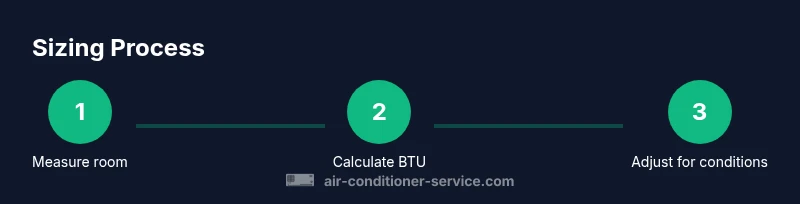
To size a portable unit effectively, start with accurate room measurements and a clear sense of how the space is used. Measure length, width, and ceiling height; convert to volume if ceilings are higher than standard. Use a base BTU estimate (area × 20 BTU) for eight-foot ceilings, then apply multipliers for high ceilings (e.g., ×1.25 for 9–10 ft ceilings), sun exposure (add 10–20%), and occupancy (add 600 BTU per person beyond two). Choose a unit with BTU slightly above the calculated target to cover heat spikes but avoid excessive oversizing, which can reduce humidity control. The aim is a balanced, comfortable space with reasonable energy use.
Room-by-room examples to illustrate sizing decisions
- Small bedroom (150–250 sq ft): 5,000–8,000 BTU. This range keeps temperatures steady without over-drying the air.
- Living room or open-plan space (300–500 sq ft): 8,000–12,000 BTU. Larger spaces may require a more capable unit or strategic placement near the main seating area.
- Kitchen or sun-exposed areas (400–700 sq ft): 12,000–14,000 BTU. Kitchens and rooms with large sun exposure need higher output to counter heat gain.
Common mistakes and how to avoid them
Avoid assuming a larger room automatically needs more BTU without checking insulation and external heat sources. Don’t rely on square footage alone—the same space with south-facing windows may require more BTU. Don’t overlook the exhaust hose length and window kit compatibility, which affect performance. Air Conditioner Service advises validating the final choice with the unit’s coverage chart and considering a small BTU buffer for peak heat days.
Tools & Materials
- Measuring tape (at least 25 ft / 7.6 m)(Used to measure room length, width, and ceiling height to compute area and volume)
- Notebook and pen(Record measurements, notes, and calculations)
- Calculator (or smartphone calculator)(To compute BTU targets and apply multipliers)
- Access to window dimensions and insulation details(Helpful for more accurate sun exposure adjustments)
- BTU sizing reference chart(Optional sheet or app with baseline BTU per square foot and multipliers)
Steps
Estimated time: 25-40 minutes
- 1
Measure the room
Use the measuring tape to record length and width in feet, then multiply to get floor area. If ceilings exceed eight feet, note the height to adjust volume calculations.
Tip: Take measurements in the space you actually cool, not just a baseline footprint. - 2
Compute base BTU target
Multiply the area (sq ft) by 20 BTU to get a rough baseline. For eight-foot ceilings, this is your starting point.
Tip: If you’re unsure about ceiling height, use volume instead of area for a more precise estimate. - 3
Adjust for ceiling height and heat sources
If ceilings are higher than eight feet, apply a multiplier (e.g., 1.25 for 9–10 ft). Add 10–20% for sun exposure and poor insulation, and 600 BTU for each person beyond two.
Tip: Wear sun exposure as a quick screen: larger windows usually demand more BTU. - 4
Select the right BTU range
Choose a unit with BTU equal to or slightly above the adjusted target (typically 10–20% buffer). This helps with humidity control without excessive cycling.
Tip: Overly aggressive oversizing can reduce humidity removal and efficiency. - 5
Check unit specs and efficiency
Review the product’s coverage chart, Energy Star rating, and noise level. Ensure the exhaust hose and window kit fit your setup.
Tip: A quieter unit with good efficiency can improve comfort even if BTU is similar to another option. - 6
Plan installation and test
Install the unit with minimal hose bends, test cooling in different spots, and verify that the unit maintains a comfortable temperature.
Tip: Place the unit away from heat sources and in a location with clear airflow for best results.
Common Questions
What BTU range do I need for a 350 sq ft room?
For about 350 sq ft, a portable AC in the 8,000–12,000 BTU range is commonly recommended, depending on sun exposure and insulation. Always reference the unit’s coverage chart and your measurements.
For a 350 square foot room, look at portable AC units around 8,000 to 12,000 BTU, depending on sun and insulation.
Can I size by ceiling height instead of area?
Ceiling height affects volume, so it helps to adjust BTU targets if you have ceilings taller than eight feet. Use volume-based estimates when available rather than area alone.
If your ceilings are higher than eight feet, consider volume-based sizing rather than area alone.
Will an oversized portable AC cool a room evenly?
An oversized unit can cool quickly but may struggle with humidity removal, leading to a less comfortable environment. Humidity control benefits from properly sized units.
Too big can cool fast but may not dehumidify well, affecting comfort.
How does sun exposure affect sizing?
Sunlit rooms gain heat, raising cooling needs. Increase BTU slightly for rooms with large windows or strong sun.
Sunny rooms need a bit more BTU to counter heat gain.
Do occupancy and appliances change BTU needs?
More people and heat-generating appliances raise heat load. Add about 600 BTU per person beyond two occupants and account for ovens or large electronics.
More people or appliances mean more BTU is needed.
Are portable ACs energy-efficient compared to window units?
Portable units can be efficient but depend on BTU tuning and insulation. Look for Energy Star ratings and proper venting to maximize efficiency.
Energy efficiency depends on proper sizing and venting; check Energy Star if available.
What if I have an irregular-shaped room?
Compute the main cooling area and consider a slightly larger unit if there are hot zones or multiple heat sources. Use a conservative buffer to cover irregularities.
For irregular spaces, err on the side of a bit larger BTU and check performance.
Is there a quick way to verify after installation?
Run the unit for a few hours, monitor the temperature and humidity, and adjust placement or size if you notice persistent hot spots.
Test over a few hours and adjust if needed.
Watch Video
The Essentials
- Measure the actual cooled space precisely.
- Base BTU on area, then adjust for height, sun, and occupancy.
- Choose a unit with a modest BTU buffer for reliability.
- Consider energy efficiency and noise for long-term comfort.