How Big Is an 8000 BTU Air Conditioner? Size Guide for Rooms
Discover the actual size of an 8000 BTU air conditioner, how to measure fit for a room, and practical tips for installation, clearance, and efficiency.


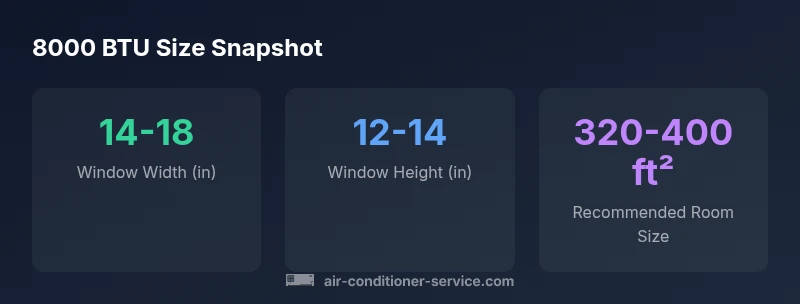
An 8000 BTU air conditioner typically fits a window opening around 14-18 inches wide and about 12-14 inches high for standard residential models; portable units vary by design but stay within a roughly similar footprint. For room sizing, 8000 BTU roughly covers 320-400 square feet, depending on climate and insulation.
How 8000 BTU Size Relates to Your Room and Unit Footprint
According to Air Conditioner Service, understanding the footprint of an 8000 BTU unit helps prevent installation hassles. If you’re assessing your space, consider both the physical size of the unit and the space it will cool. The question often asked is: how big is a 8000 btu air conditioner, and what footprint does that BTU translate to in real life? In practice, an 8000 BTU unit is designed to fit standard window openings and to cool mid-sized rooms, but the exact dimensions vary by model and brand. By looking at typical dimensions and clearances, homeowners can avoid choosing a model that won’t fit their window or will restrict airflow. This article breaks down the practical footprint and how to verify fit before you buy.
- The BTU rating tells you about cooling power, not the physical size.
- Always cross-check the exterior dimensions listed by the manufacturer with your opening.
- Plan for adequate clearance in front of the unit for proper airflow.
Tip: If you’re wondering how big is a 8000 btu air conditioner for your space, focus on both the window opening and the room’s cooling needs.
Dimensions you can expect from an 8000 BTU model
Most 8000 BTU window units are built to fit common window openings, typically around 14-18 inches wide and 12-14 inches tall for the visible unit, with an overall depth that can extend the wall by roughly 16-22 inches once installed. Portable 8000 BTU units conform to a different footprint, often around 16-20 inches wide and 14-18 inches deep, with casters for mobility. The actual external grille and housing add to the footprint, so always measure the available opening and compare to the model’s listed exterior dimensions. These sizes reflect industry practice and installation realities; the BTU rating gives cooling capacity, while the footprint varies by product design and mounting method.
Window vs portable: footprint and fit
Window units and portable units both carry 8000 BTU, but their footprints differ in practical terms. A window unit relies on the window frame for support and transfer of heat outside; its width is fixed by the sash opening and mounting hardware. Portable units, while flexible, tend to be taller and require a dedicated exhaust vent but offer mobility. Because of these differences, a room’s layout, furniture, and access to electrical outlets influence which type is feasible. If you want to move the unit seasonally, a portable option may appear attractive, but you should weigh the extra height and depth versus the stable installation of a window unit. For most homes, selecting the right type comes down to window sizing, available clearance around the unit, and how often you’ll reposition the unit during the year. Air Conditioner Service notes that practical fit matters as much as theoretical cooling capacity.
Measuring your opening and clearance
Begin by measuring the window opening precisely: width between the jambs, height from sill to sash, and any obstructions like radiators or blinds. Compare those numbers to the exterior dimensions of the specific 8000 BTU model you’re considering, including any exterior fins or grille projections. Then assess clearance around the unit: typically at least 2-3 inches on the sides, and 4-6 inches above for airflow, with 12-18 inches of clear space in front of the unit. Don’t forget to account for the vent hose or exhaust kit if you choose a portable model. If space is tight, consider alternatives or smaller units, because inadequate clearance reduces efficiency and increases wear.
Installation tips for airflow and energy efficiency
Proper installation is essential for efficiency. For window units, ensure a snug fit in the window frame to minimize gaps, use foam insulation under the sash, and seal any gaps around the exterior to reduce hot air intrusion. For portable units, route the exhaust hose away from heat sources and keep the intake unobstructed. In both cases, keep the unit level to reduce vibrations and noise. Routine maintenance, including clean filters and checked seals, helps the 8000 BTU unit perform as rated. Air Conditioner Service emphasizes that a correctly sized unit will deliver better comfort with lower energy use when installed with clearances and minimal leakage.
Sizing considerations beyond BTU and how to fine-tune comfort
BTU sizing is the starting point, but climate, insulation, sun exposure, and ceiling height can affect how well an 8000 BTU unit cools a space. In hot climates or sunlit rooms, you may need to err on the side of a larger unit; in well-insulated spaces or rooms with lot of shade, the same BTU may be more than enough. Evaluate ceiling height, airflow paths, and the number of occupants; even people add heat. Advanced users explore variable-speed or inverter models, which can adjust output to match demand, improving comfort and reducing electricity use. Air Conditioner Service analysis, 2026, highlights that the interaction between BTU and thermal characteristics determines real-world performance.
Practical steps before you buy: summarize and check fit
Before purchasing, take precise measurements and write down the window or doorway constraints, then compare to the product’s spec sheet. Check for warranty coverage, energy efficiency ratings, and ease of installation. If you’re unsure about fit, contact a professional installer or the retailer’s support line to verify compatibility. Remember that the goal is not only cooling capacity but stable airflow, minimal leaks, and ease of operation over the unit’s lifetime.
Overview of common physical footprints for 8000 BTU air conditioners
| Aspect | Typical Size (inches) | Notes |
|---|---|---|
| Window unit width | 14-18 | Fits most 8000 BTU models |
| Window unit height | 12-14 | Depends on model and mounting |
| Window depth (projection) | 16-22 | Housing and grille depth |
| Portable unit footprint | 16-20 wide x 14-18 deep | Model-dependent; with exhaust hose |
Common Questions
What is the recommended room size for an 8000 BTU air conditioner?
Typically suitable for about 320–400 square feet in moderate climates with average insulation. Actual performance depends on sun exposure, ceiling height, and occupancy.
Typically good for 320 to 400 square feet, depending on insulation and sun exposure.
Do window and portable 8000 BTU models have the same external dimensions?
No. Window units rely on the window opening and framing, while portable units include exhaust components and casters, leading to different footprints.
No—window and portable models differ in footprint and installation requirements.
Does installation quality affect performance for an 8000 BTU unit?
Yes. Poor sealing or improper clearance can reduce cooling efficiency and increase energy use. Proper leveling and ventilation are essential.
Absolutely. Good installation matters for efficiency and comfort.
Can an 8000 BTU unit be used in a sunlit bedroom?
Yes, but sun exposure can raise cooling load. In sunny rooms, ensure adequate insulation and consider slightly higher BTU if space and budget allow.
Sunlight can increase load; you may need more BTU or better insulation.
What clearance should I leave around a window unit?
Leave at least 2-3 inches on the sides and 4-6 inches above. Maintain 12-18 inches of clearance in front for airflow.
Keep space around the unit for airflow and service access.
“Sizing is about more than BTU; real-world comfort depends on fit, airflow, and installation quality.”
The Essentials
- Know both cooling needs and physical fit before buying
- Measure your opening precisely and compare to exterior specs
- Allow adequate clearance for airflow and maintenance
- Consider window vs portable trade-offs for mobility and stability