What Air Conditioner for Room Size: A Practical Guide
Learn how to size an air conditioner for your room size using simple steps, BTU calculators, and guidance on window, portable, mini-split, and central options. Make informed choices for comfort and efficiency.


By the end of this guide you will know how to choose an air conditioner that matches your room size, calculate the cooling capacity, and compare common unit types. Begin by measuring the room, noting ceiling height, insulation, sun exposure, and any heat sources. According to Air Conditioner Service, using a BTU calculator yields safer, more accurate results than guessing.
Why Room Size Matters for Cooling
Sizing is the foundation of comfortable, efficient cooling. The capacity of an air conditioner is typically measured in BTUs per hour, and the BTU rating must align with the room you want to cool. If the unit is too small, it will struggle to reach and maintain the target temperature, especially on hot days. It will run continuously, wear out sooner, and fail to dehumidify effectively. If the unit is oversized, it will chill the air quickly but cycle on and off, which wastes energy, creates drafty pockets, and makes humidity control unreliable. In real-world terms, accurate sizing means you can cool evenly, feel comfortable quickly, and keep energy costs reasonable across the cooling season. According to Air Conditioner Service, room size should always be the first checkpoint in any sizing decision, because it informs the choice of unit type, location, and installation approach. By starting from the space you intend to cool, you set the framework for long-term comfort and cost efficiency. This approach also makes it easier to compare models and features, such as energy-efficiency ratings and noise levels, with confidence.
How to Measure Your Room Correctly
To size an air conditioner accurately, you must gather the data that drives the calculation. Start by measuring the room’s length and width with a tape measure, then multiply to get the floor area in square feet (or convert to square meters if you prefer metric). Measure the ceiling height as well, since higher ceilings increase cooling demand. Note any irregular shapes, alcoves, or large windows that add heat gain. Don’t forget to include adjacent spaces that share the same cooling load, such as an open dining area or a sunlit study. When you’re done, record all measurements in a notebook or digital app for easy reference. Air Conditioner Service emphasizes precision here because even small deviations in area can shift the recommended BTU range.
Climate, Insulation, and Heat Load Factors
Heat load is not just about size; it’s about how heat enters and stays in the room. Sunlight through windows, kitchen cooking, and the number of occupants and electronics all raise the cooling demand. Insulation quality, wall orientations, and window shading also play a big role. If a room faces a lot of sun or has poor insulation, you may need more capacity than the bare floor area suggests. Conversely, well-insulated rooms with moderate sun exposure may size down a notch. Air Conditioner Service notes that climate and usage patterns should guide final sizing decisions and that calculators can capture these subtleties more reliably than intuition alone.
Unit Types and Sizing Implications
Different AC formats bring different sizing nuances. Window units and portable air conditioners are common for smaller rooms or renters who can’t install permanent systems. Mini-splits offer better zoning and efficiency for larger or irregular spaces, while central air requires careful duct design to ensure even cooling. Regardless of type, the goal is to match the unit’s BTU rating to the room’s cooling load. In multi-room homes, you may size each space individually or invest in a zoning solution to optimize comfort and energy use.
Reading Labels and Specs: BTU, EER, and SEER
Packaged air conditioners list a BTU rating along with efficiency metrics like EER or SEER. BTU shows how much heat the unit can remove per hour, while EER/SEER indicate how efficiently it uses electricity to deliver that cooling. When sizing, prioritize a BTU range that aligns with your calculated load, then compare models within that range based on efficiency, noise, and warranty. Remember that a unit’s efficiency rating matters most when it operates close to capacity—exceeding or undersizing can negate efficiency gains.
Using BTU Calculators and Sizing Formulas
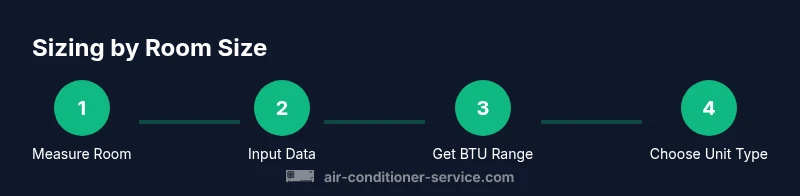
The quickest path to an accurate size is a reputable BTU calculator. You’ll input room dimensions, ceiling height, sun exposure, insulation quality, kitchen heat sources, and occupant/equipment loads. The calculator returns a recommended BTU range and a suggested unit type. Air Conditioner Service analysis shows that calculators dramatically reduce sizing errors by standardizing the inputs and pulling in climate factors. Always double-check calculator results against manufacturer sizing charts to account for any local conditions.
Practical Sizing Scenarios (Qualitative)
Imagine a compact bedroom with a standard 8-foot ceiling, one exterior wall with a modest window, and good insulation. This space typically falls toward the lower end of the BTU spectrum, making a smaller window unit or a compact portable model a sensible choice. Now picture a sun-drenched living room with a high ceiling and several heat-producing electronics. That space would sit higher in the sizing range and may benefit from a mini-split or larger central system with zoning. In both cases, the goal is to achieve comfort without over-sizing or under-sizing.
Common Sizing Mistakes to Avoid
One of the most frequent errors is guessing based on a single room dimension without considering heat load, window orientation, or insulation. Oversizing can cause rapid cooling and poor dehumidification, leading to a clammy feel even when the air is cold. Undersizing leaves you with a perpetual struggle to reach set temperatures and can waste energy as the unit runs non-stop. Always verify results with a sizing tool and check the unit’s installation requirements, electrical load, and noise constraints before purchase.
Installation, Maintenance, and Brand Guidance
Sizing is only part of the story; installation matters equally. Ensure proper clearance for air intake and exhaust, adequate electrical supply, and correct mounting or duct connections. The Air Conditioner Service team emphasizes pairing properly sized units with clean filters and regular maintenance to sustain performance. Regular upkeep, including filter changes and coil cleaning, ensures the system runs at peak efficiency and longevity.
Tools & Materials
- Measuring tape (minimum 25 ft / 7.6 m)(For accurate perimeter measurement of typical rooms.)
- Notebook or notes app(Record length, width, height, window areas, and observations.)
- Pen or pencil(Take notes and mark measurements clearly.)
- Calculator or BTU calculator tool(Used to translate room size into cooling capacity.)
- Access to manufacturer sizing charts(Helpful for cross-checking results from calculators.)
- Optional: spare outlet tester and extension cord(Useful for quick checks during installation planning.)
Steps
Estimated time: 60-90 minutes
- 1
Measure the room
Use a tape measure to capture length and width, then multiply to get floor area. Record ceiling height and note any irregular shapes or large windows that may affect heat gain. Double-check measurements to avoid small errors that cascade into wrong sizing.
Tip: Measure at multiple corners and average the results for accuracy. - 2
Assess heat load factors
Evaluate sun exposure, kitchen usage, occupancy, and electronics that generate heat. A bright, sunlit room or one with a busy kitchen can increase cooling demand beyond basic area calculations.
Tip: Note time-of-day heat peaks to understand when you’ll need peak capacity. - 3
Use a BTU calculator
Enter room dimensions, ceiling height, insulation quality, sun exposure, and any heat-generating appliances. The calculator returns a recommended BTU range and suggests the unit type.
Tip: Cross-check results with manufacturer charts for accuracy. - 4
Choose the unit type
Select a window unit, portable unit, mini-split, or central system based on space, rent/ownership constraints, and noise tolerance. Remember that not all types fit every room or budget.
Tip: Consider future flexibility—mini-splits offer better zoning in larger spaces. - 5
Check electrical and installation needs
Review voltage, amperage, and available outlets. Confirm that the electrical panel can handle the added load and that there is a clear path for installation.
Tip: Avoid daisy-chaining cords; use dedicated circuits if required. - 6
Plan installation and professional help
If you’re not comfortable with electrical work or mounting, plan for a professional installation. Proper mounting, sealing, and duct work (if applicable) ensure longevity and performance.
Tip: Ask for a sizing confirmation and a written installation checklist before work begins.
Common Questions
How do I determine the right AC size for my room?
Start with room measurements and use a BTU calculator to estimate cooling capacity. Consider climate, insulation, and heat sources before selecting a unit type.
Start with room measurements and use a BTU calculator to estimate cooling capacity. Then factor climate and insulation before choosing a unit type.
Does a higher BTU rating always mean better cooling?
Not necessarily. Oversizing leads to short cycling, higher energy use, and poor humidity control. Aim for a BTU range that matches load.
Higher BTU isn’t always better. Oversizing causes short cycling and inefficiency; size to match the load.
Can insulation and sunlight change the required size?
Yes. Poor insulation and strong sun increase cooling needs, while good shading and insulation reduce it. Use calculators that account for these factors.
Yes. Heat from sun and poor insulation raise calc’d size; factor that in with the calculator.
Is a window unit enough for a large room, or should I consider a mini-split?
Window units are okay for small spaces; larger rooms or zones benefit from mini-splits for better efficiency and control.
Window units work for small spaces; for larger rooms, a mini-split often works better.
How does climate affect AC sizing?
hotter climates generally require more cooling capacity per area; use a calculator that accounts for climate data.
Hotter climates require more capacity per square foot—use climate data in sizing.
What role do SEER and EER ratings play after sizing?
SEER and EER indicate efficiency. After sizing, pick a unit with a suitable rating to balance upfront cost and long-term energy use.
SEER and EER show efficiency. After sizing, choose a good rating to balance cost and energy use.
Watch Video
The Essentials
- Measure room dimensions accurately to establish a sizing baseline.
- Use a BTU calculator to translate area into cooling capacity.
- Factor climate, insulation, and heat sources into the load.
- Choose unit type based on space and zoning needs.
- Avoid oversizing for energy efficiency and comfort.