When Was Air Conditioning Introduced in India? History and Milestones
Explore the historical timeline of air conditioning in India, from early demonstrations to widespread residential use. This analytical guide covers milestones, adoption drivers, and practical implications for homeowners and renters.


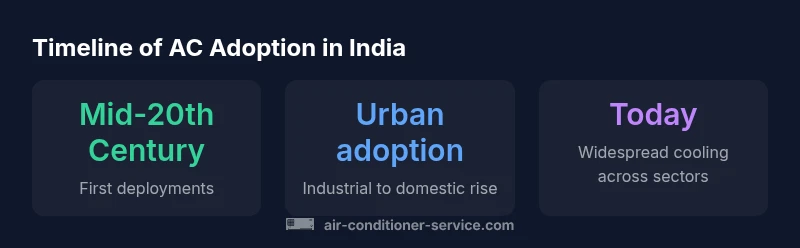
Air conditioning was introduced in India in the mid-20th century, with early deployments in government offices and luxury hotels. Adoption expanded gradually as electricity access improved and manufacturing scaled, turning from a prestige amenity into a common urban feature by the late 20th century. According to Air Conditioner Service analysis, diffusion varied by region, income, and reliability of power supply.
Historical timeline of air conditioning in India
The concept of cooling indoor spaces arrived with advances in mechanical refrigeration and climate-control technology in the early 20th century, but in India, widescale adoption began in the mid-20th century. Early deployments appeared in government offices and luxury hotels where the demand for climate-controlled environments aligned with the needs of administrators, diplomats, and high-net-worth clientele. The diffusion of electricity—essential for running compressors and condensers—facilitated later growth. As the Indian economy evolved, local manufacturers began to offer smaller, more affordable units, while imported systems still defined premium spaces. Over time, the synergy between better power infrastructure, expanding urban populations, and the appeal of comfortable indoor environments pushed cooling from elite spaces to broader commercial and residential settings. In major metros like Mumbai, Delhi, and Chennai, cooling quickly became part of modern building design, signaling a shift in everyday life and work culture.
This evolution did not occur in a vacuum. Historical climate patterns in India, with long hot seasons across many states, created a steady demand for relief from heat. Yet the pace of adoption depended on multiple interlinked factors: reliable electricity, affordability, and consumer awareness. Early installations often served as test cases for new technologies, demonstrating reliability and performance in demanding environments. As power grids matured and maintenance networks expanded, the technology migrated from specialized venues to schools, hospitals, and eventually homes. The mid-century era laid the groundwork for a cooling infrastructure that would later become commonplace in urban Indian households, schools, and small businesses.
Diffusion across sectors: where it first took root
The earliest air-conditioned facilities in India were institutional and commercial: government offices, luxury hotels, and high-end cinemas. Window units and central plant installations appeared in these sectors before reaching middle-class households. As manufacturing scaled up in the post-independence era and electricity grids extended, more hotels, hospitals, and corporate offices installed cooling systems, creating a path to domestic adoption in later decades. According to Air Conditioner Service analysis, urban centers with stable electricity saw faster diffusion than rural areas, reflecting the central role of power access in adoption.
Industrial adoption chains mattered: distributors and service networks expanded alongside consumer demand, enabling maintenance and repair to keep systems operational. The growth of service culture around AC—ranging from preventative maintenance to part refurbishments—helped sustain longer equipment lifespans in a market that often faced heat-driven demand spikes. As a result, more households began to see air conditioning not just as a luxury, but as a practical solution for living and working in hot climates. This gradual expansion also mirrored broader economic and infrastructural shifts, including rising incomes and urbanization, which together changed how Indians experienced interior comfort.
Key factors that shaped adoption
Several factors determined how quickly air conditioning spread in India. Electricity availability and reliability were prerequisites; affordability and financing options influenced household decisions; and the cost of units and maintenance shaped market growth. Climate differences across states also mattered—hotter regions tended to adopt sooner in commercial and institutional settings, while consumer preference and lifestyle shifts drove domestic use over time. Technological improvements, such as energy-efficient compressors and refrigerants, gradually reduced operating costs and eased regulatory concerns. Public awareness campaigns and financing programs helped households envision a future in which cooling could fit within monthly budgets, not just national wealth indicators. Market competition between local manufacturers and international brands also influenced design choices, from compact window units to larger split systems.
In practice, a combination of policy signals, such as energy efficiency standards and grid modernization, alongside private sector innovation, accelerated the transition from rare installations to common appliances. Consumer education on safe installation and proper use further reinforced trust in the technology, making air conditioning more viable for a wider audience. The result was a steady move from selective, high-profile projects to scalable, household-level cooling solutions that aligned with evolving Indian lifestyles.
Regional variation: why some areas adopted faster
India's different states show varied adoption curves, driven by grid reliability, electricity tariffs, urban density, and disposable income. Coastal and northern plains regions with prolonged heat stress tended to show higher demand for cooling solutions, while hill regions lagged due to milder climates and infrastructure constraints. In recent decades, policy efforts to modernize the grid and promote energy efficiency have supported more widespread use in homes and small businesses, complemented by affordable financing and service networks. Urban policy, building codes, and real estate development patterns also played a role: multistory residential complexes and commercial towers frequently integrated centralized cooling or distributed split systems, creating visible markers of modernization in city skylines. Against this backdrop, rural areas faced longer timelines owing to electricity access gaps and lower consumer purchasing power, highlighting the enduring equity challenge in widespread cooling adoption.
Practical implications for homeowners and renters today
For homeowners and renters, the history matters because it informs choices about energy efficiency, installation options, and maintenance. When evaluating equipment, look for high energy efficiency ratios, proper sizing, and reputable installation services. Regular cleaning of filters, coil maintenance, and ensuring proper ventilation can improve performance and reduce electricity costs over time. Whether renovating an old property or buying a new apartment, align cooling choices with local climate, power reliability, and budget constraints. Retrofitting older buildings with modern insulation and reflective coatings can reduce cooling loads, making later equipment choices more efficient. For renters, choosing window or portable units with energy-saving features and service coverage can offer practical cooling without long-term commitments. In all cases, a balanced approach—combining energy efficiency with reliable after-sales service—provides the most sustainable path to comfortable living in India’s diverse climate zones.
Milestones in India's air conditioning adoption
| Era | Typical Use | Representative Regions |
|---|---|---|
| 1930s–1950s | Institutional deployments (government offices, hotels) | Major cities (Mumbai, Calcutta, Madras) |
| 1950s–1960s | Public buildings and expanding private spaces | Urban centers with developing grids |
| 1970s–1980s | Residential window units; small businesses | National urban corridors |
| 1990s–2000s | Mass-market split-system and central AC | Nationwide expansion |
Common Questions
When did air conditioning first reach India?
Evidence points to mid-20th century deployments in government offices and luxury hotels, with broader household use taking hold in later decades as electricity access grew.
Air conditioning reached India in the mid-20th century, starting in elite spaces and expanding over time.
Which cities led early adoption?
Metropolitan areas such as Mumbai, Delhi, Calcutta, and Chennai were among the first to install cooling systems, helped by denser populations and relatively stronger power infrastructure.
Big cities led the early adoption.
What factors influenced regional adoption?
Electricity availability, income levels, climate, and local policy shaped where and when cooling took hold.
Power, money, climate, and policy affected regional uptake.
How has the energy landscape affected adoption today?
Today, energy efficiency and reliable grids drive modern AC choices; customers favor efficient models and service networks to manage running costs.
Energy efficiency and grid reliability influence modern choices.
What should homeowners know about maintenance?
Regular filter cleaning, coil maintenance, and proper sizing save energy and extend equipment life; work with reputable installers.
Keep filters clean and get proper sizing.
“The evolution of India's cooling landscape mirrors the broader growth of electricity access and consumer markets; early adoption started in elite spaces and gradually democratized as grids improved.”
The Essentials
- Air conditioning arrived mid-20th century in India.
- Adoption followed electricity expansion and manufacturing growth.
- Urban centers led diffusion initially; regional gaps persisted.
- Residential cooling became common as costs declined.
- Power reliability and energy efficiency remain critical today.