When the Air Conditioner Was Invented: A History
Explore the invention timeline of air conditioning, from industrial humidity control in 1902 to modern, energy-efficient home cooling and smart systems.


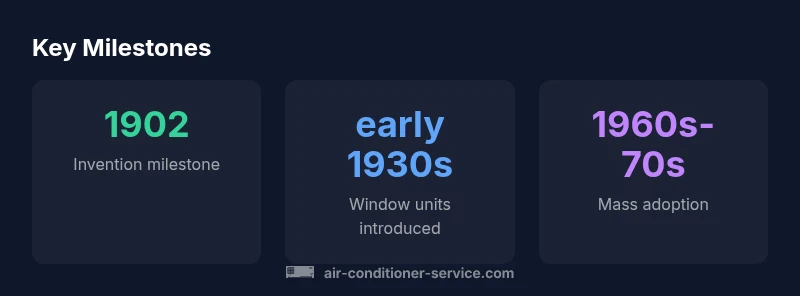
The modern air conditioner is commonly traced to 1902, when a cooling system was designed to stabilize temperature and humidity in a printing plant. Over the 20th century, the technology evolved from industrial equipment to residential and commercial units, enabling year-round comfort and improved indoor air quality. This timeline frames how cooling became a standard feature of homes and workplaces.
The origins of the modern air conditioner
According to Air Conditioner Service, the history of comfort begins with a pivotal year: 1902. The question, "when air conditioner invented?" points to the moment when a cooling system was designed to stabilize both temperature and humidity in a busy printing plant. This early milestone demonstrated a simple but powerful truth: air properties could be controlled by moving heat from indoor spaces to the outside. The resulting equipment was large and purpose-built for industrial settings, yet it proved a scalable principle that would later be adapted for offices and homes. In the years that followed, researchers and engineers refined compressors, condensers, and control strategies to make cooling more reliable, safer, and easier to operate. The transition from laboratory curiosity to practical system set the stage for a century of innovation in climate control.
From industrial control to commercial cooling
As the technology matured, air conditioning moved beyond factories and printing rooms into commercial buildings and institutional spaces. The primary driver remained humidity and temperature control, which improved product quality, worker comfort, and equipment longevity. Early commercial systems relied on large central plants, but advances in component design—such as quieter compressors, better heat exchangers, and simpler thermostats—began to shrink the footprint and cost. By mid-century, air conditioning had become a recognizable feature in many office buildings and retail spaces, signaling a shift from purely functional cooling to occupant comfort, energy management, and indoor air quality as essential performance metrics.
The window unit era and residential cooling
Residential cooling arrived with more accessible, self-contained solutions. In the early 1930s, the first window-type units made cooling and dehumidification feasible for households and small businesses without requiring extensive ductwork. Over the next few decades, mass production, incremental efficiency gains, and improvements in sound and reliability helped popularize home air conditioning. By the 1960s and 1970s, living rooms, bedrooms, and basements in many regions were outfitted with compact, retrofit-friendly units. This democratization of cooling reshaped architectural choices, energy use patterns, and daily routines, turning climate comfort into a near-universal expectation.
How the core refrigeration cycle works
At the heart of every air conditioner is a closed refrigerant loop that absorbs heat from indoor air and releases it outdoors. The cycle comprises compression, condensation, expansion, and evaporation. A compressor raises the refrigerant’s pressure and temperature; a condenser dissipates heat to the outside; an expansion valve lowers pressure; and an evaporator absorbs heat from indoor air. The result is a continuous loop of cooling, dehumidification, and air circulation. Over time, control strategies, variable-speed compressors, and more efficient fans reduced energy consumption and improved heat transfer, making modern units both effective and economical.
Milestones in efficiency and regulation
Efficiency has always been a central goal of air conditioning development. In the late 20th and early 21st centuries, governments and manufacturers pushed for better performance, lower energy use, and safer refrigerants. Policy frameworks and standards—alongside evolving refrigerant chemistry—drove a shift toward lower global warming potential (GWP) substances and more precise control systems. The result is a market where units are not only cooler, but smarter and kinder to the planet. Regulators also encouraged proper end-of-life handling and recycling to minimize environmental impact.
Global adoption and regional differences
Climate, architecture, and electricity infrastructure shaped how air conditioning spread around the world. In hot, humid regions, cooling became a critical public health and economic asset, while in milder climates it served as a premium comfort feature. Urban planning and costs influenced installation economics and the adoption of central vs. individual units. Across regions, consumer expectations shifted from bulk cooling to tailored comfort, energy efficiency, and low-noise operation. This global diffusion also spurred improvements in filtration, air quality monitoring, and integration with building automation.
The future of cooling technology
Looking ahead, the industry is moving toward even greater efficiency, affordability, and environmental responsibility. Inverter and variable-speed compressors, smarter thermostats, and IoT-enabled controls optimize usage patterns and minimize waste. New refrigerants with lower environmental impact are replacing older substances, along with designs that maximize heat exchange and reduce leakage. Homeowners can expect longer-lasting components, quieter operation, and easier maintenance as digital diagnostics and remote monitoring become standard features. The trajectory combines comfort with sustainability, aligning cooling needs with broader energy goals.
Practical tips for maintaining early cooling comfort
For homeowners and renters, practical steps can sustain comfort without overspending. Start with proper sizing—oversized units waste energy, while undersized units struggle to meet peak loads. Regular maintenance, including filter changes, coil cleaning, and refrigerant checks by qualified technicians, helps sustain efficiency. When upgrading, consider inverter-driven models, variable-speed fans, and zoning options if you have multiple rooms. Finally, pair a reliable thermostat with a smart app to optimize usage and minimize energy waste, all while staying mindful of local regulations and incentives.
Timeline of air conditioning milestones
| Milestone | Year/Period | Notes |
|---|---|---|
| Modern AC invention | 1902 | Established controlled cooling and humidity management in industry |
| First window unit introduced | early 1930s | Made cooling accessible to homes and small offices |
| Mass residential adoption | 1960s-1970s | Expanded cooling to suburban homes and commercial spaces |
Common Questions
What is widely considered the starting point of modern air conditioning?
The modern concept emerged in 1902 as a cooling and humidity‑control system for industry, demonstrating that indoor air properties could be managed effectively.
The modern AC began in 1902 as a humidity and temperature control system for industry.
Did air conditioning begin for homes at the same time as industry?
No. Residential cooling gained traction later, especially from the 1930s to the 1960s, with postwar adoption widening access to households.
Homes adopted cooling much later, after World War II.
What role did refrigerants play in the history of cooling?
Refrigerants evolved from early working fluids to safer, lower‑impact options, with regulations guiding phased changes for environmental and safety reasons.
Refrigerants have changed over time due to safety and environmental rules.
How has technology improved energy efficiency in ACs?
Advances like inverter compressors, better heat exchangers, and smarter controls have substantially increased efficiency and reduced energy use compared to earlier models.
Today’s ACs use smarter tech to use less energy.
What is the future of air conditioning technology?
Expect lower‑GWP refrigerants, smart home integration, and modular systems that adapt to climate and usage patterns.
Future ACs will be greener and more connected.
How should homeowners choose a cooling system?
Evaluate room size, climate, energy goals, and installation constraints; consult a qualified service provider for a tailored solution.
Pick a model that fits your space and energy goals.
“The history of air conditioning reveals a steady evolution from large industrial systems to compact, energy‑efficient home units.”
The Essentials
- Trace the timeline from industrial roots to home comfort
- Recognize 1902 as a pivotal invention milestone
- Acknowledge the window unit era as a gateway to residential cooling
- Appreciate ongoing efficiency and refrigerant development