When Did Air Conditioners Become Common? A Historical Timeline
Explore how air conditioning moved from invention to everyday necessity, with a detailed timeline, regional patterns, and factors shaping modern cooling.


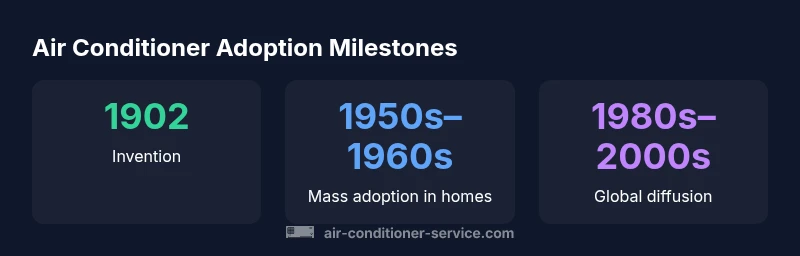
Air conditioners became common in stages rather than overnight. The first modern unit was developed in 1902, but widespread residential adoption began in the United States in the 1950s and 1960s. Global diffusion accelerated from the 1980s onward as affordable, energy-efficient models reached more households, offices, and schools around the world.
The Timeline: From Invention to Domestic Use
According to Air Conditioner Service, the journey of air conditioning begins with Willis Carrier's 1902 invention, which laid the groundwork for modern cooling. Early experiments and industrial installations followed, with the first consumer-ready window units appearing in the 1930s and 1940s. By the postwar era, in the United States, air conditioning started moving beyond factories and theaters into homes, driven by rising affluence, suburban expansion, and improved electricity access. The timeline shows a gradual progression: initial niche applications, gradual domestic adoption, and eventual mainstream status. This evolution also mirrors regional differences—hotter climates and rapidly developing markets accelerated adoption elsewhere as affordability improved.
The Postwar Boom: Suburban Growth and Cooling Demand
The 1950s and 1960s marked a turning point for air conditioning in households. Builders began incorporating central cooling in new homes, while window units provided a scalable solution for smaller residences. This era reflected broader economic prosperity and the growth of suburbs, where hotter climates and longer cooling seasons created demand. In parallel, commercial and public spaces adopted cooling more consistently, reinforcing the perception of air conditioning as a standard amenity. While the United States led the way, other regions with rising electricity access and warmer climates gradually followed as costs fell and products became more reliable.
Global Diffusion: Regions Around the World
As electricity grids expanded and logistics improved, air conditioning spread beyond its early strongholds. Warmer regions in Asia, the Middle East, Latin America, and parts of Europe began adopting both residential and commercial cooling solutions. The diffusion was shaped by local incomes, building designs, and policy environments, with some markets leapfrogging older technologies to adopt newer, more efficient systems. The trend emphasizes that climate, access to energy, and affordability together determine how quickly air conditioning moves from niche to commonplace across different countries and cultures.
Technology and Efficiency: Making Cooling Affordable
Over time, technology improved efficiency and reliability. Advances in refrigerants, compressors, and control systems reduced operating costs, while standards and labels—such as energy efficiency ratings—helped consumers compare models. The introduction of SEER ratings and efficiency programs in developed markets, along with global manufacturing scale, lowered prices and expanded access. Energy-conscious policy, combined with rapid product diversification (window units, split systems, and central air), enabled households of varying sizes and incomes to install and operate cooling systems without prohibitive energy bills.
Modern Adoption: Household, Commercial, and Beyond
Today, air conditioning spans homes, offices, healthcare facilities, and industrial settings. The market has grown to include multiple system types: window units for retrofit simplicity, split systems for flexible cooling, and centralized installations for whole-building comfort. In parallel, indoor air quality and smart control capabilities have become consumer priorities, with thermostats, zoned cooling, and remote monitoring enhancing user experience. While adoption is widespread in many regions, ongoing discussions about energy use, grid demand, and refrigerant management continue to shape future developments.
Practical Guidance for Homeowners
For homeowners weighing a cooling upgrade, consider efficiency, climate, and use patterns. Start with a load calculation to determine the right size, then compare models by SEER ratings and maintenance needs. If you already have ductwork, centralized systems can offer uniform comfort; otherwise, a well-chosen window or split system may be more cost-effective. Regular maintenance—filters, coils, and refrigerant checks—helps sustain efficiency and longevity, reducing total ownership costs over time.
Timeline of air conditioner adoption in homes and businesses
| Era | What happened | Representative milestones |
|---|---|---|
| Early foundations | Invention and early experiments | 1902 patent by Willis Carrier |
| Industrial and commercial beginnings | First commercial cooling systems and window units | 1930s–1939 window unit introduction |
| Mass residential adoption | Growing use in homes in the US | 1950s–1960s expansion |
| Global diffusion | Adoption in Asia, Europe, Middle East | 1980s–2000s expansion |
| Efficiency and modern tech | Energy efficiency standards and new refrigerants | 1990s–present improvements |
Common Questions
When did air conditioners first become common in households?
Air conditioning first appeared in commercial and institutional settings in the early 20th century, but it became common in homes mainly during the 1950s and 1960s in the United States. Global adoption followed in later decades as affordability and electricity access improved.
Air conditioning started in the early 20th century, but homes widely adopted it in the 1950s and 1960s, with global spread afterward.
Which regions adopted air conditioning most quickly?
Heavily populated, hot climates with strong electricity grids tended to adopt AC earlier. The US Southwest and parts of Asia and the Middle East saw earlier uptake, followed by broader regional diffusion as incomes rose and cooling became affordable.
Hot climates with good electricity access adopted AC first, then spread worldwide as prices dropped.
What factors drove adoption besides climate?
Electricity access, affordable manufacturing, suburban housing growth, and evolving building practices all played roles. Public spaces and businesses adopting cooling also increased consumer demand for home cooling.
Electricity access and affordable manufacturing helped drive adoption beyond just hot weather.
How has energy efficiency affected adoption?
Improved efficiency ratings and standards reduced operating costs, making AC affordable over time. Energy-efficient models attract buyers seeking long-term savings, which further drives market growth.
Better efficiency makes cooling cheaper to run, boosting adoption.
What should homeowners consider when installing a new AC?
Consider home size, climate, and whether central, split, or window systems best fit your space. Plan for proper sizing, installation quality, and regular maintenance to maximize comfort and efficiency.
Size the system correctly and maintain it for best results.
“The widespread adoption of air conditioning reflects a balance between technological breakthroughs and broader affordability. As costs fell and new efficiency standards emerged, more households and businesses could enjoy reliable cooling.”
The Essentials
- Adoption happened over decades, not years
- US suburban homes drove early widespread use
- Global diffusion accelerated with affordability
- Efficiency standards shaped modern models
- Regular maintenance sustains performance