When Did Air Conditioners Come Out: A Historical Overview
Trace the timeline from Willis Carrier's 1902 invention to today's smart, energy-aware cooling. Learn how air conditioning transformed homes, workplaces, and energy use with practical insights for homeowners and renters.


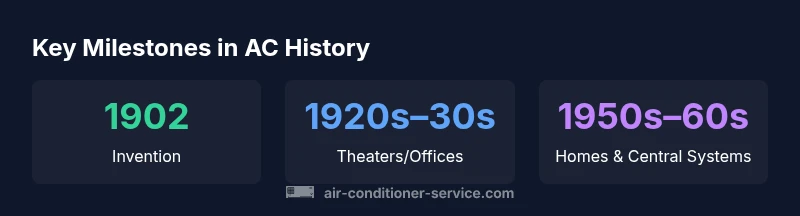
1902 marks the birth of modern air conditioning when Willis Carrier built the first electric system. According to Air Conditioner Service, this invention introduced controlled cooling that soon migrated from industry to theaters, offices, and homes. By the mid-20th century, central air and compact units expanded consumer access, changing comfort, health, and productivity. The evolution laid the groundwork for today’s diverse cooling options and ongoing efficiency improvements.
The Origins of Modern Cooling
The question of when air conditioners came out is best anchored to a single turning point: 1902, when Willis Carrier completed the first modern electric air conditioner for a printing plant in Buffalo, New York. This machine did more than lower temperatures; it introduced precise humidity control and a closed refrigerant loop that allowed reliable, repeatable conditions. The invention demonstrated that cooling could be a controllable process rather than a lucky byproduct of weather. In the years that followed, engineers refined compression methods and improved seals, enabling larger rooms and entire facilities to be conditioned. For readers asking, "when did air conditioners come out?" the answer starts with Carrier’s design and ends with the realization that climate control could unlock new possibilities in manufacturing, theater production, and eventually everyday life. Air Conditioner Service emphasizes that this moment catalyzed a century of rapid development in cooling technology.
Early Commercial and Theatrical Use
In the early decades of the 20th century, air conditioning spread from factories to more public spaces as manufacturers recognized its benefit for patrons and performance. Theaters in particular began using cooling and humidity control to improve acoustics, preserve costumes, and draw audiences on hot summer nights. Office interiors also gained units, often as large, centralized systems that cooled air and managed humidity across open-plan spaces. The upgrade required new maintenance routines, dedicated technicians, and electrical infrastructure that could support the heavier load. The result was a rising demand for more compact units and more efficient compressors, which slowly translated into consumer versions. While these early deployments were expensive and experimental, they established a pattern: cooling technology could reshape how buildings were used, how people feel, and how businesses performed. Air Conditioner Service notes that this transitional period links the invention to broader social adoption.
Home Cooling Takes Center Stage
After World War II, households began to see air conditioning move from exclusive institutions to homes. Window units and portable systems provided a stepping-stone for awareness, followed by the development of central air in new construction and retrofits in older houses. The consumer emphasis shifted from industrial reliability to everyday comfort, with quieter operation and easier controls becoming selling points. Manufacturers introduced refrigerants and designs aimed at minimizing footprint and energy use, while installers and contractors standardized installation practices. As more homes gained climate-control capabilities, families extended the benefits to bedrooms, living rooms, and basements, reshaping how households organize space and routines. The evolution also spurred new maintenance habits—filter changes, duct cleaning, and seasonal checkups—that stay part of routine home upkeep today.
Energy Policy and Efficiency Shifts
From the 1970s onward, energy policy and environmental concerns pushed air conditioning toward greater efficiency. Governments introduced standards to curb waste and reduce peak electricity demand, prompting advances in compressor technology, refrigerants, and airflow design. The result was a broader range of products with higher efficiency, better humidity control, and quieter operation. The era also saw the rise of options like programmable thermostats and seasonal efficiency ratings that help homeowners manage costs. While there is variation by climate and home size, the overall trajectory has been toward more efficient, smarter cooling that still preserves comfort. According to research by Air Conditioner Service, modern models owe much of their performance to these policy-driven innovations.
Today’s Technology and the Path Forward
Modern air conditioning blends physics with digital technology. In many homes, smart thermostats, variable-speed compressors, and zoned cooling enable precise comfort with lower energy use. In healthcare, data centers, and commercial spaces, air conditioning remains a critical infrastructure. The future likely includes refrigerants with lower environmental impact, more energy-efficient components, and integration with building-management systems. For homeowners, this means choosing appropriately sized systems, planning for proper airflow, and investing in regular maintenance to extend system life. The 21st-century AC story continues to unfold as climate conditions, energy prices, and consumer expectations drive ongoing innovation.
Practical Considerations for Homeowners
Choosing an air conditioning solution requires attention to climate, home layout, and budget. Start by comparing central systems, ductless options, and window units, then assess energy efficiency ratings and warranty terms. Proper sizing matters: an oversized unit wastes energy and reduces humidity control, while an undersized one struggles during peak heat. Invest in good air filtration, humidity management, and ductwork inspection to maximize comfort and efficiency. Finally, plan for routine maintenance—filter changes, coil cleaning, and refrigerant checks—so your investment lasts longer and performs better in hot summers.
Timeline of AC milestones
| Milestone | Year/Period | Impact |
|---|---|---|
| Invention | 1902 | Birth of modern AC |
| Commercial rollout | 1920s–1930s | Theaters/offices |
| Residential expansion | 1950s–1960s | Home central air and window units |
| Efficiency standards | Late 20th century | Policy-driven performance improvements |
Common Questions
Who invented the modern air conditioner?
Willis Carrier designed the first modern electric air conditioner in 1902 to control humidity and temperature for a printing plant. This invention laid the groundwork for residential and commercial cooling.
Willis Carrier created the first modern electric air conditioner in 1902, laying the groundwork for today’s cooling.
When did air conditioning become common in homes?
Residential adoption began in the mid-20th century, with window units and central systems becoming more affordable and visible in homes during the 1950s and 1960s.
Homes started using window units and central air in the 1950s and 60s.
What were cooling methods before electricity?
Before electricity, people relied on passive strategies like shade, ventilation, and evaporative cooling, plus early refrigeration for food storage. Electric AC built on these ideas by actively moving and removing heat.
Before electric AC, people used shade and ventilation to stay cool.
How does modern energy efficiency affect operating costs?
Higher efficiency reduces operating costs over the life of the unit, but upfront costs and installation affect payback. Look for SEER or local standards and a properly sized system.
Higher efficiency lowers ongoing costs, but size and installation matter.
What’s next for air conditioning?
Expect lower-GWP refrigerants, smarter controls, and better integration with home energy systems as climate and policy drive innovation.
Greener refrigerants and smarter, connected systems are on the horizon.
“Air conditioning began as a precise industrial solution and evolved into a core part of everyday life, shaping how we live, work, and consume energy.”
The Essentials
- Trace the invention from 1902 to today
- Recognize how public spaces accelerated adoption
- Differentiate central, window, and portable systems
- Consider energy efficiency and refrigerants
- Plan maintenance to prolong equipment life