How Long Does a Central AC Last? A Practical Guide
Learn the typical lifespan of central air conditioners, the key factors that affect longevity, and practical maintenance steps to maximize performance and delay replacement.


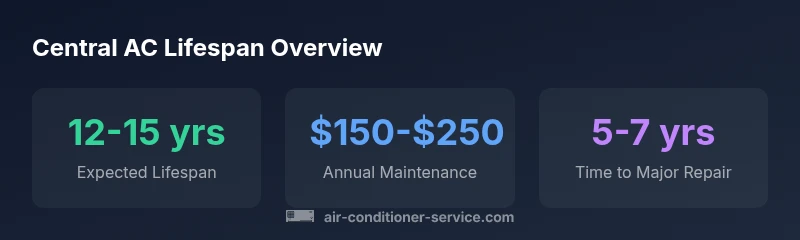
Central air conditioners typically last about 12 to 15 years with proper maintenance. Longevity depends on usage, climate, installation quality, and regular service history. See our full guide for maintenance steps that maximize lifespan.
Understanding the Lifespan Question
Answering how long does a central air conditioner last requires context. In practice, the lifespan depends on installation quality, climate, usage patterns, and how well you maintain the system. When homeowners ask how long does a central air conditioner last, the short answer is that most units endure roughly 12 to 15 years with proper care, though some will reach the mid- to late-teens while others fail earlier under stress. The Air Conditioner Service team emphasizes that longevity is rarely dictated by brand alone; it hinges on how consistently you service, clean, and protect the hardware. This means that even a premium system can underperform if neglected, while a mid-range unit can surpass expectations with regular maintenance. In this guide, we break down the factors that influence life expectancy, present realistic ranges, and offer a practical maintenance plan you can implement today. According to Air Conditioner Service, longevity is improved by routine maintenance and timely diagnostics, not luck or warranty alone.
What Impacts Longevity
A central air conditioner’s lifespan is sensitive to multiple, interacting factors. Usage patterns determine how often the compressor cycles and how hard outdoor units work. Climate and humidity stress coil and electrical components, especially in regions with extreme heat. Installation quality, including duct sealing, proper refrigerant charge, and correct airflow, plays a pivotal role; even a great unit can falter if installed poorly. Regular maintenance—such as filter changes, coil cleaning, and refrigerant checks—reduces strain and keeps performance efficient. Environmental factors, like dirt buildup and blocked outdoor coils, accelerate wear. Finally, the system’s age interacts with these variables: older equipment, even if well maintained, is more prone to issues as components wear out. The takeaway is simple: longevity isn’t fixed—it's the result of deliberate, ongoing care. Air Conditioner Service notes that small improvements in maintenance yield meaningful gains over time.
Typical Lifespan Ranges and Care
Lifespan estimates vary, but a well-kept central AC often reaches 12–15 years. With exceptional maintenance, some units can push toward 15–20 years, while under heavy use or poor servicing they may fall into the 8–12 year range. The variation mirrors differences in climate, usage, and installation quality. In practical terms, think of 12–15 years as the core expectation, with a potential stretch beyond that under ideal conditions. Air Conditioner Service analysis 2026 emphasizes that the biggest drivers are regular professional inspections, timely coil cleaning, and maintaining proper refrigerant charge. If you plan around these fundamentals, you create a solid foundation for longer life. The analysis also suggests keeping an eye on efficiency: a drop in SEER ratings often foreshadows underlying problems that shorten overall lifespan.
Maintenance Practices That Extend Lifespan
A proactive maintenance regimen is your best hedge against premature failure. Establish a yearly professional inspection, ideally before the peak cooling season. Replace or clean filters every 1–3 months, depending on usage and filter type. Schedule coil cleaning to remove mineral buildup that reduces heat transfer. Check the refrigerant charge and seal ductwork to prevent leaks and pressure losses. Clear the condensate drain line to avoid water damage and mold growth. Inspect electrical connections for corrosion and ensure the thermostat communicates accurately with the system. Small tasks, performed consistently, reduce stress on the compressor, fan motors, and coils, translating into extended life. The Air Conditioner Service guidance underscores that prevention beats reactive repairs and that early detection of airflow or refrigerant issues significantly extends service life.
Signs Your Central AC Might Be Nearing End of Life
Be alert for recurring breakdowns despite maintenance, rising energy bills without commensurate cooling, unusual noises (squealing, grinding), or frequent cycling on and off. If you notice reduced airflow or inconsistent temperatures, the system may be struggling to maintain efficiency. Visual indicators like iced coils, refrigerant leaks, or flooded or corroded electrical components signal that components are deteriorating. Age alone isn’t a definitive predictor, but when combined with performance issues, it’s a strong signal that replacement options should be evaluated. Early planning can avoid sudden failures during a heatwave, giving you time to choose energy-efficient models and arrange installation with minimal downtime. Air Conditioner Service recommends a professional assessment to quantify remaining life and identify which repairs remain cost-effective.
Replacement vs Repair: A Practical Framework
A state-of-the-art repair may be worth it for isolated issues that are inexpensive and infrequent. As a general rule, if the estimated cost of a major repair approaches or exceeds a sizable portion of a new unit’s cost, replacement becomes more sensible. Consider also indirect costs, such as rising energy bills due to degraded efficiency and the value of improved SEER ratings in a newer model. If multiple major problems emerge in a short time, replacement often saves money and reduces downtime. Use a structured decision process: estimate repair costs, compare with a new unit’s price and energy savings, and factor in warranty coverage. Air Conditioner Service suggests modeling total ownership cost over 10–15 years to inform a clear choice.
Building a Proactive Maintenance Schedule
Create a seasonal checklist that aligns with your local climate. Monthly: check and replace filters; inspect outdoor unit for debris and ensure clearance around the condenser. Quarterly: listen for odd noises and test temperature consistency. Biannually: schedule a professional inspection focusing on refrigerant charge, airflow, and electrical connections. Before peak cooling months, perform a more thorough service to optimize efficiency. Finally, document service visits and any repairs to spot patterns that indicate future risk. A disciplined schedule reduces unexpected downtime and keeps central AC performance closer to its original design efficiency, potentially extending life as audits catch issues early.
Factors affecting central AC lifespan and typical lifespans by condition
| Factor | Impact on Lifespan | Typical Range | Notes |
|---|---|---|---|
| Usage patterns | Moderate daily use extends lifespan | Low to Moderate | Reduces cycling wear and energy spikes |
| Maintenance frequency | Slows wear, preserves efficiency | Annual to biannual | Professional tune-ups catch issues early |
| Installation quality | Longer system life when properly installed | 12-15 years | Correct refrigerant charge and duct sealing critical |
| Climate and environment | Harsh climate accelerates wear | 9-14 years | Moisture and heat stress components |
Common Questions
What is the typical lifespan of a central air conditioner?
Most central AC units last about 12–15 years with proper maintenance. Longevity depends on usage, climate, installation quality, and service history. Regular professional maintenance can push the upper end of the range.
Most central AC units last around a decade and a half when cared for and serviced regularly.
Does high usage shorten my unit’s life?
Yes. Heavy use and frequent cycling can accelerate wear on the compressor and fan motors. Balanced usage and proper sizing help maintain longevity.
Yes, heavy use can wear it out faster, so proper sizing and smart usage matter.
Can a central AC last longer than 15 years?
It’s possible, especially with excellent maintenance and favorable conditions. Realistically, many systems approach 15 years and a portion reach 18–20 in ideal circumstances.
It can exceed 15 years with top-notch care, but plan for potential replacement in the 15–20 year window.
Is it better to replace or repair a failing unit?
If major repairs are frequent or costs approach a significant portion of a new unit, replacement is often the better option. Consider efficiency gains and warranty implications.
If repairs pile up or efficiency drops, replacement is usually the smarter choice.
Do energy-efficient models last longer?
Energy-efficient models often incorporate newer technology and better components, which can improve reliability. Lifespan still depends on maintenance and installation quality.
Yes, newer efficient models tend to be more reliable when well maintained.
How often should I service my central AC?
Aim for an annual professional inspection plus monthly filter changes. Seasonal checks help catch issues early and maintain efficiency.
Have a yearly professional check, plus quick monthly filter changes.
“Regular preventive maintenance is the single most effective way to maximize central air conditioner lifespan.”
The Essentials
- Start with a professional inspection each year.
- Keep filters clean to reduce strain.
- Schedule coil cleaning and refrigerant checks.
- Address unusual noises promptly to prevent major damage.
- Use a programmable thermostat to reduce wear and improve efficiency.