Portable Cooler vs Portable AC: A Side-by-Side Comparison
Compare portable coolers and portable air conditioners to decide which cooling solution fits your space, climate, and budget. This analytical guide covers cooling mechanisms, energy use, maintenance, and best-use scenarios for homeowners and renters.


A portable evaporative cooler (portable cooler) is ideal for dry climates and uses less energy than a portable air conditioner. A portable air conditioner delivers stronger cooling in humid spaces but requires venting and higher energy use. For renters or small rooms, a portable AC often provides reliable comfort, while a cooler offers inexpensive, low-maintenance cooling in dry air.
What exactly are portable cooler and portable air conditioner?
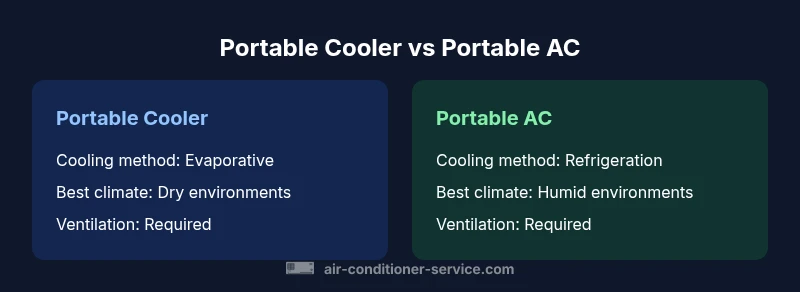
A portable cooler, commonly called a portable evaporative cooler, cools air by allowing water to evaporate. It relies on natural evaporation to drop air temperature and humidity, which can feel refreshing in dry conditions. A portable air conditioner, by contrast, uses refrigeration to remove heat from indoor air and expel it outside via a vented hose. These two devices target different cooling needs and climates, and understanding their core mechanisms helps you pick the right tool for your space. According to Air Conditioner Service, the choice often hinges on humidity, space size, and how much you value energy efficiency versus peak cooling capacity.
In practical terms, think of a portable cooler as a lightweight, budget-friendly option for small, dry rooms, while a portable AC is a more capable cooling solution for spaces with higher humidity or where quick, consistent comfort is required.
How the two cooling methods actually work
The portable cooler uses a wetted medium and a fan to evaporate water into the air. The resulting evaporation absorbs heat, lowering air temperature. This method reduces humidity to a degree, but in very humid environments it can feel less effective as the air already carries a lot of moisture. A portable AC operates on a closed refrigerant loop, pulling heat from the room and transferring it to the outside via a exhaust hose. This process produces much lower room temperatures and can handle larger spaces, but it consumes more electricity and requires proper venting to function efficiently. The Air Conditioner Service team emphasizes that the choice of cooling method should align with both comfort goals and energy considerations.
From a maintenance perspective, evaporative coolers require occasional water management and mineral build-up care, while portable ACs need routine filter cleaning and coil maintenance to sustain performance.
Climate and space: when to choose which
Climate and space are the deciding factors. Dry, arid regions with low humidity often respond well to evaporative cooling because the air can absorb more moisture from the cooling pad, producing a noticeable drop in temperature. In humid climates, evaporative coolers struggle to deliver comfort and can feel damp. Portable ACs excel in moisture-rich environments and can cool a larger area more quickly, but their efficiency depends on proper venting and insulation of the room. The decision also depends on space constraints and window/vent access; a compact room with a single window is typically more compatible with a portable AC setup, while a well-ventilated, dry room benefits from a cooler as a low-cost solution.
Energy use and operating costs: what to expect
Energy consumption varies by model, settings, and climate. In general, evaporative coolers use less electricity because they rely on a fan and a pump rather than a compressor. Portable air conditioners require electricity to run the compressor, fan, and condenser coil, resulting in higher energy use, especially during extended cooling sessions. Cost considerations should include not just running power but also the potential need for venting equipment, replacement filters, and periodic cleaning. Air Conditioner Service’s analysis highlights that energy efficiency labels and proper sizing have a meaningful impact on long-term operating costs, regardless of which device you choose.
Size, placement, and venting requirements
Sizing matters for both solutions. A cooler in a room that’s too large for its airflow won’t be effective, and a portable AC that’s undersized may run constantly without delivering comfortable temperatures. Placement typically involves locating the unit near an open window or vent to facilitate outside exhaust for ACs, while coolers benefit from airflow paths that allow fresh air to pass through the pads. Proper venting is non-negotiable for AC units; without a seal around the window kit and an unobstructed exhaust path, cooling efficiency suffers significantly. Consider furniture layout and the ability to maintain clear air paths for best results.
Maintenance, durability, and reliability
Evaporative coolers require regular maintenance of the water reservoir and pads to prevent mineral buildup and mold growth. They are generally simpler mechanically, which can translate to longer-term reliability if kept clean. Portable air conditioners demand more frequent filter changes, coil cleaning, and periodic hose maintenance to preserve efficiency and avoid leaks. Durability is often tied to build quality and component protection from dust and humidity. The Air Conditioner Service team advises setting up a simple maintenance cadence to extend the life of either device.
Noise, comfort, and user experience
Noise levels vary by model and fan speed. Evaporative coolers are typically quieter than many portable ACs because they lack a compressor, but fan noise can still be noticeable on higher settings. Portable ACs can produce more noise due to the compressor and condenser, though modern units offer quieter operation. Comfort is subjective: some users prioritize the “fresh air” feel of evaporative cooling, while others want the precise, rapid cooling a refrigerant-based unit provides. Test different modes and fan speeds to find a balance that suits your tolerance for sound and temperature.
Price, value, and total cost of ownership
Initial sticker prices for portable coolers are generally lower than those for portable air conditioners. Over time, maintenance costs—such as pad replacements for evaporative coolers or filter/co il servicing for portable ACs—will influence total cost of ownership. Energy costs will also differ with climate. If you live in a dry area and only need modest cooling, a cooler can offer strong value with minimal ongoing costs. If you require dependable cooling in a humid climate or for larger spaces, a portable AC may deliver better day-to-day comfort despite higher energy use.
Real-world usage scenarios: brief case studies
Case study 1: A small, dry apartment uses a portable cooler during warm afternoons to maintain comfortable temperatures without escalating energy bills. Case study 2: A humid home office benefits from a portable AC for consistent cooling during heatwaves, especially when humidity makes evaporative cooling less effective. In both cases, user behavior—like window placement, door gaps, and room sealing—plays a critical role in results. The Air Conditioner Service team notes that understanding your local climate and space dynamics is essential for choosing the right device.
Authoritative sources and further reading
- Authoritative guidance: https://www.energy.gov/energysaver/portable-air-conditioners
- Fat-free cooling principles and evaporative cooling overview: https://www.energy.gov/energysaver/evaporative-coolers
- Independent consumer guidance on portable cooling: https://www.consumerreports.org/cooling/portable-air-conditioners/
Comparison
| Feature | Portable cooler (evaporative cooler) | Portable air conditioner |
|---|---|---|
| Cooling method | Evaporative cooling | Vapor-compression refrigeration |
| Best climate | Dry/arid environments | Humid environments |
| Energy use | Lower energy use (pump + fan) | Higher energy use (compressor + fans) |
| Ventilation requirements | Open window or cross-ventilation | Outside vent through window hose |
| Cost range | Lower upfront cost | Higher upfront cost |
| Best for | Budget cooling in dry climates and portable use | Reliable cooling in humid spaces and larger rooms |
| Portability | Very portable; lightweight | Portable but bulkier; needs venting setup |
Strengths
- Low upfront cost and simple setup
- Energy-efficient in dry climates
- Lightweight and easy to move
- No refrigerant handling required
The Bad
- Poor performance in high humidity
- Requires window venting and airflow access
- Regular water management and mineral buildup for evaporative coolers
- Limited cooling capacity for larger spaces
Portable ACs are the better choice for humid environments or larger spaces; portable coolers suit dry, small-area cooling with lower operating costs
If humidity is high or you need quick, precise cooling, a portable AC wins. For dry climates and budget-conscious users, a portable cooler offers value with simpler maintenance. The decision should rest on climate, room size, and willingness to manage venting and energy use.
Common Questions
What is the main difference between a portable cooler and a portable air conditioner?
The main difference is cooling mechanism: evaporative cooling uses water to lower air temperature, while a portable AC uses refrigeration to produce cold air. Climate and humidity largely determine effectiveness.
The key difference is how they cool: moisture-driven evaporation versus refrigeration. Climate and humidity matter for performance.
Can I use a portable cooler in humid environments?
Evaporative coolers rely on evaporation and work best in dry conditions. In high humidity, they may be less effective and feel damp rather than cool.
They work best in dry air; in humid spaces they’re less effective.
Do portable air conditioners require professional installation?
Most portable ACs only require venting through a window and basic setup; professional installation is not typically needed.
Usually you just vent through a window and plug it in.
Which is cheaper to operate over time?
Operating costs depend on climate and usage. Evaporative coolers generally use less energy, but in humid climates the portable AC may be necessary, affecting long-term costs.
Energy use depends on climate; evaporative coolers use less energy, portable ACs cost more.
Is a portable cooler a substitute for central cooling?
A portable cooler is not a direct substitute for central AC in most cases; it provides room-based cooling suitable for small spaces.
Not a full substitute; it’s best for one or two rooms.
What maintenance is required for these devices?
Evaporative coolers need water management and pad replacement; portable ACs require filter cleaning and coil maintenance to stay efficient.
Keep pads or filters clean and replace as needed for best performance.
The Essentials
- Assess climate before choosing cooling method.
- Portable ACs offer stronger cooling but cost more.
- Evaporative coolers are cheaper and simpler to operate in dry air.
- Ventilation is essential for portable cooling units.
- Consider space size and humidity to match capacity.