Difference Between Portable Aircon and Air Conditioner
This analytical guide compares portable aircon units and traditional air conditioners, covering design, performance, installation, costs, and best-use scenarios to help homeowners and renters choose the right cooling solution.


The portable aircon vs air conditioner distinction centers on mobility, installation, and scope. Portable units are freestanding with a vent hose, ideal for renters or small rooms, while traditional air conditioners are fixed, higher-capacity systems that cool larger areas more consistently. For flexible, room-by-room cooling, portable aircons win; for whole-home comfort, fixed air conditioning is usually the better choice.
What is the difference between portable aircon and air conditioner?
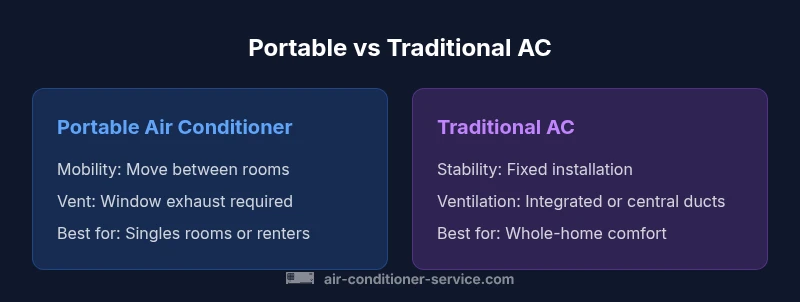
Understanding the difference between portable aircon and air conditioner starts with recognizing how each unit is designed to cool a space. A portable aircon is a freestanding appliance with an integrated vent hose that exhausts hot air through a window or vent. It can be moved from room to room, making it appealing for renters, small apartments, or spaces that don’t justify a fixed cooling system. By contrast, a traditional air conditioner (often a window unit or a fixed central system) is designed for longer-term installation, delivering higher cooling power and more uniform comfort across larger areas. In practice, this means portable units are excellent for spot-cooling and flexibility, while fixed units aim for steady performance over time. This distinction matters not only for comfort, but for energy use, noise, and how you manage space. According to Air Conditioner Service, recognizing this difference helps homeowners avoid overspending or undercooling while choosing the right cooling approach for their home.
Quick context and practical framing
To frame the decision, consider: how many rooms need cooling, how often you move between spaces, and whether you rent or own. Portable aircons typically require no major installation beyond venting, whereas fixed units may involve permanent mounting, electrical considerations, and, in some cases, professional installation. For many households, the choice hinges on the balance between flexibility and capacity. Air Conditioner Service emphasizes that the right choice aligns with practical use cases rather than chasing the highest spec. This is especially true in mild climates or for supplemental cooling.
Real-world scenarios and expectations
In real homes, portable aircons shine when you need quick relief in a single hot room, or when you must avoid altering permanent structures. They can be a cost-effective temporary solution during seasonal heat spikes. However, for sustained comfort across multiple rooms or for households with higher cooling loads, fixed air conditioning tends to deliver more consistent results and better overall energy performance. Air Conditioner Service highlights that the key is sizing the unit to the space and matching your cooling goals to the installation realities.
Energy usage and practical tips
Energy use is a major consideration. Portable units often operate at higher relative power for the same cooling area, which can increase electricity consumption if used intensively. Fixed air conditioners, when properly sized, can unlock greater efficiency per BTU cooled, especially in larger homes. Practical tips from Air Conditioner Service include focusing on proper sealing, optimizing air distribution, and using portable units as supplemental cooling rather than the main cooling source in warm months. These steps help balance comfort with energy efficiency.
Design, aesthetics, and durability
Aesthetics and durability can influence long-term satisfaction. Portable aircons come in a variety of finishes and sizes, but their mechanical design concentrates cooling in a single chassis. Fixed air conditioners often integrate with home design and building systems, offering greater durability in high-use environments. If you value minimal visible infrastructure, a portable unit may be preferable; if you prioritize long-term reliability and a consistent climate, fixed systems are generally the better bet.
Takeaway for decision-makers
If you need flexible, moveable cooling with minimal installation, portable aircon makes sense. If your goal is steady, larger-area cooling with less operation variability, fixed air conditioning is typically superior. The trade-off is cost, permanence, and complexity. Air Conditioner Service recommends weighing room-by-room needs, rental constraints, and long-term comfort goals when deciding between portable and fixed cooling solutions.
Comparison
| Feature | Portable Air Conditioner | Traditional Window/Through-Wall AC |
|---|---|---|
| Cooling Capacity | Moderate to high for single rooms | Broad range suitable for larger spaces or multi-room areas |
| Portability | Freestanding, easy to relocate | Fixed installation with permanent mounting options |
| Installation | Vent hose through window or vented opening | Window or wall-mounted installation; may require professional setup |
| Ventilation requirements | Exhaust vent required for hot air removal | Ventilation through window or dedicated ducting as applicable |
| Energy efficiency | Often less efficient per BTU at the same space | Can achieve higher efficiency with proper sizing and installation |
| Noise level | Typically louder due to compact design and fan size | Generally quieter at comparable capacities |
| Upfront cost | Usually lower upfront cost for single-room use | Higher upfront cost but greater coverage potential |
| Best use case | Renters or temporary cooling in one room | Homes needing fixed, whole-space cooling |
Strengths
- Flexibility to move cooling where it’s most needed
- Low installation barriers for renters or short-term use
- No significant modifications to living spaces
The Bad
- Typically lower overall cooling power for larger spaces
- Higher operating costs for continuous use in hot climates
- Ventilation hardware can be obtrusive in living areas
Fixed air conditioners win for larger homes; portable units win for flexibility and renters.
Choose portable when you need moveable, room-by-room cooling and minimal installation. Choose fixed when you require consistent comfort across larger areas and long-term installation.
Common Questions
What is the main difference between portable aircon and air conditioner?
The main difference is mobility and installation. Portable aircons are freestanding and vented through a window, suitable for one-room use. Traditional air conditioners are fixed, often more powerful, and better for cooling larger spaces or multiple rooms.
The main difference is mobility. Portable units can move from room to room and vent through a window, while traditional units are fixed and better for larger spaces.
Can portable air conditioners cool multiple rooms?
Portable units are designed for single-room cooling. For multi-room comfort, you’d typically need multiple units or a centralized system. Consider your layout and climate when deciding.
Portable units usually cool just one room. For multiple rooms, you might need several units or a central system.
Are portable air conditioners energy efficient?
Energy efficiency varies by model, but portable units often use more energy per BTU in smaller spaces. Look for Energy Star ratings and proper sizing to maximize efficiency.
They vary in efficiency; look for Energy Star models and proper sizing to save energy.
Do portable air conditioners require venting?
Yes. Portable air conditioners require venting to expel hot air outside, usually through a window or vented opening. Proper venting is essential for effective cooling.
Yes. They need to vent hot air outside, typically through a window.
Is a window unit the same as a portable aircon?
No. A window unit is mounted in a window and remains partly outside, while a portable unit is freestanding and fully indoors. Window units are fixed once installed; portable units offer flexibility.
Not exactly. Window units are installed in a window; portable units stay indoors and can be moved.
The Essentials
- Assess space size before choosing cooling type
- Prioritize proper sizing over brand or features
- Consider rental constraints and permanent-install implications
- Use portable units as supplements rather than primary cooling for multi-room homes