Cost to Run an AC for 24 Hours: Practical Guide for Homes
Estimate the daily cost of running your air conditioner with a practical calculator, real-world scenarios, and cost-saving tips. Learn how wattage, efficiency, and local rates drive expenses. Air Conditioner Service analysis, 2026.


Understanding the 24-hour running cost foundations
To estimate the daily cost of running an air conditioner for 24 hours, you need three pieces of information: the unit's electrical power draw in watts (W), the number of hours you run it each day, and your local electricity price per kilowatt-hour (kWh). The conversion from watts to dollars is straightforward: DailyCost = (W / 1000) × HoursPerDay × CostPerkWh. For example, a 1,500-watt air conditioner running 24 hours at $0.15 per kWh would consume 1.5 kW × 24 h = 36 kWh; multiplied by 0.15 equals $5.40 for that day. If usage drops to 8 hours, cost drops to about $1.80. Real-world costs depend on duty cycle, thermostat settings, and how long the compressor runs against cooling demand. Efficiency ratings, like SEER, influence the actual electrical draw at different indoor and outdoor conditions. In practice, small rooms with good insulation and a lower setpoint can keep costs reasonable, while large, poorly insulated spaces or extreme climates push daily costs higher. According to Air Conditioner Service, understanding these factors helps homeowners plan budgets and choose smarter cooling strategies.
Factors that affect your daily cost
Costs are not a fixed number; they shift with how you use the system and how well the home is built. Here are the core drivers:
- Unit size and SEER rating: Higher efficiency reduces power draw for the same cooling load.
- Thermostat setpoints and schedules: Lowering the target temperature or leaving the unit running continuously increases runtime.
- Climate and humidity: Hot, humid days prolong compressor operation and fan activity.
- Insulation and air leaks: Drafts and poor sealing raise the cooling load.
- Equipment age and maintenance: Older or dirty systems work harder, consuming more power.
- Utility rate structure: Time-of-use pricing or tiered rates change the daily cost.
Real-world variations are common; a well-insulated home with a modern, efficient unit can dramatically lower daily cost compared with an old, inefficient system in a heatwave. The Air Conditioner Service team emphasizes that running cost is a function of both efficiency and usage; even small efficiency upgrades can yield meaningful savings over a season.
Real-world scenarios
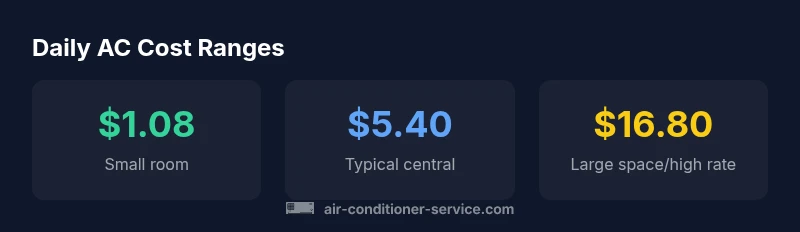
Consider three practical scenarios to illustrate daily cost ranges. Scenario A uses a compact wall unit in a small room; Scenario B uses a mid-size central system; Scenario C models a hot, humid day with a large space:
- Scenario A: 900 W unit running 8 hours at $0.15/kWh. Daily cost ≈ (0.9 × 8 × 0.15) = $1.08. This keeps a small room comfortable with modest energy use.
- Scenario B: 1500 W central system running 24 hours at $0.15/kWh. Daily cost ≈ (1.5 × 24 × 0.15) = $5.40. Central systems typically cost more, but offer even cooling and comfort during peak heat.
- Scenario C: 3500 W unit running 24 hours at $0.20/kWh. Daily cost ≈ (3.5 × 24 × 0.20) = $16.80. Large spaces or extreme climates push costs higher.
These examples show how wattage, runtime, and rate combine to shape daily expenses. When you account for insulation and temperature targets, your own numbers can land anywhere on this spectrum. Air Conditioner Service’s analysis highlights that the same unit will cost differently in a hot summer versus a milder shoulder season.
Practical steps to lower daily running costs
Saving money on 24-hour running costs involves smarter usage and better efficiency, not just turning the AC off. Practical steps include:
- Upgrade to a higher-efficiency unit (higher SEER) or reposition the existing thermostat for better load matching.
- Seal air leaks and improve insulation to reduce cooling demand.
- Use programmable cooling schedules and set higher temperatures when you’re away.
- Employ ceiling or portable fans to improve perceived cooling and reduce compressor runtime.
- Maintain and service the system regularly: replace filters, clean coils, and check for refrigerant issues.
- Consider zoning or fans in unused rooms to minimize overall load.
Small, consistent changes often yield compounding savings over a season. Air Conditioner Service recommends that homeowners track usage during peak periods to identify the most impactful adjustments. A well-maintained system paired with smart scheduling lowers daily costs without sacrificing comfort.
How to use the calculator results in daily planning
The calculator translates watts, hours, and local rate into a daily cost, helping you budget and compare scenarios. Use it to:
- Compare different units or settings before a purchase or retrofit.
- Plan daily cooling spend during heat waves.
- Decide whether a programmable thermostat or fan-assisted cooling is worth it for your home.
Inputs are straightforward: watts (power draw), hours run per day, and cost per kWh. The result is a clear daily cost you can apply to your budget, HOA planning, or energy-saving goals. Remember, real-world run time varies with indoor setpoint, outdoor temperature, humidity, and occupancy. Air Conditioner Service’s guidance is to treat the calculator as a planning tool rather than a precise bill predictor, and to validate estimates with your utility’s actual tariff.
Myths and practical considerations
A common myth is that larger AC always costs more to operate; in reality, efficiency and run-time dominate the bill. A modern, properly sized unit with a high SEER rating can cool spaces more quickly and at a lower average power draw than an older, oversized system. Another misperception is that you must run the AC 24/7 to stay comfortable; smart thermostats and strategic ventilation can maintain comfort with much lower daily costs. Finally, daily costs will fluctuate with tariff changes and weather patterns, so review your rates periodically. The key is to couple efficient equipment with mindful usage for predictable, manageable cooling costs.